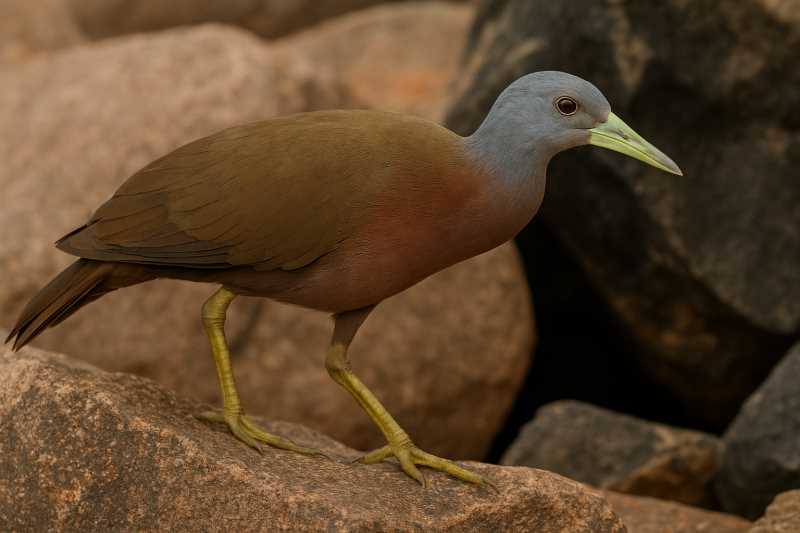
The Chestnut Rail (Eulabeornis castaneoventris) is a distinctive and elusive member of the rail family (Rallidae), confined to the tropical coastal mangroves and estuarine swamps of northern Australia and southern New Guinea. This shy bird, known for its deep chestnut plumage and skulking behaviour, is one of Australia’s lesser-known wetland birds. Despite its relatively large size for a rail, the Chestnut Rail remains poorly studied due to its secretive lifestyle in difficult-to-access habitats. For birdwatchers and ecologists alike, the species offers both a challenge and a reward, symbolising the biodiversity and fragility of Australia’s northern coastal ecosystems.
Identification and Description
The Chestnut Rail is a medium-to-large rail, reaching up to 35–38 cm in length. Its most striking feature is its rich chestnut-coloured underparts, which contrast with the olive-brown upperparts and darker brown crown. The bill is relatively long, strong, and slightly down-curved, yellowish in colour with a dusky tip. The eyes are reddish, and the legs and feet are sturdy and greyish, well-adapted to navigating the mud and roots of mangrove forests.
Unlike some other rails, the Chestnut Rail is not highly sexually dimorphic—males and females appear similar, though males may be slightly larger. Juveniles are duller and more mottled, offering better camouflage during their vulnerable early life stages.
Its vocalisations are surprisingly loud and carry well through the mangroves: a series of grating, croaking, or honking calls often delivered at dawn or dusk, particularly during the breeding season.
Distribution and Habitat
The Chestnut Rail is found in northern Australia, particularly in the Northern Territory (including the Top End, Kakadu National Park, and the Tiwi Islands), and occasionally in far northwestern Queensland. It also occurs in the southern lowlands of New Guinea, from Papua to Papua New Guinea’s southern coast.
The species is a habitat specialist, almost entirely restricted to coastal mangrove forests, tidal creeks, mudflats, and nearby brackish wetlands. These ecosystems, characterised by tangled roots, salty mud, and dense cover, offer the perfect environment for the rail’s secretive lifestyle.
Its close association with mangroves makes the Chestnut Rail vulnerable to any degradation of these ecosystems, particularly from coastal development and rising sea levels.
Behaviour and Feeding
True to its family, the Chestnut Rail is a skulking ground-dweller, moving stealthily among the roots and leaf litter of mangrove thickets. It is rarely seen in the open, often slipping away into cover at the slightest disturbance. When flushed, it prefers to run, but can make short, direct flights through dense vegetation if necessary.
It is mostly diurnal, though often most active during low tide, when mudflats are exposed, and food becomes accessible. The diet includes:
- Insects and insect larvae
- Crustaceans
- Molluscs
- Small amphibians
- Seeds and plant matter
It forages by walking slowly through shallow water or mud, using its bill to probe under leaves, into crevices, or beneath wet soil.
Breeding and Nesting
Breeding takes place during the wet season, typically from November to April, although timing may vary locally depending on rainfall and food availability. The nest is a shallow cup constructed from sticks, reeds, and leaves, often placed on raised platforms such as roots, low branches, or driftwood above the high tide line.
The female lays 2 to 5 eggs, pale in colour with fine speckling. Both parents are believed to share in incubation and chick-rearing, as is typical for many rail species. The chicks are precocial—covered in dark down and capable of leaving the nest soon after hatching, though they remain dependent on their parents for food and protection for several weeks.
Conservation Status
The Chestnut Rail is listed as a species of Least Concern by the IUCN, but it is poorly studied, and its true population status remains uncertain. It is generally considered uncommon to locally common, depending on the availability and quality of mangrove habitat.
Key threats include:
- Mangrove clearance for coastal development or aquaculture
- Pollution of tidal creeks and estuaries
- Sea level rise and increased salinity due to climate change
- Disturbance from tourism or recreational boating
Given its reliance on a specific and vulnerable habitat type, ongoing monitoring and protection of mangrove ecosystems is crucial to its conservation.
Observation and Birdwatching
Spotting a Chestnut Rail in the wild is a prized experience for birders visiting Australia’s tropical north. The best chance of an encounter is during early morning or late afternoon, particularly at low tide in mangrove forests near Darwin, Kakadu, or along the Cobourg Peninsula. Remaining still and quiet while listening for its raspy calls is often more successful than active searching.
Despite its size and striking colouration, its shy behaviour and dense habitat make it a real challenge to observe—adding to its allure among keen naturalists.
Conclusion
The Chestnut Rail is a fascinating yet elusive inhabitant of Australia’s northern mangrove forests—a bird perfectly adapted to one of the most unique and threatened ecosystems on the continent. With its rich chestnut plumage, secretive lifestyle, and ecological importance, this bird underscores the value of conserving coastal habitats. Ensuring the survival of mangroves means preserving not only biodiversity but also one of Australia’s most remarkable avian specialists.
Related posts