Introduction
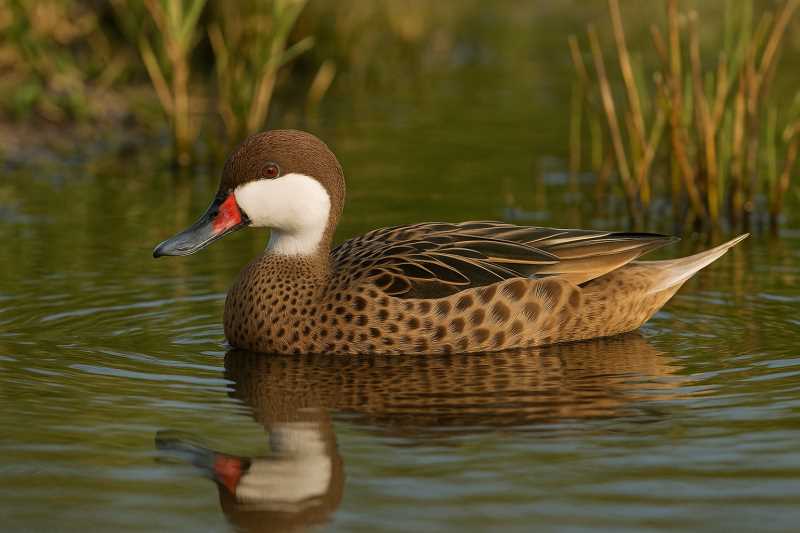
The white-cheeked pintail, Anas bahamensis, is a medium-sized dabbling duck of the Caribbean, northern and eastern South America, the Galápagos Islands and, occasionally, southern Florida. It is generally a resident or locally sedentary species associated with shallow wetlands, coastal lagoons and other brackish or saline waters. Its white cheeks and throat, dark crown, red markings at the base of the bill and pointed tail make it distinctive among New World ducks. (nationalzoo.si.edu)
Physical Description
The white-cheeked pintail measures approximately 38–51 cm in length, with a wingspan of about 55–68 cm. It has a warm brown body, a darker brown crown and hindneck, pale cheeks and throat, and a finely patterned breast, flanks and back. The tail is pointed and generally pale buff to whitish. A green, iridescent speculum is visible when the wing is raised or in flight. (nationalzoo.si.edu)
The bill is greyish-blue to dark grey, with a conspicuous red or coral-coloured patch at its base in adults. The legs are grey, and the eyes are reddish to red-brown. Males and females are broadly similar, although females are usually somewhat duller and may show less intense red on the bill. Juveniles have less sharply defined facial contrast and generally lack, or show less strongly, the adult red bill marking. (nationalzoo.si.edu)
Geographic variation in size and plumage is recognised. The Galápagos form is generally smaller than mainland and Caribbean populations, and the extent of the contrast between the brown crown and white cheek can vary among regional forms.
Range and Habitat
The species occurs patchily across the Caribbean and along parts of the northern, western and eastern coasts of South America. It also occurs in the Galápagos Islands, where the resident subspecies is geographically isolated. Small numbers may appear in southern Florida, although records farther north can involve escaped or released birds. (nationalzoo.si.edu)
White-cheeked pintails favour shallow wetlands, coastal lagoons, mangrove margins, tidal mudflats, saltmarshes, saline ponds and other brackish habitats. They also use freshwater ponds, lakes and marshes, particularly where suitable shallow feeding areas are available. In parts of its South American range, the species occurs mainly in lowland wetlands, although local records extend to higher elevations. (nationalzoo.si.edu)
The species is usually considered non-migratory, but local movements between wetlands can occur. Research in Puerto Rico documented movements between Culebra Island and the Humacao Wildlife Refuge, demonstrating the importance of connected wetland systems and protected refuge sites. (pubs.usgs.gov)
Behaviour and Diet
White-cheeked pintails are commonly seen alone, in pairs or in small groups, although larger gatherings may form where food and suitable water are concentrated. They feed by dabbling, tipping forward in shallow water and reaching below the surface rather than diving. Their diet includes aquatic vegetation, seeds and aquatic invertebrates, with the balance varying according to habitat and seasonal availability. (snr.unl.edu)
Breeding timing varies geographically and is influenced by rainfall and the availability of water. In the Bahamas, courtship and breeding can occur over an extended period, and some pairs remain together outside the breeding season. Most pairs are socially monogamous, although occasional polygyny and mate changes have been recorded. (mendeley.com)
The nest is usually concealed in dense vegetation, including grass, shrubs or mangrove cover, near water. A typical clutch contains about 6–10 eggs, although broader ranges of approximately 5–12 eggs have been reported. Incubation lasts about 25 days. The ducklings are precocial, leaving the nest soon after hatching and swimming and feeding under the protection of the female. (tau.ac.il)
Identification Tips
Look for the following combination of features:
- Warm brown plumage with darker spotting on the breast, flanks and sides.
- A sharply contrasting white cheek and throat beneath a dark brown crown.
- A greyish-blue or dark bill with a red patch at the base in adults.
- A pointed, pale tail and a green speculum visible in flight.
- A compact dabbling-duck shape and relatively plain brown body.
The white-cheeked pintail can be distinguished from the blue-winged teal, Spatula discors, by its larger size, warmer brown plumage, white cheeks and red-based bill. In parts of South America it may be compared with the Puna teal, Spatula puna, but the white-cheeked pintail has a brown rather than blackish crown, warmer overall plumage and a distinctive red mark at the base of the bill. Young birds may be more difficult to identify because the bill marking is reduced or absent. (peruaves.org)
Conservation Status
The white-cheeked pintail is currently assessed as Least Concern globally. Nevertheless, regional populations can be vulnerable to wetland drainage, coastal development, hunting pressure, pollution and the degradation of mangrove, lagoon and marsh habitats. The global population assessment is not equally well documented across all parts of the range, so local monitoring remains important. (animaldiversity.org)
Protected wetlands, careful management of coastal development, control of hunting and regular population surveys are important conservation measures. Research in Puerto Rico has shown that wildlife refuges can make a significant contribution to regional survival and population maintenance. (pubs.usgs.gov)
Frequently Asked Questions
Where does the white-cheeked pintail live?
It occurs in the Caribbean, northern and eastern South America and the Galápagos Islands. It is also recorded occasionally in southern Florida.
Is the white-cheeked pintail a migratory duck?
It is generally regarded as a non-migratory or sedentary species. Local movements between wetlands do occur, particularly where birds move between feeding, breeding and refuge sites.
What does the white-cheeked pintail eat?
Its diet consists mainly of aquatic plants, seeds and aquatic invertebrates. It usually feeds by dabbling in shallow water rather than diving.
How can the species be identified?
The most useful field marks are the white cheeks and throat, dark brown crown, warm brown body, pointed pale tail and greyish bill with a red patch at its base in adults.
How many eggs does it lay?
A clutch commonly contains about 6–10 eggs, although reported clutch sizes range from approximately 5 to 12 eggs. Incubation lasts about 25 days.
Is the white-cheeked pintail endangered?
No. The species is assessed globally as Least Concern, although local populations may be affected by habitat loss, hunting and degradation of coastal and inland wetlands.
References
- BirdLife International. 2016. Anas bahamensis. The IUCN Red List of Threatened Species 2016: e.T22680287A92853819. Available at: https://www.iucnredlist.org/species/22680287/92853819. Accessed 8 September 2026.
- Collazo, J. A. and Bonilla-Martínez, G. 2001. Population size, survival, and movements of white-cheeked pintails in eastern Puerto Rico. Caribbean Journal of Science, 37(3–4), 194–201. Available at: https://pubs.usgs.gov/publication/70022961. Accessed 8 September 2026.
- Fink, D., Auer, T., Johnston, A., Strimas-Mackey, M., Ligocki, S., Robinson, O., Hochachka, W., Jaromczyk, C., Crowley, D., Dunham, K., Stillman, A., Davies, I., Rodewald, A., Ruiz-Gutierrez, V. and Wood, C. 2023. eBird Status and Trends, Data Version: 2022. Cornell Lab of Ornithology. https://doi.org/10.2173/ebirdst.2022.
- Gill, F., Donsker, D. and Rasmussen, P., eds. 2026. IOC World Bird List, version 15.2. International Ornithologists’ Union. Available at: https://www.worldbirdnames.org/. Accessed 8 September 2026.
- Rivera-Milán, F. F. 2007. Estimation of abundance and recommendations for monitoring white-cheeked pintails in wetlands of Puerto Rico and territorial islands. The Journal of Wildlife Management, 71(4), 1361–1369. https://doi.org/10.2193/2006-068.
- Smithsonian’s National Zoo and Conservation Biology Institute. n.d. White-cheeked pintail. Available at: https://nationalzoo.si.edu/animals/white-cheeked-pintail. Accessed 8 September 2026.
- Sorenson, L. G. 1992. Variable mating system of a sedentary tropical duck: the white-cheeked pintail (Anas bahamensis bahamensis). The Auk, 109(2), 277–292. https://doi.org/10.2307/4088196.
- Johnsgard, P. A. 1975. Waterfowl of North America. Bloomington: Indiana University Press.
Related posts