Introduction
The Western Hooded Pitta, Pitta sordida, is a brightly coloured ground-feeding passerine of South and Southeast Asia. It belongs to the pitta family, Pittidae, and is recognised by the IOC World Bird List as the species formerly known more broadly as the Hooded Pitta. That earlier name covered several geographically distinct taxa that are now treated as separate species, including the Nicobar, Minahasa, Eastern and Biak Hooded Pittas. (worldbirdnames.org)
Despite its jewel-like plumage, the Western Hooded Pitta is often difficult to see. It spends much of its time in shaded vegetation, moving quietly through leaf litter and dense undergrowth. Its loud, repeated whistle may reveal its presence before the bird appears. Depending on geography, it may be resident, locally nomadic or migratory. The northern form, commonly associated with the Chestnut-crowned group, undertakes the most substantial seasonal movements, while many populations farther south are resident or make shorter movements. (pmc.ncbi.nlm.nih.gov)
The species has a wide distribution and is currently assessed as Least Concern globally. That classification should not be interpreted as evidence that all populations are secure. Forest clearance, degradation of understorey habitat and the loss of suitable leaf-litter feeding grounds remain relevant concerns, particularly where natural habitats are being converted to intensive agriculture or urban development. (datazone.birdlife.org)
Physical Description
The Western Hooded Pitta is a compact, short-tailed bird measuring approximately 16–19 centimetres in length. Published mass figures vary, but available summaries place adults broadly within the range of about 42–80 grams. As with many geographically variable Asian birds, measurements may differ among subspecies and populations, so these figures are best treated as approximate rather than as a universal standard. (indiabiodiversity.org)
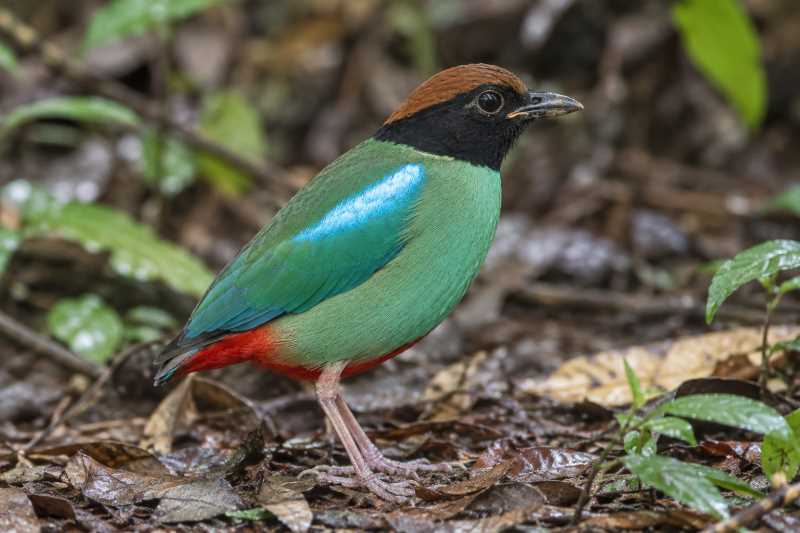
Adults are strongly patterned. The head is predominantly black, contrasting with a chestnut or warm brown crown patch in the northern Chestnut-crowned group. The back, mantle and upper wings are rich green. A vivid blue or blue-green patch is visible on the wing, especially when the bird moves or briefly opens its wings. The lower breast, abdomen and vent are generally red to crimson, although the exact balance of red, green, blue and chestnut varies geographically.
The bill is dark and fairly stout, suited to probing and picking prey from leaf litter. The legs are pinkish, flesh-coloured or reddish depending on population and individual condition. The short tail and rounded body give the bird a somewhat compact appearance when it is standing on the ground. In typical pitta fashion, its bright colours are most conspicuous when the bird is moving, while the green, brown and black patterning can provide effective camouflage in shaded forest-floor vegetation.
Sexual dimorphism is limited. Males and females are generally similar in size and plumage, and field identification does not normally depend on sex-specific characters. Some variation in colour intensity may occur between individuals, but it should not automatically be interpreted as evidence of sex or age.
Juveniles are duller than adults. Their upperparts tend to be less saturated green, while the underparts are more muted and greyish or greenish. The chestnut crown and blue wing markings may be less strongly developed than in adults. This subdued plumage gradually changes as the young bird moults into adult feathering.
Geographic variation is important in this species. The birds breeding from the Himalayas eastwards through mainland Southeast Asia are commonly associated with the Chestnut-crowned form, P. s. cucullata. Other populations in the Malay Peninsula, Sumatra, Borneo, Java and the Philippines show differences in crown colour, head pattern, body colour and the extent of blue on the wings. Some former members of the wider Hooded Pitta complex have been elevated to species rank, so older field guides and online records may use “Hooded Pitta” for birds that are now assigned to different species. (worldbirdnames.org)
Range and Habitat
The Western Hooded Pitta occupies a broad but discontinuous range across South Asia, mainland Southeast Asia and parts of maritime Southeast Asia. Its distribution includes portions of northern and northeastern India, Nepal, Bangladesh, Myanmar, Thailand, Laos, Cambodia, Vietnam and southern China, with additional populations on parts of the Malay Peninsula and several islands of Indonesia and the Philippines. The precise limits of the species depend on the taxonomic treatment being followed, because the former Hooded Pitta complex has undergone substantial revision. (worldbirdnames.org)
The species is not endemic to a single country or island. Instead, it is a geographically variable bird composed of several recognised subspecies and regional populations. The mainland population traditionally called Pitta sordida cucullata is the most clearly migratory component. It breeds in the Himalayan foothills and parts of northern mainland Asia, then moves southwards during the non-breeding season, with wintering areas extending into the Malay Peninsula and Sumatra. Other populations, particularly in the equatorial part of the range, are mainly sedentary or make shorter seasonal movements. (pmc.ncbi.nlm.nih.gov)
Western Hooded Pittas are associated with forested and semi-forested environments where the ground layer remains humid, shaded and rich in leaf litter. Suitable habitats include evergreen and semi-evergreen forest, moist deciduous woodland, secondary forest, forest margins, bamboo and scrub, plantations with a developed understorey, and some large gardens or urban parks. The species can therefore persist in modified landscapes when dense vegetation, quiet ground cover and adequate prey remain available.
Habitat use varies between populations. In parts of mainland Asia, migrating birds may appear in wooded parks, gardens and secondary growth outside the breeding season. In tropical areas, resident birds are more closely associated with lowland and foothill forest, although local records may extend to higher elevations. The bird usually avoids exposed, intensively managed ground with little understorey cover.
The most important habitat features are often close to ground level. A thick layer of fallen leaves provides shelter and supports earthworms, beetles, ants, spiders and other invertebrates. Moist soil is also important, particularly after rain, because it makes prey easier to locate and extract. Streams, ravines, forest edges and areas beneath dense shrubs may be especially productive, although the species is not restricted to places immediately beside water.
The Western Hooded Pitta’s distribution illustrates why broad range maps should be interpreted carefully. A record from a country does not mean the species is widespread there, and a record from a protected area does not guarantee regular sightings. Local abundance can change according to rainfall, habitat condition, migration timing and the availability of suitable ground cover.
Where to See This Species
Sightings are easiest where wooded habitat, damp ground and dense leaf litter occur together. The species is often detected by its distinctive call before it is seen. In Singapore, current bird reports have documented Western Hooded Pittas at several publicly accessible parks and nature areas, particularly during the migratory season. (singaporebirdgroup.wordpress.com)
Singapore Botanic Gardens, Central Region, Singapore
The Singapore Botanic Gardens is a realistic place to look during the migratory season. Its extensive wooded areas, rainforest vegetation and mature plantings provide shaded ground habitat within a highly accessible public garden. National Parks Board material specifically notes that Hooded Pittas may be observed in the Gardens during the migratory season, while recent local bird reporting has recorded Western Hooded Pittas around the Rainforest Trail. Look quietly along shaded paths and leaf-littered edges rather than concentrating on open lawns. (nparks.gov.sg)
Nearby accommodation: Central Singapore offers a wide range of hotels, serviced apartments, hostels and guest houses, with convenient access to the Gardens by public transport.
Dairy Farm Nature Park, western Singapore, Singapore
Dairy Farm Nature Park lies within Singapore’s central nature network and includes secondary forest, streams, fruit trees and trails suitable for birdwatching. Western Hooded Pitta has been reported from the park in recent local bird records. The Wallace Trail and surrounding wooded areas are the most sensible places to search, particularly where leaf litter and dense vegetation meet quieter trail sections. The park is publicly accessible, although visitors should follow current opening hours and trail regulations. (singaporebirdgroup.wordpress.com)
Nearby accommodation: The Hillview and Bukit Timah areas provide the nearest practical base, with hotels, serviced apartments and other accommodation available in western and central Singapore.
Hindhede Nature Park, western Singapore, Singapore
Hindhede Nature Park forms part of the wider Bukit Timah forest landscape and offers shaded trails, mature vegetation and leaf-litter habitat. Recent bird reporting has documented Western Hooded Pitta at the site. It is best treated as a seasonal or opportunistic location rather than a guaranteed site, and birders should check quiet understorey areas while listening for the species’ repeated whistle. (singaporebirdgroup.wordpress.com)
Nearby accommodation: Bukit Timah, Beauty World and Hillview are the nearest practical accommodation areas, with hotels, serviced apartments and guest houses accessible from the park.
Behaviour and Diet
The Western Hooded Pitta is primarily terrestrial. It usually forages alone or as a pair, moving through leaf litter with short hops, quick runs and sudden pauses. The bird may flick aside leaves with its bill, probe damp soil or seize prey from the surface. Its compact body and short tail are well suited to this ground-based lifestyle.
It is generally secretive despite its vivid plumage. A bird may remain motionless beneath vegetation for several minutes before crossing a path or opening in the understorey. When disturbed, it often makes a rapid, low flight into dense cover rather than rising high above the canopy. This behaviour, combined with its preference for shaded habitat, explains why the species is frequently heard more often than seen.
The diet consists mainly of terrestrial invertebrates. Recorded or reported prey includes beetles, ants, termites, crickets, grasshoppers, caterpillars, insect larvae, spiders and other small arthropods. Earthworms and other soft-bodied soil animals are also important components of the diet in suitable conditions. The bird may supplement this animal-based diet with berries and other small fruits. (indiabiodiversity.org)
Foraging activity is influenced by moisture. After rain, earthworms and other prey may be closer to the surface, and birds can become more active on paths, banks and open patches within otherwise dense habitat. During dry periods, they may remain in damp gullies, shaded forest or areas with particularly deep leaf litter.
The call is a loud, clear, repeated whistle, often described in field accounts as a double-noted “qweek-qweeek” or similar phrase. It can carry surprisingly well through forest. Calls may be repeated from a concealed perch or from within dense vegetation, and in some areas they are used to maintain contact between members of a pair or to advertise a territory.
Breeding behaviour varies across the range and is not equally well documented in all populations. Breeding is generally associated with the wetter or seasonally favourable part of the year, with reported dates differing between regions. Pairs are territorial and may defend a breeding area through calling and direct interactions with intruders.
The nest is a domed or rounded structure made from leaves, grass, roots and other plant material. It is usually placed on or close to the ground, sometimes among roots, fallen vegetation, banks or low dense growth. Both adults are involved in parental care. Available accounts indicate that both parents incubate the eggs or contribute to incubation and that both feed the young, although detailed information on clutch size, incubation periods and fledging success remains uneven across the species’ wide range.
The northern migratory population is particularly interesting from a behavioural perspective. Genomic and biogeographic research indicates that long-distance migration is unusual within the former Pitta sordida complex and is concentrated mainly in the cucullata lineage. This contrasts with many southern and island populations, which are largely resident. (pmc.ncbi.nlm.nih.gov)
Identification Tips
Look for the following combination of features:
- A compact, short-tailed bird that spends much of its time on the ground.
- A predominantly black head.
- A chestnut or warm brown crown patch in the northern Chestnut-crowned group.
- Bright green back and upperparts.
- A conspicuous blue or blue-green wing patch.
- Red to crimson lower underparts and vent.
- Deliberate hopping or short running movements through leaf litter.
- A loud, repeated, fluty whistle from shaded woodland.
The bird’s colour pattern is usually unmistakable once it is seen clearly, but brief views can be confusing. In dense forest, the green back may blend with vegetation, while the red underparts may be visible only for a moment as the bird turns or crosses a path.
The Blue-winged Pitta, Pitta moluccensis, is the most relevant comparison in many parts of Southeast Asia. It is also a colourful, ground-feeding pitta and may occur in similar wooded habitats. The Western Hooded Pitta generally shows a blacker head, a more prominent chestnut crown area in the northern forms, greener upperparts and a different balance of blue and red in the wing and underparts. Care is needed because lighting, posture and geographic variation can make the two species appear more alike than expected.
The Indian Pitta, Pitta brachyura, overlaps with the Western Hooded Pitta in parts of the Indian subcontinent. It has a distinctive buff or pale supercilium and a different head pattern, whereas the Western Hooded Pitta’s head is predominantly black. The Indian Pitta also commonly shows a stronger buff-and-blue facial pattern and should not be identified solely from a glimpse of green, blue and red plumage.
The most reliable approach is to combine several characters: head pattern, crown colour, wing patch, underpart colour, habitat, call and location. Taxonomic changes also mean that older photographs or checklists may label a bird simply as “Hooded Pitta” even when the current species name is Western Hooded Pitta.
Conservation Status
The Western Hooded Pitta is currently assessed as Least Concern on the IUCN Red List. It has a very broad geographic range and is represented by multiple populations across South and Southeast Asia. The global assessment does not provide a basis for assuming that the species is common everywhere, and local declines may be masked by the size of the overall distribution. (datazone.birdlife.org)
A precise global population estimate should not be quoted without a current, species-specific assessment. Population monitoring is uneven across the range, and the recent splitting of the former Hooded Pitta complex makes older estimates difficult to compare directly with current taxonomy.
The principal conservation concern is habitat loss and degradation. Clearing of forest, conversion to plantations or intensive farmland, removal of understorey vegetation and the drying or disturbance of forest-floor habitat can all reduce the species’ feeding and breeding opportunities. Migratory populations may also be affected by the cumulative loss of stopover and wintering habitat along their seasonal routes.
Some populations occur in protected areas, forest reserves, large urban parks and other managed landscapes. Maintaining connected forest, retaining dense understorey, protecting streams and damp gullies, and reducing unnecessary clearance of leaf litter can benefit the species. For migratory birds, conservation must extend across both breeding and non-breeding areas rather than focusing on a single reserve.
Further research would be valuable on population trends, movements, breeding success, regional ecology and the conservation status of individual subspecies. Taxonomic clarification is also important because populations formerly grouped under one widespread name may have different distributions, threats and conservation needs.
Frequently Asked Questions
What is the scientific name of the Western Hooded Pitta?
The scientific name is Pitta sordida. It is a member of the pitta family, Pittidae. The name Western Hooded Pitta was adopted after several former members of the broader Hooded Pitta complex were recognised as separate species. (worldbirdnames.org)
Where does the Western Hooded Pitta live?
It occurs across parts of South Asia, mainland Southeast Asia and maritime Southeast Asia. Its range includes wooded habitats in countries such as India, Nepal, Bangladesh, Myanmar, Thailand, Malaysia, Indonesia and the Philippines, although exact limits vary with current taxonomy.
Is the Western Hooded Pitta migratory?
Some populations are migratory, while others are resident or make shorter seasonal movements. The northern cucullata population is the principal long-distance migrant, breeding in the Himalayan and mainland Asian region and wintering farther south. Many tropical island populations are largely sedentary. (pmc.ncbi.nlm.nih.gov)
What does the Western Hooded Pitta eat?
It mainly eats invertebrates found on or in the forest floor, including insects, larvae, beetles, ants, termites, spiders and earthworms. It may also take berries and other small fruits. Birds often forage in damp leaf litter, especially after rain.
How can I identify a Western Hooded Pitta?
Look for a short-tailed ground bird with a black head, green upperparts, a blue wing patch and red lower underparts. Northern birds commonly show a chestnut crown. The species’ loud repeated whistle is often easier to detect than the bird itself.
Is the Western Hooded Pitta endangered?
It is currently listed as Least Concern globally, not Endangered. Nevertheless, habitat loss and degradation remain important threats, and local populations may decline where forest understorey, leaf litter and damp ground habitat are removed. (datazone.birdlife.org)
References
- BirdLife International
- IOC World Bird List
- Ericson et al., genomic differentiation and taxonomy of the Pitta sordida complex
Related posts