Introduction
The Marbled Wood Quail, Odontophorus gujanensis, is a ground-dwelling New World quail of humid tropical forests in Central and northern South America. It is a secretive, largely sedentary species that usually remains within dense forest undergrowth and is more often detected by its calls than seen.
Physical Description
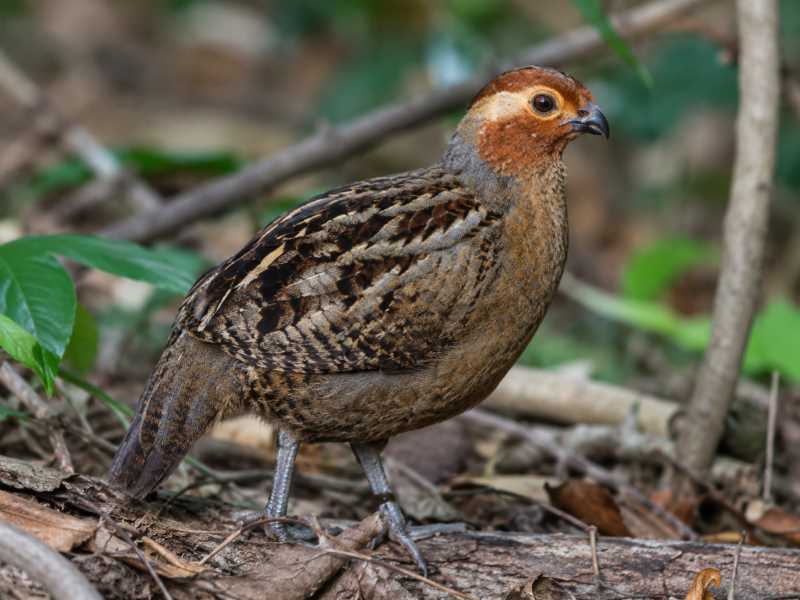
The Marbled Wood Quail measures approximately 23–29 cm in length. Its plumage is predominantly brown, buff and grey, with fine black barring and vermiculation across the body. The wings have dark spots and occasional white markings, while the throat is whitish and finely barred. A short, thick crest lies back from the crown.
The bright orange-red bare skin around the eyes is one of the species’ most useful identification features. The eyes are dark, the bill is black, and the legs and feet are dark greenish-grey. Males and females are broadly similar in appearance, although females may be slightly smaller and some geographic forms show differences in the depth of the underparts and head colour. Immature birds are less strongly marked than adults.
Several recognised subspecies vary geographically. Birds north of the Amazon may be greyer and more heavily barred, while some populations south of the Amazon have more rufous colouring on the face, chin and throat.
Range and Habitat
The Marbled Wood Quail occurs from Costa Rica and Panama through Colombia, Venezuela, Guyana, Suriname, French Guiana, Ecuador, Peru, Bolivia and Brazil. Its distribution includes much of the Amazon Basin and adjacent lowland forest regions.
It is primarily a bird of humid lowland and lower-elevation tropical forest, although it also occurs in suitable subtropical forest. It uses the forest floor, especially in ravines, stream valleys and areas with dense, tangled undergrowth. Mature second-growth forest may also provide habitat, although the species is strongly associated with forested landscapes.
The Marbled Wood Quail is considered sedentary rather than migratory. Local movements may occur within its home range, but there is no evidence of regular long-distance migration.
Behaviour and Diet
This species is shy and elusive. It normally walks through leaf litter and dense undergrowth, running or remaining concealed when disturbed and flying only when closely pressed. It commonly occurs in small coveys or family groups, with groups of around eight birds reported in some regions.
Marbled Wood Quails forage on the ground, taking a mixed diet that includes berries, fallen fruits, seeds and invertebrates such as insects. They may scratch through leaf litter while searching for food. Their presence is often revealed by vocal activity at dawn and dusk, when pairs or groups may give repeated antiphonal calls.
Breeding information remains limited. The nest is made on or very close to the ground, often as a deep hollow in fallen leaves or a roofed structure with a side entrance. Published accounts report clutches of about four or five white eggs. Incubation and parental behaviour have been described from field observations, but the available information is not extensive enough to support precise generalisations about mating systems or lifespan. As with other New World quails, the young are precocial and leave the nest soon after hatching.
Identification Tips
Look for a medium-sized, compact forest quail with the following combination of features:
- Predominantly brown and buff plumage with fine black barring.
- A short, thick crest that lies back along the crown.
- Bright orange-red bare skin around the eyes.
- A whitish, finely barred throat and chestnut or rufous tones on the chin and face in some populations.
- Dark spotted wings and a generally cryptic appearance against leaf litter.
- Secretive behaviour on the forest floor and loud repeated calls, especially around dawn and dusk.
The bright eye-ring helps separate the Marbled Wood Quail from several other wood quails. The species is generally more uniformly brown and heavily barred than the Starred Wood Quail, which has a greyer head and conspicuous white markings on the underparts. In areas where it overlaps with the Spot-winged Wood Quail, the Marbled Wood Quail is typically browner and shows a more prominent orange-red eye-ring.
Conservation Status
The Marbled Wood Quail is currently assessed as Least Concern on the global conservation scale. Its extensive geographic range and occurrence across several large forest regions help explain this assessment. However, its status is not uniform throughout the range, and some local populations may be affected by deforestation, forest degradation, road construction, agricultural expansion and hunting.
Protecting large, connected tracts of humid forest is the most important conservation measure. Maintaining dense understorey vegetation, limiting unsustainable hunting and improving knowledge of local population trends would also benefit the species. A global population estimate should not be inferred from its Least Concern status, because reliable population data are limited.
Frequently Asked Questions
Where does the Marbled Wood Quail live?
It occurs in humid tropical forests from Costa Rica and Panama through northern and western South America, including the Amazon Basin and the Guianas.
Is the Marbled Wood Quail migratory?
No. It is regarded as largely sedentary, remaining in forest habitats throughout the year rather than undertaking regular long-distance migration.
What does the Marbled Wood Quail eat?
Its diet includes seeds, berries, fallen fruits and small invertebrates such as insects. It searches for food on the forest floor and in leaf litter.
How can the species be identified?
The most useful field marks are its brown, finely barred plumage, short laid-back crest and conspicuous orange-red bare skin around the eyes. It is also often detected by its repeated calls at dawn or dusk.
Does the Marbled Wood Quail live in groups?
Yes. It is commonly reported in small coveys or family groups, although group size varies by locality and season.
Where does it build its nest?
The nest is placed on or near the ground, usually in a hollow among fallen leaves or in a roofed structure with a side entrance. Published accounts report clutches of approximately four or five eggs.
References
- BirdLife International. 2025. Handbook of the Birds of the World and BirdLife International Digital Checklist of the Birds of the World, Version 10. BirdLife International, Cambridge. Available through the BirdLife International and Avibase taxonomic resources. Accessed 8 September 2026.
- Gill, F., Donsker, D. and Rasmussen, P., eds. 2026. IOC World Bird List, Version 15.2. International Ornithologists’ Union. Available at: https://www.worldbirdnames.org/. Accessed 8 September 2026.
- Integrated Taxonomic Information System. n.d. Odontophorus gujanensis (J. F. Gmelin, 1789), Marbled Wood Quail. ITIS Report, TSN 175932. Available at: https://www.itis.gov/servlet/SingleRpt/SingleRpt?search_topic=TSN&search_value=175932. Accessed 8 September 2026.
- Restall, R., Rodner, C. and Lentino, M. 2006. Birds of Northern South America: An Identification Guide, Volume 1, Species Accounts. Christopher Helm, London.
- Salter, J. F., Oliveros, C. H., Hosner, P. A., Manthey, J. D., Robbins, M. B., Moyle, R. G., Brumfield, R. T. and Faircloth, B. C. 2022. Historical specimens and the limits of subspecies phylogenomics in the New World quails (Odontophoridae). Molecular Phylogenetics and Evolution 175: 107559. Available at: https://doi.org/10.1016/j.ympev.2022.107559.
- Skutch, A. F. 1947. Life history of the Marbled Wood-Quail. The Condor 49(6): 217–232. Available at: https://doi.org/10.2307/1364180.
- Stiles, F. G. and Skutch, A. F. 1989. A Guide to the Birds of Costa Rica. Cornell University Press, Ithaca, New York.
Related posts