Introduction
The Wedge-tailed Green Pigeon (Treron sphenurus) is a remarkable avian species belonging to the family Columbidae, which encompasses pigeons and doves. Known for its vibrant plumage and unique morphology, this bird holds a special place in the biodiversity of the Asian continent. From its striking appearance to its ecological significance, the Wedge-tailed Green Pigeon presents intriguing facets worthy of exploration.
Taxonomy and Distribution
The Wedge-tailed Green Pigeon is scientifically classified under the genus Treron, which comprises several species of green pigeons. Treron sphenurus is predominantly found in the subtropical and tropical forests of South Asia, extending its range to parts of Southeast Asia. Its habitat spans countries such as India, Nepal, Bhutan, Myanmar, Laos, and Vietnam, where it thrives in dense forests and wooded regions.
Physical Description
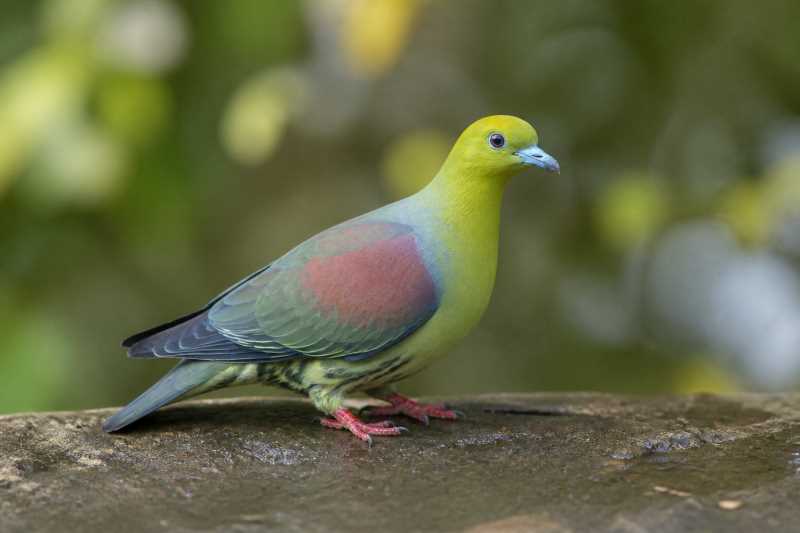
The Wedge-tailed Green Pigeon is easily recognizable by its striking green plumage, which serves as effective camouflage amidst the foliage of its forest habitat. The bird measures approximately 28 to 33 centimeters in length, with a tail that is notably wedge-shaped, hence its common name. Its plumage is predominantly green with a gentle yellowish tinge on the belly and undertail, while the wings are accented by darker green or bluish hues. The bird’s eyes are encircled by a vivid ring of red or orange, adding to its distinctive appearance.
Behavior and Diet
Wedge-tailed Green Pigeons are primarily frugivorous, meaning their diet consists mainly of fruits. They play a crucial role in their ecosystems as seed dispersers, aiding in the propagation of various plant species. These pigeons are often observed foraging in flocks, moving from tree to tree in search of ripe fruits. Their strong, agile flight capabilities enable them to navigate through dense canopies with ease.
Social creatures by nature, Wedge-tailed Green Pigeons exhibit communal roosting behavior. They are known to gather in large numbers, particularly during the breeding season. This social structure not only enhances their foraging efficiency but also offers protection against potential predators.
Reproduction and Lifespan
The breeding season for Wedge-tailed Green Pigeons typically coincides with the onset of the monsoon, when food resources are abundant. During this time, males engage in elaborate courtship displays to attract females, often involving a series of cooing calls and aerial displays.
The female usually lays a clutch of one to two eggs, which are incubated by both parents. The incubation period lasts about 14 to 16 days, followed by a fledging period of approximately two to three weeks. Both parents are actively involved in feeding and nurturing the chicks until they are ready to venture out on their own.
Conservation Status
The IUCN currently lists the Wedge-tailed Green Pigeon as a species of Least Concern, indicating that it is not at immediate risk of extinction. However, like many forest-dwelling species, it faces threats from habitat destruction and fragmentation. Deforestation for agriculture and urban development poses significant challenges to its habitat, underscoring the need for effective conservation strategies.
Efforts to preserve the Wedge-tailed Green Pigeon’s habitat are critical, as they not only protect this species but also the broader ecological communities that depend on these forests. Initiatives involving reforestation and the establishment of protected areas can help mitigate the adverse effects of human activities.
Cultural Significance
In various cultures across its range, the Wedge-tailed Green Pigeon is regarded as a symbol of peace and prosperity. Its gentle demeanor and harmonious presence in nature have inspired numerous folklore and artistic representations. Moreover, its role in maintaining the ecological balance reinforces its cultural and environmental value.
Conclusion
The Wedge-tailed Green Pigeon (Treron sphenurus) is a testament to the rich avian diversity of Asia’s forests. Its vibrant plumage, essential ecological role, and social behavior make it a subject of interest for ornithologists and nature enthusiasts alike. Protecting this species and its habitat ensures the preservation of the intricate web of life that sustains our planet. As we continue to delve into the wonders of biodiversity, the Wedge-tailed Green Pigeon stands as a vibrant emblem of nature’s creativity and resilience.
Related posts