Introduction
The Vogelkop Owlet-nightjar (Aegotheles affinis) is a little-known nocturnal bird endemic to the Arfak Mountains on the Bird’s Head Peninsula of north-western New Guinea. It belongs to the small family Aegothelidae and is more closely related to other owlet-nightjars than to true owls. The species was described by Tommaso Salvadori in 1876 and was formerly treated by some authorities as a form of the Barred Owlet-nightjar.
Physical Description
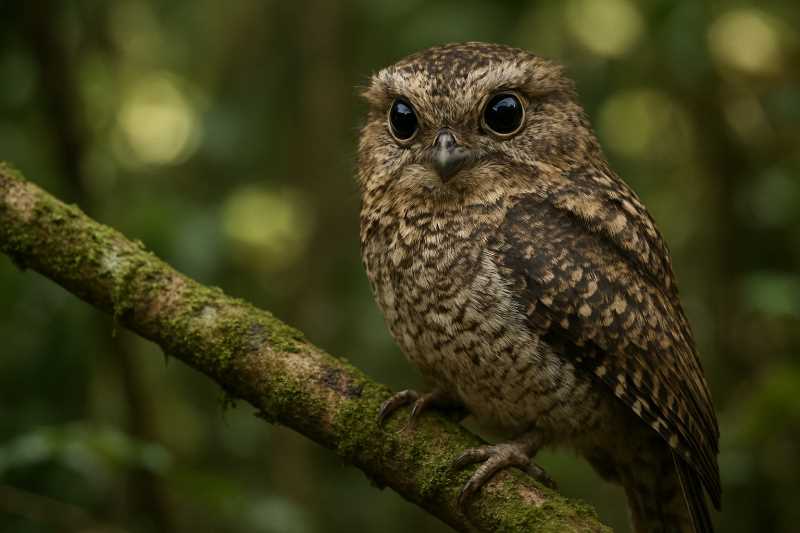
The Vogelkop Owlet-nightjar is a compact, large-headed bird measuring approximately 23 centimetres in length. Its plumage is predominantly dark brown, grey-brown and rufous-brown, with fine mottling and barring that provide effective camouflage against bark, branches and dense forest vegetation.
It has a broad facial pattern, prominent pale eyebrows and large dark eyes suited to low-light conditions. The wings are relatively short and rounded, while the tail is fairly long and rounded. Males and females are not known to show obvious differences in plumage. Detailed information on juvenile plumage and age-related variation remains limited.
Despite its owl-like appearance and common name, it is not an owl. Its facial structure, soft plumage and nocturnal habits are adaptations associated with the owlet-nightjars, a distinct family within the order Aegotheliformes.
Range and Habitat
The Vogelkop Owlet-nightjar is endemic to New Guinea and is known primarily from the Arfak Mountains of West Papua, Indonesia. Available records place it in moist forest from lower elevations into the hill and montane zones, with documented records extending from approximately 80 to 1,500 metres above sea level.
It favours forested landscapes with dense vegetation, mature trees and suitable cavities or sheltered branches for daytime roosting. The species is not migratory, and its restricted distribution makes it one of the characteristic birds of the Arfak Mountains. Its wider distribution remains poorly documented, partly because it is nocturnal, inconspicuous and difficult to detect.
Where to See This Species
Pegunungan Arfak Nature Reserve, West Papua, Indonesia
The Pegunungan Arfak Nature Reserve protects forest across the Arfak Mountains, the core known range of the Vogelkop Owlet-nightjar. The species has been documented in the reserve and surrounding Arfak birding areas, where observers have recorded roosting birds in forest cavities and dense woodland. It is most realistically sought with experienced local guides, especially around forest trails and established birding camps, although sightings are difficult and may depend on locating a roost rather than observing active nocturnal flight.
Nearby accommodation: Manokwari is the main practical gateway, with hotels and guest houses, while village homestays, camps and simple lodge-style accommodation may be available closer to reserve access points.
Behaviour and Diet
The Vogelkop Owlet-nightjar is nocturnal and spends the daylight hours concealed in dense vegetation, tree hollows or sheltered roosting sites. It is generally solitary or encountered singly, and its cryptic plumage makes it easy to overlook even when present.
Like other owlet-nightjars, it is believed to feed mainly on flying insects and other small invertebrates, including moths and beetles. It may forage from a perch, making short, silent flights to capture prey in the air or gleaning insects from nearby foliage. Species-specific information about its diet, territorial behaviour and vocal repertoire is scarce, and published descriptions of its calls should be treated cautiously.
Breeding behaviour is also poorly documented. Tree cavities and other enclosed sites are considered likely to be important for roosting and nesting, but the number of eggs, incubation period and parental care are not well established for this species.
Identification Tips
- Look for a small, compact nocturnal bird with a large head, large dark eyes and a relatively long, rounded tail.
- The overall colour is subdued brown, grey-brown and rufous-brown, with fine mottling and barring rather than bold patches.
- Broad pale eyebrows and a lightly marked face can be useful at close range.
- A bird sitting motionless against a tree trunk or inside a cavity may be easier to find than one in flight.
- Distinguishing it from other owlet-nightjars in the Arfak Mountains requires attention to size, plumage pattern, habitat and locality. The Mountain Owlet-nightjar can occur in the same general region, so photographs or a clear view are valuable for confirmation.
Conservation Status
The Vogelkop Owlet-nightjar is currently assessed as Near Threatened on the IUCN Red List. The assessment reflects its restricted known distribution, limited information about its population and continuing pressure on forests in the Arfak region.
The main potential threats are the loss and degradation of forest through agriculture, logging, road construction and other infrastructure development. Because the species is difficult to survey, its population size and trend are not well established. Protecting remaining forest in the Arfak Mountains, maintaining habitat connectivity and supporting locally led conservation and sustainable land-use practices are important measures for its protection.
Frequently Asked Questions
Where is the Vogelkop Owlet-nightjar found?
It is endemic to New Guinea and is known primarily from the Arfak Mountains on the Bird’s Head Peninsula of West Papua, Indonesia.
Is the Vogelkop Owlet-nightjar an owl?
No. Despite its owl-like face and nocturnal habits, it belongs to the family Aegothelidae, not the true owl family Strigidae or the barn owl family Tytonidae.
What does the Vogelkop Owlet-nightjar eat?
It is believed to feed mainly on moths, beetles and other small invertebrates. It probably catches some prey during short flights from a perch and may also glean insects from vegetation.
When is the best time to look for this species?
It is most active after dark, but daytime roosts may provide the best opportunity for observation. Searching should be undertaken with local guides who know suitable forest sites and can minimise disturbance.
Can the Vogelkop Owlet-nightjar be seen in a protected area?
Yes. It has been documented in and around the Pegunungan Arfak Nature Reserve in West Papua, which protects forest within its known range.
Is the Vogelkop Owlet-nightjar threatened?
It is classified as Near Threatened. Its restricted range, limited population information and continuing loss or degradation of forest habitat are the principal conservation concerns.
References
- IOC World Bird List
- IUCN Red List of Threatened Species
- BirdLife International
Related posts