Introduction
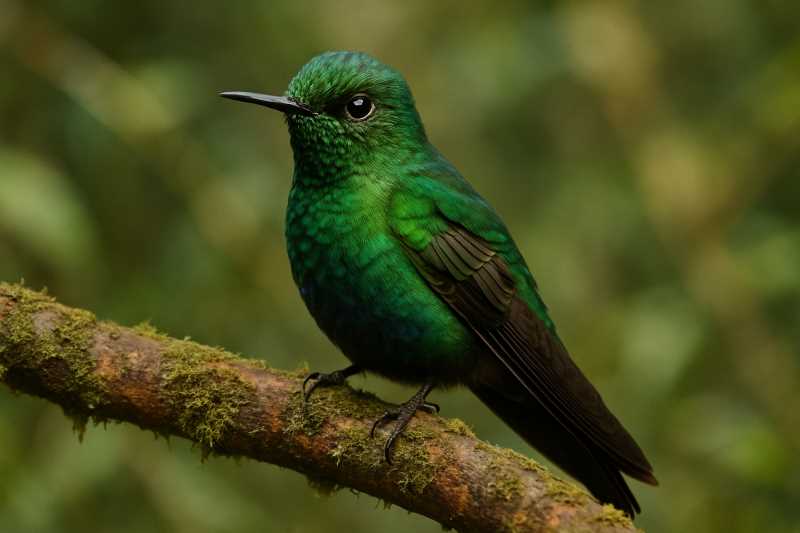
The Viridian Metaltail, Metallura williami, is a small Andean hummingbird found in Colombia and Ecuador. It inhabits high-elevation forest edges, elfin woodland, shrubby páramo and other areas near the upper treeline. Its dark bronze-green plumage, iridescent throat patch and metallic tail make it a distinctive bird of the northern Andes.
Physical Description
The Viridian Metaltail is a small hummingbird, measuring approximately 8.5–9 centimetres in length, with a relatively short, straight bill of about 15 millimetres. Both sexes have dark bronze-green upperparts and a metallic tail that may appear green, bronze, blue or purplish depending on the light.
The male is generally darker and more strongly iridescent, with a subtle shimmering green patch on the throat. The female is less vividly coloured and usually has paler, buff-coloured underparts marked with greenish spots or discs. The tail pattern is broadly similar in both sexes.
The wings are short and powerful, suited to rapid flight through dense vegetation and along forest margins. Several geographic forms are recognised, and the intensity of the plumage can vary across the species’ range.
Range and Habitat
The Viridian Metaltail occurs along the Andes of Colombia and Ecuador. It is associated with high-elevation habitats, generally from about 2,500 to 3,800 metres, although local records may fall outside this broad range.
Typical habitats include humid montane forest, elfin woodland, forest edges, dense shrubs, páramo margins and areas of scattered vegetation near the treeline. It may also use flowering shrubs, hedgerows and other semi-open habitats where suitable nectar plants are available. The species is not considered migratory, although individuals may move locally in response to flowering conditions and weather.
Recognised subspecies occupy different parts of the Andes. These include forms in the northern and central Andes of Colombia and additional forms extending through southern Colombia into Ecuador.
Where to See This Species
Los Nevados National Natural Park, Caldas and adjoining departments, Colombia
The Viridian Metaltail is documented in Los Nevados National Natural Park, where the combination of high-elevation forest, páramo and treeline vegetation provides suitable habitat. Look around flowering shrubs, forest edges and stunted woodland, particularly along accessible highland roads and trails. The species has also been recorded in the wider park area used for birdwatching.
Nearby accommodation: Manizales and Villamaría provide practical bases with hotels, guest houses and rural accommodation. Highland accommodation is also available in the wider Los Nevados area, subject to access and park conditions.
Puracé National Natural Park, Cauca and Huila, Colombia
The species is recorded in Puracé National Natural Park and is reported from high-elevation western slopes, including shrubby forest margins and vegetation near the páramo. Search flowering bushes and sheltered edges between approximately 3,100 and 3,300 metres, while allowing for local variation in distribution.
Nearby accommodation: Popayán is the main practical base, with hotels and guest houses. Smaller accommodation may be available in settlements around Puracé and the park approaches.
Podocarpus National Park, Loja and Zamora Chinchipe, Ecuador
Podocarpus National Park has documented records of the Viridian Metaltail in its bird inventory. The species can be sought in high-elevation forest, páramo-edge vegetation and shrubby clearings, especially in areas with flowering plants and open views along trails.
Nearby accommodation: Loja is a convenient base with hotels and guest houses, while Vilcabamba and other communities near park access points offer additional lodges and self-catering accommodation.
Behaviour and Diet
The Viridian Metaltail is active during the day and usually forages alone. It feeds mainly on nectar from flowering plants, visiting shrubs and other plants at different levels of the vegetation. Like other hummingbirds, it contributes to pollination as pollen is transferred between flowers during feeding.
Small insects and spiders are also taken, providing protein and other nutrients. These animal foods are particularly important when feeding young. The bird may catch small prey in short sallies or pick it from vegetation.
Individuals can defend productive feeding areas, chasing away other hummingbirds or intruders. It often perches quietly between feeding visits, making patient observation near flowering bushes more productive than searching only for birds in flight.
Breeding information is not equally well documented across the species’ range. As in other metaltails, the female is expected to build the small cup-shaped nest and undertake the main parental duties. Nests are likely to be made from plant fibres, moss and spider silk and placed in sheltered vegetation, but breeding dates and nesting details vary geographically and should be treated cautiously.
Identification Tips
- Look for a small, compact hummingbird with dark bronze-green plumage and a metallic tail.
- The tail may appear green, bronze, blue or purplish as the angle of the light changes.
- Adult males usually show a subtle but noticeable iridescent green throat patch.
- Females are duller, with paler buffy underparts marked by greenish spots.
- Search high-elevation forest edges, elfin woodland, páramo margins and flowering shrubs rather than dense forest interiors alone.
- The Tyrian Metaltail can occur in similar Andean habitats. Compare the overall plumage, throat pattern, underpart markings and tail colour carefully, as lighting can alter the apparent colour of both species.
Conservation Status
The Viridian Metaltail is currently classified as Least Concern. It has a relatively broad distribution across the northern Andes, but suitable habitat is being reduced or altered in some areas by deforestation, agricultural expansion, grazing, burning and other land-use changes.
Protected areas such as Los Nevados, Puracé and Podocarpus help conserve important high-elevation habitat. Maintaining connected forest edges, páramo vegetation and native flowering plants is also important for preserving feeding and breeding opportunities. The global population size and precise population trend should not be assumed without a current species assessment.
Frequently Asked Questions
Where is the Viridian Metaltail found?
The species is found in the Andes of Colombia and Ecuador, particularly in high-elevation montane forest, elfin woodland, páramo margins and shrubby treeline habitats.
What does the Viridian Metaltail look like?
It is a small hummingbird with dark bronze-green plumage, a metallic green throat patch in the male and a tail that can appear green, bronze, blue or purplish. Females are generally duller and more buff-coloured below.
What does the Viridian Metaltail eat?
It feeds mainly on nectar from flowering plants, supplemented by small insects and spiders. The animal prey provides an important source of protein, especially during breeding.
Is the Viridian Metaltail migratory?
It is generally regarded as a resident Andean species rather than a long-distance migrant. Local movements may occur when flowering conditions, weather or food availability change.
Where is the best place to see a Viridian Metaltail?
Documented wildlife-viewing locations include Los Nevados National Natural Park and Puracé National Natural Park in Colombia, and Podocarpus National Park in Ecuador. High-elevation forest edges, páramo margins and flowering shrubs are productive places to search.
Is the Viridian Metaltail endangered?
No. It is currently classified as Least Concern, although habitat loss and degradation remain concerns in parts of its Andean range.
References
- IOC World Bird List
- IUCN Red List of Threatened Species
- Parques Nacionales Naturales de Colombia
Related posts