Introduction
The Rainbow-bearded Thornbill (Chalcostigma herrani) is a small hummingbird of the high Andes. It belongs to the hummingbird family Trochilidae and is recognised especially for the male’s narrow, iridescent throat patch, which can flash green, blue, gold and reddish tones in suitable light. The species occurs in Colombia, Ecuador and northern Peru, mainly in high-elevation páramo, elfin woodland and montane scrub.
Physical Description
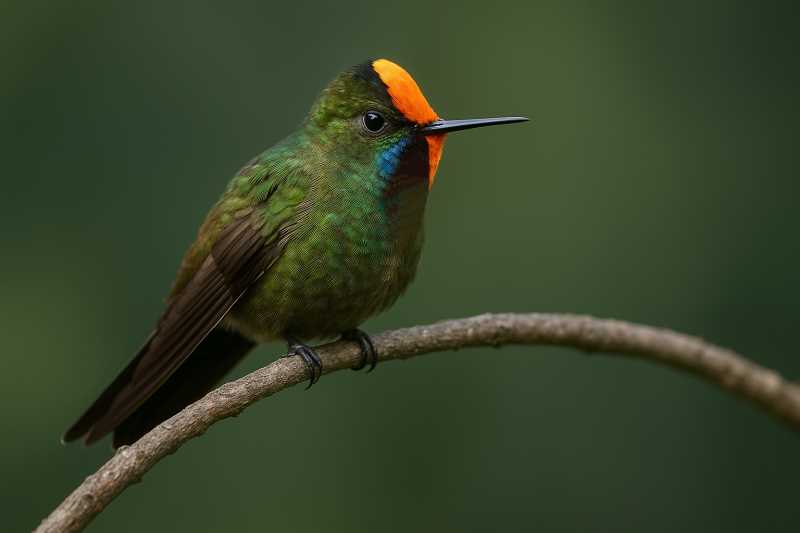
The Rainbow-bearded Thornbill measures approximately 10–12 cm in length. Both sexes have a short bill, a rufous or chestnut crown, bronzy-green upperparts and a dark, forked tail with conspicuous pale or white tips.
Adult males are distinguished by a narrow, elongated throat patch formed by iridescent feathers. Its apparent colour changes with the angle of the light and may range from green and blue to gold, copper and red. Females lack the fully developed throat beard, while immature birds resemble females and may show only limited throat iridescence.
Range and Habitat
The species has a discontinuous distribution in the northern Andes. It occurs locally in Colombia, more continuously through the Andes of Ecuador, and southwards into northern Peru. Some taxonomic treatments recognise geographically distinct subspecies, including the form Chalcostigma herrani tolimae associated with the central Colombian Andes.
It is generally found between about 2,700 and 4,000 metres above sea level. Preferred habitats include páramo scrub, elfin forest, high-elevation montane woodland and shrubby slopes near the tree line. It may also use rocky, well-drained areas containing terrestrial bromeliads, shrubs and other flowering plants, as well as patches of Polylepis woodland.
Where to See This Species
Yanacocha Reserve, Pichincha Province, Ecuador
Yanacocha is a documented site for the species and protects high-elevation habitats on the northern slopes of Pichincha. The reserve’s upper montane forest, páramo margins and flowering plants provide suitable habitat for high-Andean hummingbirds. Rainbow-bearded Thornbills have also been recorded visiting flowering plants in the reserve, although sightings are not guaranteed.
Nearby accommodation: Quito is the main practical base, with hotels, guest houses, hostels and organised day trips to the reserve. Limited lodge-style accommodation may also be available through the reserve operator.
Tapichalaca Reserve, Zamora-Chinchipe Province, Ecuador
Rainbow-bearded Thornbill is included in documented bird lists for Tapichalaca Reserve. The reserve’s upper elevations contain wet montane forest, shrubby clearings and highland habitats that support a diverse hummingbird community. Look along flowering shrubs and forest edges, particularly in cooler upper sections of the reserve.
Nearby accommodation: The reserve itself has lodge-style accommodation, while Valladolid and nearby settlements provide additional guest houses and small lodging options.
Cajas National Park, Azuay Province, Ecuador
The species is recorded in the avifauna of Cajas National Park and the adjoining Mazán Reserve. Páramo vegetation, rocky slopes, shrublands and patches of high-elevation woodland provide appropriate habitat. Birdwatchers should search sheltered flowering areas and scrub near the park’s higher trails, taking account of cold, windy conditions and rapidly changing weather.
Nearby accommodation: Cuenca is the principal gateway, with hotels, guest houses, hostels and self-catering accommodation. Basic camping and limited accommodation options may also be available near parts of the park, subject to park regulations.
Behaviour and Diet
The Rainbow-bearded Thornbill is usually encountered alone or in pairs. Like other high-Andean hummingbirds, it feeds mainly on nectar from flowering plants and can visit both native shrubs and terrestrial bromeliads. It may cling to a flower or nearby branch while feeding rather than hovering continuously.
Small insects and other arthropods are also likely to form part of its diet, supplying protein and other nutrients. Males may defend productive feeding areas or display their iridescent throat feathers during interactions with other birds, but detailed information on territoriality and courtship remains limited.
The species is not known for long-distance migration. Local movements may occur in response to flowering conditions, weather and the availability of food at different elevations. Publicly available information on nest construction, clutch size and incubation is comparatively limited, so breeding details should be treated cautiously.
Identification Tips
- Look for a small, short-billed hummingbird in high Andean scrub, páramo or elfin woodland.
- The rufous crown and broad white tips to the dark, forked tail are useful features on both sexes.
- In males, the narrow, elongated throat patch can appear almost black until it catches the light, then flash with several iridescent colours.
- Females and immature birds have a much less prominent throat patch and can be more difficult to separate from other small high-elevation hummingbirds.
- Do not rely on colour alone. Observe the combination of crown colour, tail pattern, short bill, habitat and elevation.
- The Blue-mantled Thornbill is a potentially confusing relative in parts of the range, but it is generally associated with higher elevations and differs in its mantle and throat pattern. Careful views are needed where both species occur.
Conservation Status
The Rainbow-bearded Thornbill is currently assessed as Least Concern on the IUCN Red List. It has a relatively broad Andean distribution, but it depends on specialised high-elevation habitats that can be affected by agricultural expansion, burning, overgrazing, vegetation clearance and changes in climate.
Conservation priorities include protecting páramo, elfin forest and Polylepis woodland, maintaining connected high-elevation habitat, and managing reserves so that flowering plants and natural vegetation are retained. The species also benefits from the protection of reserves such as Yanacocha, Tapichalaca and Cajas National Park.
Frequently Asked Questions
Where can the Rainbow-bearded Thornbill be found?
It occurs in the Andes of Colombia, Ecuador and northern Peru, mainly in high-elevation páramo, elfin woodland and montane scrub.
What does the Rainbow-bearded Thornbill look like?
It is a small hummingbird with a short bill, a rufous crown, bronzy-green plumage and a dark, forked tail with pale tips. Adult males have a narrow, multicoloured iridescent throat patch.
Why is it called the Rainbow-bearded Thornbill?
The name refers to the male’s elongated throat feathers, which form a beard-like patch that can show several iridescent colours when viewed in the right light.
What does the Rainbow-bearded Thornbill eat?
Its diet consists mainly of nectar from high-Andean flowers, supplemented by small insects and other arthropods.
Is the Rainbow-bearded Thornbill endangered?
No. It is currently classified as Least Concern, although the páramo and montane habitats on which it depends remain vulnerable to land-use change and climate-related pressures.
Where is the best place to look for this species?
Documented viewing locations include Yanacocha Reserve, Tapichalaca Reserve and Cajas National Park in Ecuador. Search flowering shrubs, páramo edges and high-elevation forest margins, preferably with local guidance.
References
- BirdLife International
- IOC World Bird List
- Phytotaxa
Related posts