Introduction
The Violet-headed Hummingbird (Klais guimeti) is a small Neotropical hummingbird and the only recognised species in the genus Klais. It occurs from Central America through the northern and western parts of South America, where it occupies humid forest, woodland edges, second growth and some shaded cultivated areas.
Physical Description
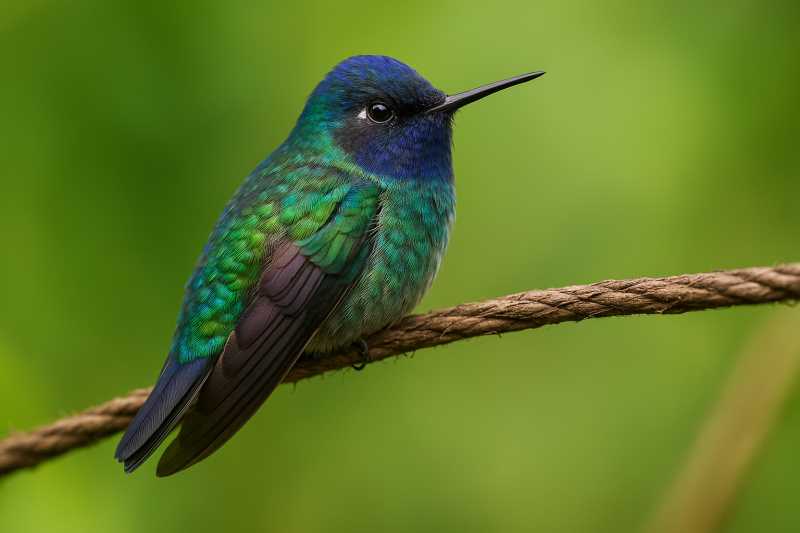
The Violet-headed Hummingbird is a small hummingbird measuring approximately 8–9 cm in length. It has a short, straight, black bill, dusky wings and a greenish tail with pale grey tips. Both sexes have a conspicuous pale or white spot behind the eye.
Adult males have metallic green upperparts and a strongly iridescent violet-blue crown and throat. The breast is greyish and becomes paler towards the belly, with green often visible on the flanks. The violet colour can appear blue, purple or almost black depending on the light and viewing angle.
Females are duller. They retain the green upperparts, violet or bluish crown and pale post-ocular spot, but their throat and underparts are mainly grey. Immature birds resemble females and may show less-developed violet colouring on the head.
Range and Habitat
The species has a broad but locally uneven distribution. It occurs from eastern Honduras through Nicaragua, Costa Rica and Panama, then across Colombia, Venezuela, Ecuador, Peru and Bolivia, with some checklists also recording a range extending into northern Brazil. Several geographic forms are recognised, including K. g. merrittii in Central America and K. g. guimeti and K. g. pallidiventris in South America.
The Violet-headed Hummingbird is generally resident rather than a long-distance migrant, although local movements may occur in response to flowering and seasonal conditions. It is associated with humid lowland and foothill forest, montane evergreen forest, forest edges, tall second growth, thickets, shaded gardens, hedgerows and shade-grown plantations. It is usually found from the lowlands to approximately 1,400 metres, with higher records reported in parts of Colombia and Venezuela.
Where to See This Species
Braulio Carrillo National Park area, Heredia and San José provinces, Costa Rica
The humid foothill forests and forest-edge habitats around Braulio Carrillo National Park are suitable for Violet-headed Hummingbirds. Birding records and regional trip reports document the species at hummingbird gardens near the park, particularly where flowering plants border forest and secondary growth. Look carefully in sheltered gardens, along forest edges and around flowering shrubs.
Nearby accommodation: San José, San Isidro de Coronado and the communities along the park approaches provide hotels, guest houses, lodges and self-catering accommodation.
Cerro Hoya National Park, Azuero Peninsula, Panama
An annotated bird checklist for Cerro Hoya National Park includes the Violet-headed Hummingbird. The species is associated with humid forest and forest clearings, and may be encountered along accessible trails or near flowering vegetation. The park is remote, so sightings are likely to depend on careful searching and local guidance.
Nearby accommodation: Tonosí is the nearest practical gateway, with small guesthouses and rural accommodation. Visitors should arrange transport and access locally before travelling into the park area.
Piedras Blancas National Park, Puntarenas Province, Costa Rica
The Violet-headed Hummingbird is included on the bird list for the Esquinas Rainforest Lodge area within the Piedras Blancas National Park region. Humid lowland rainforest, clearings and flowering plants around forest lodges provide suitable places to search for this small, fast-moving species.
Nearby accommodation: Golfito is the main practical base, offering hotels, rainforest lodges, cabins and other visitor accommodation.
Behaviour and Diet
Violet-headed Hummingbirds are active during daylight hours and usually forage alone. Individuals may defend productive flowers or feeding areas from other hummingbirds, although the strength of territorial behaviour varies with food availability. They hover while feeding and often perch quietly in shaded vegetation between feeding visits.
Nectar from a variety of flowering plants forms the main part of the diet. Small insects and spiders are also taken, especially when birds need additional protein. Their hovering flight, extendable tongue and specialised bill allow them to exploit flowers that are difficult for many other birds to reach.
Breeding information is less thoroughly documented than for some better-studied hummingbirds. The female builds a small cup-shaped nest from plant fibres and other soft materials, often incorporating spider silk, and is responsible for incubation and care of the young. Two white eggs are normally laid, and the nest is usually placed on a slender branch or other protected support. Breeding activity varies geographically and is often associated with periods of plentiful flowering.
Identification Tips
- Look for a very small hummingbird with a short, straight black bill and a green body.
- The male’s brilliant violet-blue crown and throat are the key features, but the colour may look blue, purple or dark depending on the light.
- Both sexes show a noticeable pale spot behind the eye.
- The underparts are greyish to whitish rather than completely green, and the tail is relatively short with pale grey tips.
- Females and immature birds are duller and can be overlooked among other small green hummingbirds.
- The Violet-headed Hummingbird is smaller and more compact than the Violet Sabrewing, with a much shorter bill and no broad white tail corners. It can also be separated from the Violet-fronted Brilliant by its smaller size, shorter bill and more compact shape.
Conservation Status
The Violet-headed Hummingbird is currently assessed as Least Concern. Its extensive geographic range, use of secondary growth and tolerance of some human-modified habitats help reduce its immediate risk of extinction.
Nevertheless, the species can be affected locally by deforestation, agricultural expansion, removal of forest edges and loss of flowering plants. Protecting humid foothill and lowland forest, maintaining connected secondary growth and retaining flowering vegetation in shaded agricultural landscapes are important conservation measures. A reliable global population estimate is not stated here because published estimates and assessment details may vary between sources.
Frequently Asked Questions
Where can the Violet-headed Hummingbird be found?
It occurs from eastern Honduras through Central America and across northern and western South America, including Colombia, Venezuela, Ecuador, Peru and Bolivia.
What does the Violet-headed Hummingbird look like?
It is a small green hummingbird with a short, straight black bill and a pale spot behind the eye. Males have a brilliant violet-blue crown and throat, while females are duller with grey underparts.
Is the Violet-headed Hummingbird migratory?
It is generally considered resident rather than migratory. Local movements may occur when flowering conditions or food availability change.
What does the Violet-headed Hummingbird eat?
It feeds mainly on nectar from flowering plants and supplements this diet with small insects and spiders.
Where does the Violet-headed Hummingbird live?
It favours humid lowland and foothill forest, forest edges, second growth, thickets, shaded gardens and some shade-grown plantations, usually below about 1,400 metres.
Is the Violet-headed Hummingbird endangered?
No. The species is currently assessed as Least Concern, although habitat loss can cause local declines and remains an important conservation concern.
References
- BirdLife International
- IUCN Red List of Threatened Species
- Annotated Checklist of the Birds of Cerro Hoya National Park, Panama
Related posts