Upland Goose (Chloephaga picta): A Detailed Exploration of a Distinguished Avian Species
The Upland Goose (Chloephaga picta) is a captivating bird species that commands attention due to its striking appearance and unique ecological role. Native to the southern reaches of South America, this bird is often found in the open grassy plains and fields of Patagonia, the Falkland Islands, and Tierra del Fuego. As a member of the Anatidae family, the Upland Goose shares familial ties with ducks, swans, and other geese, yet it stands out due to its distinctive characteristics and behaviors.
Physical Characteristics
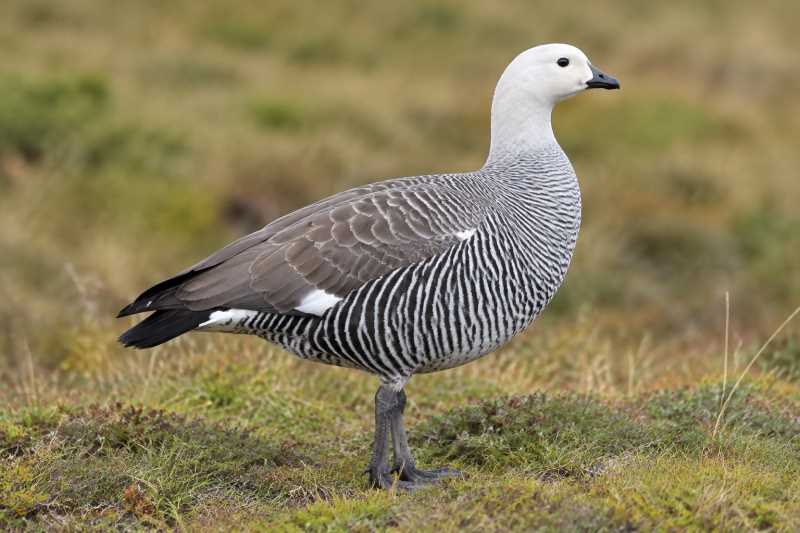
The Upland Goose is easily identifiable by its stark sexual dimorphism. Males boast a predominantly white plumage with contrasting black wing feathers, while females are adorned with a more subdued brown plumage with intricate barred patterns. This difference in coloration not only aids in sexual identification but also plays a role in their nesting strategies, with the more camouflaged females better blending into the environment while incubating eggs.
Both genders share a robust build, with an average length ranging from 60 to 72 centimeters (24 to 28 inches) and a wingspan that extends about 125 centimeters (49 inches). Their legs are a vivid orange, and they possess a stout, robust bill designed for their grazing lifestyle.
Habitat and Distribution
The Upland Goose is predominantly found in the open grasslands and pampas of southern South America. Favoring flat, wide-open spaces, they are particularly plentiful in areas like the Falkland Islands, where they are a common sight. Their presence is also notable in Tierra del Fuego and as far north as the Pampas of Argentina.
Their migration patterns are largely influenced by the seasons. During the warmer months, these geese are known to inhabit higher altitudes, but as winter approaches, they descend to lower altitudes to escape the harsh conditions. This altitudinal migration is a fascinating aspect of their ecology, demonstrating their adaptability to varying climatic conditions.
Diet and Feeding Behavior
Primarily herbivorous, the Upland Goose feeds on a variety of grasses and sedges. Their diet consists largely of seeds, leaves, and stems, which they forage for in flocks. This grazing behavior not only sustains them but also plays a crucial role in the ecosystem by controlling grass growth and contributing to the nutrient cycle.
Interestingly, their feeding habits are also a testament to their adaptability. During times when vegetation is sparse, they have been observed feeding on agricultural crops, which can sometimes bring them into conflict with local farmers.
Reproduction and Lifespan
The breeding season of the Upland Goose typically occurs between September and December. During this time, males engage in elaborate displays to attract females, showcasing their plumage and engaging in territorial fights to ward off rivals.
Once paired, the female will lay a clutch of 5 to 8 eggs, which she incubates for about 30 days. The male, meanwhile, stands guard, protecting the nest from potential predators. This division of labor ensures the safety and success of their offspring.
Chicks are precocial and are able to walk and feed themselves within hours of hatching, though they remain under the watchful eyes of their parents. The family unit stays together until the young reach independence, usually several months post-hatching.
In the wild, Upland Geese can live up to 15 years, though this lifespan can vary based on environmental conditions and predation pressures.
Conservation Status and Threats
Currently, the Upland Goose is classified as a species of Least Concern by the International Union for Conservation of Nature (IUCN). However, their populations are not without threats. Habitat loss due to agricultural expansion and urban development poses significant risks. Additionally, their foraging on crops can lead to conflicts with farmers, sometimes resulting in lethal control measures.
Conservation efforts are essential in ensuring the continued survival of this species. Measures such as habitat protection and the promotion of sustainable agriculture can help mitigate these threats.
Conclusion
The Upland Goose is an integral part of the southern South American landscape, contributing both ecologically and aesthetically to the regions it inhabits. Its unique characteristics and behaviors make it a subject of interest for ornithologists and bird enthusiasts alike. Continued conservation efforts and sustainable practices will be crucial in preserving this remarkable species for future generations to appreciate.
In sum, the Upland Goose not only enriches the biodiversity of its native habitats but also serves as a reminder of the delicate balance between wildlife and human land use.
Related posts