Introduction
The Diamantina Sabrewing (Campylopterus diamantinensis) is a little-known hummingbird endemic to Brazil’s Espinhaço Range in Minas Gerais. It is associated with high-elevation rocky landscapes and forested ravines, and is recognised as a separate species after formerly being treated as a subspecies of the Grey-breasted Sabrewing.
Physical Description
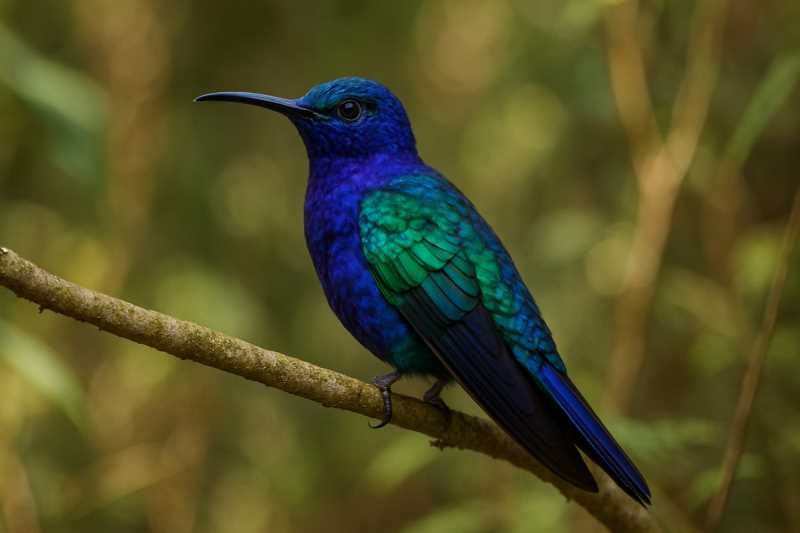
The Diamantina Sabrewing is a medium-sized hummingbird measuring approximately 13 cm in length. It has dark green upperparts, a darker crown, dark greyish underparts and a small white spot behind the eye. The bill is long and slightly down-curved, with a dark upper mandible and a paler lower mandible.
The central tail feathers are metallic bronze-green, while the outer tail feathers show bronze-green bases, darker central areas and broad pale tips. The thickened outer primary feathers characteristic of sabrewings can be visible in flight or at close range.
Males and females are very similar in appearance. Females are generally slightly duller, but the species does not show the strong male-female colour contrast found in some other hummingbirds. Reliable information on juvenile plumage is limited.
Range and Habitat
The species is endemic to southeastern Brazil and occurs along the Espinhaço Range of Minas Gerais, from the Serra do Cabral and Serra do Cipó southwards towards the Serra do Caraça. The type locality is Córrego das Pedras, in the municipality of Diamantina.
The Diamantina Sabrewing is associated mainly with high-elevation campos rupestres, a rocky montane vegetation type consisting of grasses, shrubs and scattered small trees. It is particularly linked to forested streams, damp ravines and sheltered slopes within this generally dry, fire-prone landscape. Records are concentrated at roughly 1,000 to 2,050 metres above sea level.
It is considered resident rather than migratory, although its movements between nearby highland habitats are poorly documented. The species is not restricted to the state of Bahia or to Chapada Diamantina, as previously stated in the original article.
Where to See This Species
Serra do Cipó National Park, Minas Gerais, Brazil
The park contains suitable high-elevation campos rupestres, rocky ravines and streamside vegetation, and the species has been documented from the Alto do Palácio area and other parts of the Serra do Cipó region. It is a realistic site for targeted searches, although sightings may require patience because the hummingbird is localised and not reliably common.
Nearby accommodation: The Serra do Cipó village area and surrounding settlements offer pousadas, guest houses, small hotels, campsites and self-catering accommodation.
Sempre-Vivas National Park, Minas Gerais, Brazil
The Diamantina Sabrewing has been documented from Morro da Torre, also known as Landinho, within the park. The protected area’s highland rocky vegetation and stream corridors match the species’ known habitat. Access and visitor arrangements should be checked with park authorities before travelling, as some areas require prior planning or authorisation.
Nearby accommodation: Diamantina is the main practical gateway, with hotels, guest houses, pousadas and self-catering accommodation.
Santuário do Caraça, Minas Gerais, Brazil
This privately protected reserve is open to visitors and includes high-altitude campos rupestres supporting the species. The reserve’s avifauna information specifically recognises the Diamantina Sabrewing from the Caraça highlands. Stream valleys, mountain trails and rocky upper slopes provide the most appropriate habitats to search.
Nearby accommodation: The sanctuary itself provides visitor accommodation, while Catas Altas, Santa Bárbara and Barão de Cocais offer additional hotels, guest houses and other lodging options.
Behaviour and Diet
The Diamantina Sabrewing is an agile hummingbird capable of hovering while feeding. It is expected to defend profitable flowering plants or feeding areas, as many sabrewings do, but detailed observations of territorial behaviour in this species remain limited.
Its diet is not well documented. Nectar from flowering plants is presumed to be important, particularly in sheltered streamside and ravine habitats. Like other hummingbirds, it is also expected to take small arthropods for protein and other nutrients, probably by gleaning from vegetation or catching insects during short flights.
The species is not known to undertake regular long-distance migration. Information about courtship, nesting dates, nest placement and parental care remains scarce, and further field study is needed.
Identification Tips
- Look for a medium-sized, dark green hummingbird in highland rocky vegetation, especially along shaded streams and ravines.
- The white spot behind the eye is a useful feature when viewing conditions allow.
- Note the dark greyish underparts, slightly down-curved bill and tail with broad pale tips on the outer feathers.
- The species may appear less brightly coloured than some tropical hummingbirds because its plumage is predominantly dark green and grey rather than intensely iridescent.
- The Grey-breasted Sabrewing can be difficult to separate where ranges or historical records overlap. Geographic location is important, as the Diamantina Sabrewing is associated with the Espinhaço highlands of Minas Gerais, while the Grey-breasted Sabrewing occupies a much broader range.
Conservation Status
The Diamantina Sabrewing is currently assessed as Near Threatened. Its population size has not been quantified, and the population is believed to be decreasing. The species has a small, fragmented range and depends on specialised highland habitats.
Potential threats include habitat degradation, inappropriate or increasingly frequent fires, grazing, land-use change and the effects of climate change on montane vegetation and water availability. The species benefits from protection in several conservation areas, including Serra do Cipó National Park, Sempre-Vivas National Park and Santuário do Caraça. Continued surveys, habitat protection and careful fire and visitor management are important conservation measures.
Frequently Asked Questions
Where does the Diamantina Sabrewing live?
It lives in the Espinhaço Range of Minas Gerais, southeastern Brazil, particularly in high-elevation campos rupestres, rocky ravines and forested stream corridors.
Is the Diamantina Sabrewing found in Chapada Diamantina?
No. The species’ confirmed range is in Minas Gerais, not the Chapada Diamantina region of Bahia. The similar regional names have contributed to confusion between the bird and the landscape.
Is the Diamantina Sabrewing migratory?
It is regarded as resident. Long-distance migration has not been documented, although local movements within the Espinhaço highlands are possible.
What does the Diamantina Sabrewing eat?
Its detailed diet is poorly known, but it is expected to feed on nectar and supplement this with small arthropods, as do many related hummingbirds.
How can the Diamantina Sabrewing be identified?
Look for a dark green hummingbird with a white spot behind the eye, greyish underparts, a slightly down-curved bill and pale-tipped outer tail feathers in highland rocky or streamside habitat.
Is the Diamantina Sabrewing endangered?
It is currently listed as Near Threatened rather than Vulnerable or Endangered. Its small range, specialised habitat and suspected population decline nevertheless make it a conservation priority.
References
- BirdLife International
- Cornell Lab of Ornithology, Birds of the World
- Instituto Chico Mendes de Conservação da Biodiversidade
Related posts