Hermit Warbler: A Detailed Look at a Western Forest Songbird
The Hermit Warbler (Setophaga occidentalis) is a small yet strikingly beautiful songbird native to the western parts of North America. With its unique plumage and melodious song, this bird is a favorite among birdwatchers and ornithologists alike. This article delves into the characteristics, habitat, behavior, and conservation status of the Hermit Warbler, providing a comprehensive overview of this fascinating species.
Physical Characteristics
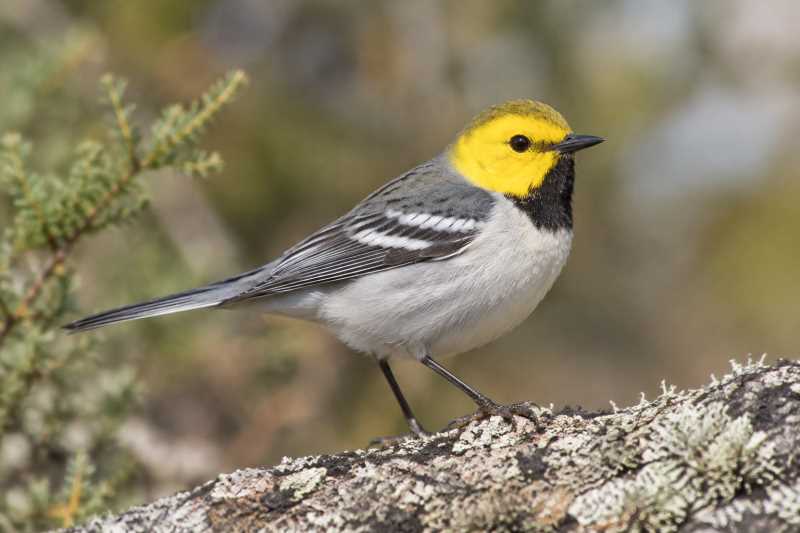
The Hermit Warbler is a small passerine bird, typically measuring around 5 inches in length with a wingspan of approximately 7 inches. One of the most distinguishing features of this species is its bright yellow face, which contrasts sharply with its black chin and throat. The rest of its plumage is primarily gray, with black streaks on its back and wings. Males and females exhibit similar coloring, although females tend to have slightly duller plumage than their male counterparts.
Juvenile Hermit Warblers can be identified by their duller coloration and lack of the distinctive black chin seen in adults. The bright yellow face of the Hermit Warbler makes it relatively easy to identify in its natural habitat, even from a distance.
Habitat and Range
The Hermit Warbler is predominantly found in the coniferous forests along the western coast of North America, ranging from Washington and Oregon in the north, down through California, and into parts of Baja California. These birds have a strong preference for mature forests, particularly those dominated by Douglas firs and other evergreen species.
During the breeding season, Hermit Warblers are primarily found at higher elevations, where they build their nests high in the canopy. In contrast, during the winter months, they migrate to lower elevations and can be found in a variety of forested habitats, including oak and pine-oak forests, as they move southward into Mexico and Central America.
Behavior and Diet
Hermit Warblers are primarily insectivorous, foraging for a variety of insects and spiders among the foliage of trees. They are known for their acrobatic foraging behavior, often hanging upside down or hovering briefly to capture prey. In addition to insects, they may also consume small quantities of berries and other plant material, particularly during the winter months when insect availability is lower.
These birds are solitary foragers during the breeding season. However, outside of this period, they may join mixed-species feeding flocks, particularly during migration. This behavior not only increases their foraging efficiency but also provides added protection from predators.
Breeding and Reproduction
The breeding season for Hermit Warblers typically begins in late spring, with nest building commencing in May or June. Both males and females participate in selecting the nest site, which is usually located high in the canopy of a coniferous tree. The nest is a compact cup made of twigs, grass, and other plant materials, lined with softer substances such as feathers and moss.
Females lay a clutch of 3 to 5 eggs, which are incubated for about two weeks. Once hatched, the chicks are fed by both parents and fledge approximately two weeks after hatching. Hermit Warblers are known for their strong territorial behavior during the breeding season, with males singing frequently to defend their territory and attract a mate.
Vocalizations
The song of the Hermit Warbler is a series of high-pitched, musical notes that are often described as a "zree-zree-zree" sound. This song is used primarily by males during the breeding season to establish territory and attract females. In addition to their song, Hermit Warblers also produce a variety of calls, including soft chips and trills, used for communication between mates and within flocks.
Conservation Status
The Hermit Warbler is currently listed as a species of Least Concern by the International Union for Conservation of Nature (IUCN). However, like many forest-dependent species, it faces threats from habitat loss and fragmentation due to logging and urban development. Conservation efforts aimed at preserving mature forest habitats are crucial for the continued survival of the Hermit Warbler.
In addition to habitat protection, ongoing research and monitoring are important to understand the population dynamics and migration patterns of this species. Birdwatching organizations and conservation groups play a key role in these efforts, working to ensure that the Hermit Warbler continues to thrive in its natural habitat.
Conclusion
The Hermit Warbler is a captivating species that embodies the beauty and complexity of forest ecosystems. With its distinctive appearance and enchanting song, it continues to capture the hearts of bird enthusiasts across its range. As we strive to protect and preserve our natural environments, the Hermit Warbler serves as a reminder of the intricate interconnections that define our planet’s biodiversity.
By understanding and appreciating the unique qualities of the Hermit Warbler, we can better advocate for the conservation measures needed to ensure its survival for future generations.
Related posts