Introduction
The Tourmaline Sunangel (Heliangelus exortis) is a small hummingbird of the northern Andes. It occurs in Colombia and Ecuador, where it inhabits humid montane forests, forest edges, cloud forests and elfin woodland. The species is largely resident and is locally common in suitable high-elevation habitat.
Physical Description
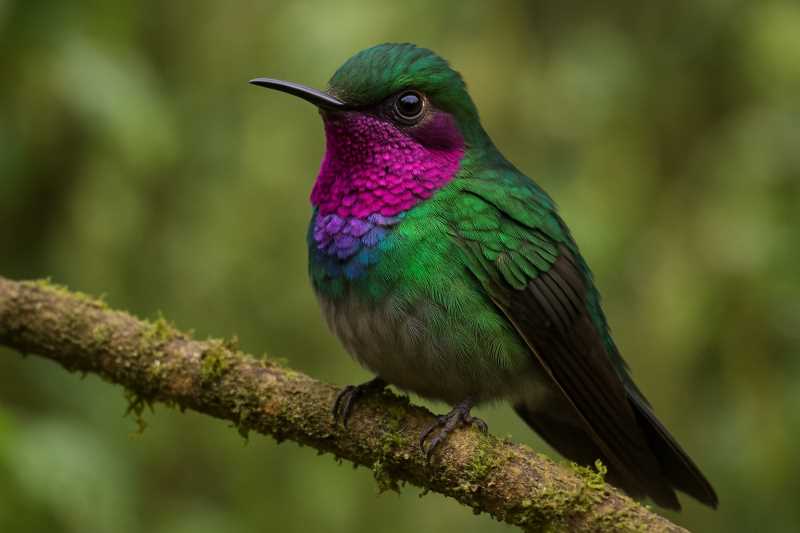
The Tourmaline Sunangel is approximately 10–11 cm long and has a short, straight, blackish bill. Both sexes have dark, shining green upperparts, greyish underparts with green spotting, a long, deeply forked tail and pale or white undertail-coverts.
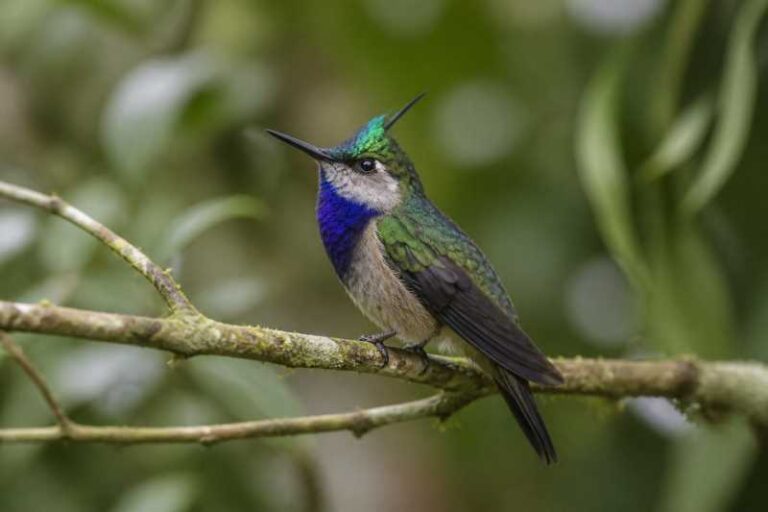
Adult males are distinguished by a glittering green frontlet above the bill, a dark violet-blue chin and a prominent rosy-pink gorget bordered with iridescent green. Females lack the green frontlet and have a mainly whitish throat marked with green to dusky speckling. Some females may show a small amount of iridescent colour on the throat. Immature birds resemble females, although young males may show developing colour on the chin and throat.
Range and Habitat
The Tourmaline Sunangel occurs in all three Andean cordilleras of Colombia and extends south along the eastern slope of the Andes through Ecuador to Morona-Santiago Province. It is not known to undertake long-distance migration, although occasional local movements may occur.
It is mainly found between about 2,300 and 3,400 metres above sea level, with some records at lower elevations. Preferred habitats include humid to wet premontane and montane forest, cloud forest, elfin forest, forest edges, bushy clearings and shrubby pastures. It can persist in some disturbed or regenerating landscapes, particularly where flowering plants and dense vegetation remain available.
Where to See This Species
Guango Lodge and Reserve, Napo Province, Ecuador
Guango Lodge and its surrounding reserve are established high-elevation birdwatching sites on the eastern Andean slope near Papallacta. The Tourmaline Sunangel is regularly listed among the likely hummingbirds in the reserve’s temperate montane forest, where it may visit flowering plants and feeders.
Nearby accommodation: Papallacta is the nearest practical gateway settlement, with hotels, thermal-resort accommodation, guest houses and other lodging options. Accommodation is also available at the wildlife-viewing venue itself.
Reserva Ecológica Río Blanco, Caldas, Colombia
The Río Blanco reserve near Manizales protects humid Andean montane forest and is a recognised birdwatching location with documented Tourmaline Sunangel records. Forest trails, edges and flowering areas provide suitable places to search for this territorial hummingbird.
Nearby accommodation: Manizales is the nearest major accommodation centre, with hotels, guest houses and self-catering options. Rural lodging may also be available near the reserve, subject to local access arrangements.
Behaviour and Diet
The Tourmaline Sunangel is active during daylight hours and is usually encountered alone or in pairs rather than in large groups. Individuals may defend feeding territories aggressively, especially around productive flowers or feeders. It commonly feeds at low-growing flowers and may cling to a flower while taking nectar instead of hovering continuously.
Nectar forms the main part of its diet. The species also takes small insects and other arthropods, capturing them from a perch or gleaning them from vegetation. These animal foods provide protein and other nutrients that are particularly important during breeding.
The species is largely sedentary. Its breeding season appears to extend from approximately March to August, although timing may vary across its range. The female builds the nest and incubates a clutch of two white eggs. Detailed information about incubation and fledging periods remains limited.
Identification Tips
Look for a small, dark-green hummingbird with a distinctly forked tail and pale undertail-coverts in humid highland forest or along a forest edge. The male’s combination of a green frontlet, violet-blue chin and rosy-pink gorget is distinctive when seen in good light.
Females are more subdued and can be recognised by their whitish, finely spotted throat, dark green upperparts and long forked tail. The Tourmaline Sunangel may be confused with other Heliangelus sunangels where ranges overlap, so the throat pattern, frontlet colour, undertail-coverts, elevation and geographic location should all be considered together.
Conservation Status
The Tourmaline Sunangel is currently assessed as Least Concern on the IUCN Red List. Its population size has not been reliably quantified, but the species is locally fairly common and occurs in a number of protected areas.
Deforestation, agricultural expansion, urban growth and fragmentation of Andean montane forest remain potential threats, particularly where forest is cleared at higher elevations. Protecting remaining cloud forest, maintaining connected habitat and conserving flowering vegetation around forest edges will benefit the species and the wider hummingbird community.
Frequently Asked Questions
Where does the Tourmaline Sunangel live?
It lives in the Andes of Colombia and Ecuador, mainly in humid montane forest, cloud forest, elfin forest, forest edges and shrubby clearings.
What does a Tourmaline Sunangel look like?
It is a 10–11 cm hummingbird with dark green upperparts, greyish underparts, a long forked tail and pale undertail-coverts. Males have a green frontlet, violet-blue chin and rosy-pink gorget, while females have a whitish spotted throat.
What does the Tourmaline Sunangel eat?
Its main food is nectar from flowering plants. It also catches small insects and other arthropods from the air or vegetation.
Is the Tourmaline Sunangel migratory?
It is considered largely resident. Some local movements may occur, but it does not undertake a regular long-distance migration.
Where is the best place to see a Tourmaline Sunangel?
Guango Lodge and Reserve near Papallacta in Ecuador and Reserva Ecológica Río Blanco near Manizales in Colombia are documented birdwatching locations where the species can be sought in suitable montane forest habitat.
Is the Tourmaline Sunangel endangered?
No. It is currently classified as Least Concern, although habitat loss and fragmentation remain important conservation concerns in the Andes.
References
- BirdLife International
- IUCN Red List of Threatened Species
- Cornell Lab of Ornithology, Birds of the World
Related posts