Introduction
Sykes’s Nightjar (Caprimulgus mahrattensis) is a nocturnal member of the nightjar family, Caprimulgidae. It is associated mainly with the dry, open landscapes of north-western South Asia, where its sandy, mottled plumage provides effective daytime camouflage. The species is also known as the Sindh Nightjar and was named after Colonel William Henry Sykes, who described it in 1832. (ww.worldbirdnames.org)
Physical Description
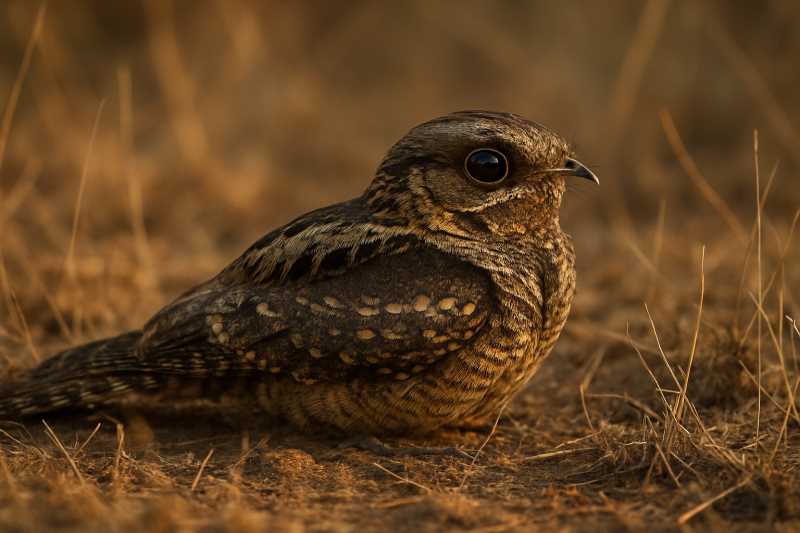
Sykes’s Nightjar is a medium-sized nightjar, measuring approximately 24–27 centimetres in length. Its upperparts are generally sandy grey or sandy brown, finely marked with blackish-brown streaks, spots and vermiculations. The underparts are paler and mottled, helping the bird blend with dry soil, leaf litter, thorn scrub and desert substrates.
The species has a broad, flattened head, large dark eyes, a short bill and prominent bristles around the mouth. Its wings are long and pointed, and the tail is moderately long. In flight, pale or white markings on the wings and tail can become more conspicuous, particularly in adult males. Females usually have less extensive and less brilliant white markings, while juveniles are generally duller and can be particularly difficult to identify. (faunaofindia.nic.in)
Range and Habitat
Sykes’s Nightjar occurs primarily in Pakistan, southern Afghanistan, south-western Iran and north-western India. Within India, records and breeding evidence are concentrated in dry western and north-western areas, including Gujarat, Rajasthan and Punjab, although its distribution and seasonal status are not uniform across the region. (static1.squarespace.com)
It favours semi-desert and arid landscapes with open ground and scattered dry thorn scrub. Suitable habitats include uncultivated tracts of the Indus plains, sandy and clay deserts, scrubland, dry grassland and open dry deciduous country. The species is a ground-nesting bird, so areas with relatively undisturbed bare or sparsely vegetated ground are important.
Sykes’s Nightjar is not best described as a uniformly resident species throughout its range. Some populations breed locally, while others may move seasonally or occur as winter visitors. The extent of these movements remains insufficiently documented in some parts of South Asia. (static1.squarespace.com)
Behaviour and Diet
Sykes’s Nightjar is mainly crepuscular and nocturnal. It usually becomes active at dusk, may feed during the night and can also be seen shortly before sunrise. During daylight, it typically rests motionless on the ground or on a low perch, relying on its cryptic plumage rather than flight to avoid detection.
The species feeds on flying insects, including moths, beetles, grasshoppers, locusts, crickets and cicadas. It often launches from the ground or a low perch to catch prey in the air. Like other nightjars, it has a wide gape and stiff bristles around the bill that assist with aerial insect capture. Its soft-edged flight feathers help reduce sound during flight.
The territorial call is a hard, rapidly repeated churr or rattle. It may continue for several seconds or, in some circumstances, for several minutes. Unlike the call of the European Nightjar, the notes of Sykes’s Nightjar are delivered at a relatively even pitch and rate. (static1.squarespace.com)
Breeding has been recorded from March into the spring and early summer period, although the precise timing varies geographically. The nest is a simple scrape or depression on the ground, usually placed among sand, stones, dry vegetation or leaf litter. The clutch normally consists of one or two well-camouflaged eggs. Available breeding information remains limited in comparison with that of better-studied nightjar species. (es.wikipedia.org)
Identification Tips
Look for the following combination of features:
- Sandy-grey or sandy-brown plumage with fine blackish markings.
- A relatively plain, cryptically patterned appearance when perched.
- Long pointed wings and a broad-headed nightjar shape.
- Pale or white wing and tail markings visible during flight, especially in adult males.
- Occurrence in open arid or semi-arid country rather than dense forest.
- A hard, rapidly repeated churr or rattling territorial call.
Sykes’s Nightjar can be confused with the Savanna Nightjar (Caprimulgus affinis) where their ranges overlap. Identification is not always reliable from a brief view, particularly for females, juveniles and worn adults. Wing and tail patterns, overall ground colour, plumage details and vocalisations should be assessed together rather than relying on a single feature. (indianbirds.in)
Conservation Status
Sykes’s Nightjar is currently assessed as Least Concern on the IUCN Red List. The global population is not known to be undergoing a rapid decline, but detailed population estimates are unavailable and local trends may differ between regions. (en.wikipedia.org)
Potential local pressures include the conversion of open scrub and semi-desert habitat to agriculture, infrastructure and settlements, as well as the degradation of uncultivated ground. Because the species nests on the ground, disturbance and the loss of sparsely vegetated nesting sites may affect breeding birds. Conservation priorities include retaining large areas of natural dry scrub and desert habitat, protecting known breeding sites and improving knowledge of the species’ distribution, movements and population trends.
Frequently Asked Questions
Where does Sykes’s Nightjar live?
It is found mainly in Pakistan, southern Afghanistan, south-western Iran and north-western India. It prefers open arid and semi-arid habitats with scattered thorn scrub, dry grassland and exposed ground.
Is Sykes’s Nightjar found in India?
Yes. It has been recorded in north-western India, particularly in Gujarat, Rajasthan and Punjab. Breeding has been documented in parts of India, although its abundance and seasonal status vary between locations.
What does Sykes’s Nightjar eat?
It mainly eats flying insects, including moths, beetles, grasshoppers, locusts, crickets and cicadas. It usually catches prey during short aerial sallies from the ground or a low perch.
When is Sykes’s Nightjar active?
It is primarily active at dusk, during the night and shortly before dawn. During the day, it usually remains still and concealed on the ground or on a low perch.
How does Sykes’s Nightjar nest?
It lays one or two camouflaged eggs in a simple scrape or depression on the ground. The nest is usually placed among sand, stones, dry vegetation or leaf litter.
What does Sykes’s Nightjar sound like?
Its territorial call is a hard, rapidly repeated churr or rattle. The call can last from several seconds to several minutes and is generally delivered at a fairly even pitch and rate.
References
- BirdLife International. n.d. Sykes’s Nightjar Caprimulgus mahrattensis species factsheet. BirdLife International Data Zone. Available at https://datazone.birdlife.org/species/factsheet/sykess-nightjar-caprimulgus-mahrattensis. Accessed 8 September 2026.
- Gill, F., Donsker, D. & Rasmussen, P. (eds). 2026. IOC World Bird List, version 15.2. International Ornithologists’ Union. Available at https://www.worldbirdnames.org/. Accessed 8 September 2026.
- Roberts, T. & King, B. 2005. The territorial call of Sykes’s Nightjar Caprimulgus mahrattensis. Forktail 21: 166–167. Available at https://static1.squarespace.com/static/5c1a9e03f407b482a158da87/t/5c1ffb4d8a922d911fef6caa/1545599821722/Roberts-Sykes.pdf.
- Ganpule, P. 2026. Field identification of the Savanna Nightjar Caprimulgus affinis and the Sykes’s Nightjar Caprimulgus mahrattensis: A cryptic challenge. Indian BIRDS 22(1): 1–12. Available at https://indianbirds.in/wp-content/uploads/2026/05/IB_22_1_Ganpule_SavannaNightjar_SykesNightjar.pdf.
- Tiwari, J. K. & Dadu, K. 2010. Nesting of Sykes’s Nightjar Caprimulgus mahrattensis in the Great Rann of Kachchh, Gujarat, India. Indian BIRDS 5(5): 152–153. Available at https://indianbirds.in/pdfs/IB_5.5_152-153.pdf.
- Blanford, W. T. 1898. The Fauna of British India, Including Ceylon and Burma: Birds, Volume 3. London: Taylor and Francis. Species account for Caprimulgus mahrattensis. Available at https://faunaofindia.nic.in/PDFVolumes/fbi/003/index.pdf. Accessed 8 September 2026.
Related posts