Introduction
The Sulawesi Nightjar (Caprimulgus celebensis) is a little-known nocturnal bird of the nightjar family, Caprimulgidae. It is endemic to Sulawesi and nearby satellite islands, where its cryptic plumage and mainly nocturnal activity make it difficult to detect. Much of what is known about the species comes from vocal records and local surveys rather than extensive population studies.
Physical Description
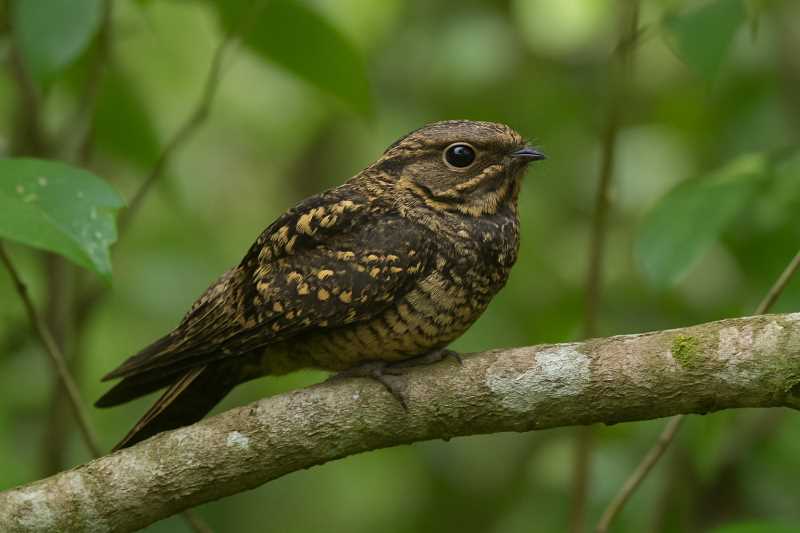
The Sulawesi Nightjar is a medium-sized nightjar with cryptic brown, grey and buff plumage that helps it blend into leaf litter, bare ground, woodland edges and shaded perches. Its long, pointed wings, short bill and wide gape are characteristic of aerial insect-catching nightjars. Available life-history data give an adult body mass of approximately 64 g, although measurements may vary between individuals and sources.
The plumage is heavily patterned rather than brightly coloured, providing camouflage during daylight roosting. Reliable information on sex differences, juvenile plumage and age-related variation is limited, so these features should not be inferred from better-known nightjar species.
Range and Habitat
The Sulawesi Nightjar is a breeding endemic of Sulawesi, Indonesia. Published records also document the species on satellite islands including Buton and Kabaena. Its distribution appears patchy, and parts of the range remain poorly surveyed, particularly for nocturnal birds.
The species has been recorded in lowland woodland, forest edge, open country, agricultural land and secondary vegetation. Surveys on Buton detected it most often by voice in agricultural areas and along forest edges, with some records from forest interior. Records from Kabaena indicate that it can occur from coastal lowlands to upland secondary forest, although the available evidence does not establish a precise upper elevational limit.
The Sulawesi Nightjar is regarded as sedentary rather than migratory. Its apparent use of disturbed and edge habitats does not remove the importance of retaining native forest, especially where agricultural land and secondary vegetation are connected to remaining forest.
Behaviour and Diet
The Sulawesi Nightjar is nocturnal and is most likely to be active from dusk through the night and around dawn. It feeds on flying invertebrates, which it captures during aerial foraging. As with other nightjars, it may remain motionless during daylight, making it easier to detect by its call than by sight.
The species is frequently recorded acoustically. Field surveys in Buton found that vocal detection was more reliable than visual observation, and nocturnal birds are probably under-recorded in areas where surveys concentrate on daytime species.
Breeding information is limited. Life-history compilations report a clutch of two eggs, but detailed information about nest placement, incubation, parental care and the development of young is not well documented for this species. The available evidence does not justify treating the breeding behaviour as fully known.
Identification Tips
- Search at dusk, during the first hours of darkness and before sunrise, particularly along forest tracks, woodland edges, open clearings and agricultural margins.
- Listen carefully for the species’ repetitive night call, as vocal detection is often more successful than searching for a perched bird.
- Look for a medium-sized nightjar with mottled brown-grey plumage, long pointed wings and a broad-headed silhouette in flight.
- Do not rely on plumage alone in Sulawesi. The Sulawesi Nightjar may occur alongside other nocturnal species, including the larger Great Eared Nightjar and the distinct Satanic Nightjar, so call, habitat and range should be considered together.
- Avoid flushing roosting birds unnecessarily. A stationary nightjar can be difficult to see and may be disturbed before it is identified confidently.
Conservation Status
The Sulawesi Nightjar is currently assessed as Least Concern on the IUCN Red List. This category should not be interpreted as evidence that the species has a stable or well-measured population. BirdLife International notes that the species is poorly known, and field studies have described it as infrequently recorded or probably under-recorded.
Habitat clearance, agricultural expansion, logging and the fragmentation of native vegetation are important conservation concerns across Sulawesi and its satellite islands. The species’ use of forest edges and some agricultural habitats may provide local tolerance of habitat modification, but it does not demonstrate that intensive land-use change is harmless.
Important conservation measures include protecting remaining lowland and hill forest, maintaining connected mosaics of native vegetation and secondary growth, and conducting more targeted nocturnal surveys. Better information on distribution, breeding ecology, population trend and responses to habitat change is needed before more precise conservation planning is possible.
Frequently Asked Questions
Where is the Sulawesi Nightjar found?
It is endemic to Sulawesi, Indonesia, and has also been recorded on nearby satellite islands including Buton and Kabaena.
Is the Sulawesi Nightjar migratory?
Available species accounts treat it as sedentary rather than migratory. There is no established evidence that it undertakes regular long-distance migration.
What habitat does the Sulawesi Nightjar use?
It has been recorded in lowland woodland, forest edge, secondary vegetation, open country and agricultural land. Some records also come from forest interior and upland areas.
What does the Sulawesi Nightjar eat?
It is an aerial insectivore that feeds on flying invertebrates captured during nocturnal foraging.
How can the Sulawesi Nightjar be identified?
The most useful clues are its mottled brown-grey camouflage, nightjar shape, nocturnal activity and distinctive call. Listening is often more effective than searching visually.
Is the Sulawesi Nightjar threatened?
The species is currently listed as Least Concern, but its biology and population remain poorly known. Continued forest loss and habitat fragmentation across its restricted island range warrant monitoring and habitat protection.
References
- BirdLife International. 2026. Sulawesi Nightjar Caprimulgus celebensis Species Factsheet. BirdLife DataZone. Available at: https://datazone.birdlife.org/species/factsheet/sulawesi-nightjar-caprimulgus-celebensis. Accessed 8 September 2026.
- Gill, F., Donsker, D. and Rasmussen, P., eds. 2026. IOC World Bird List, version 15.2. International Ornithologists’ Union. Available at: https://www.worldbirdnames.org/. Accessed 8 September 2026.
- Martin, T. E., Kelly, D. J., Keogh, N. T., Heriyadi, D., Singer, H. A. and Blackburn, G. A. 2012. The avifauna of Lambusango Forest Reserve, Buton Island, south-east Sulawesi, with additional sightings from southern Buton. Forktail, 28, 107–112. Available at: https://static1.squarespace.com/static/5c1a9e03f407b482a158da87/t/5c21241440ec9a0a40f49242/1545675796982/Lambusango-FR.pdf.
- Myhrvold, N. P., Baldridge, E., Chan, B., Sivam, D., Freeman, D. L. and Ernest, S. K. M. 2015. An amniote life-history database to perform comparative analyses with birds, mammals, and reptiles. Ecology, 96(11), 3109. https://doi.org/10.1890/15-0846R.1.
- O’Connell, D. P., Sealy, S., Ó Marcaigh, F., Karya, A., Bahrun, A., Analuddin, K., Kelly, D. J. and Marples, N. M. 2017. The avifauna of Kabaena Island, south-east Sulawesi, Indonesia. Forktail, 33, 40–45. Available at: https://www.orientalbirdclub.org/s/Kabaena.pdf.
- Pigot, A. L., Sheard, C., Miller, E. T., Bregman, T. P., Freeman, B. G., Roll, U., Seddon, N., Trisos, C. H., Weeks, B. C. and Tobias, J. A. 2020. Macroevolutionary convergence connects morphological form to ecological function in birds. Nature Ecology & Evolution, 4(2), 230–239. https://doi.org/10.1038/s41559-019-1070-4.
- Oiseaux.net. 2026. Sulawesi Nightjar Caprimulgus celebensis. Oiseaux.net species account, incorporating data from BirdLife, IOC and published trait databases. Available at: https://www.oiseaux.net/en/oiseaux/sulawesi.nightjar.html. Accessed 8 September 2026.
Related posts