Introduction
The Campbell Teal, also known as the Campbell Island Teal, is a small, flightless duck endemic to New Zealand’s Campbell Island group. Its accepted scientific name is Anas nesiotis. Once thought to be extinct on Campbell Island after the arrival of introduced Norway Rats, the species survived on nearby Dent Island and has since been reintroduced to its former home.
Physical Description
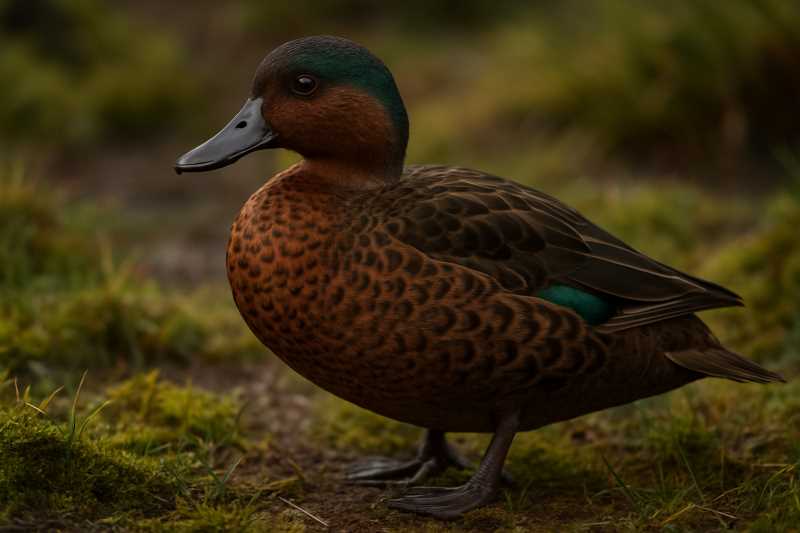
The Campbell Teal is a compact, dark-plumaged duck about 43 centimetres long. Adult males are generally larger than females and have dark sepia plumage, green iridescence on the head and back, a dark chestnut breast, a paler brown abdomen and a noticeable white patch at the base of the tail. Females are more uniformly dark brown, with a paler abdomen.
Both sexes have a conspicuous white eye-ring, dark brown eyes, a dark-grey bill and dark grey-brown legs and feet. The wings are extremely short, with the folded primary feathers reaching only about halfway along the back. This reduced wing structure reflects the species’ flightless lifestyle. Reported average weights are approximately 400 grams for males and 310 grams for females, although measurements from wild birds are limited.
Juveniles are less well documented than adults but are generally duller and browner. As in other ducks, their plumage becomes more distinct as they mature.
Range and Habitat
The Campbell Teal is endemic to the Campbell Island group, a remote subantarctic archipelago about 700 kilometres south of New Zealand’s South Island. The principal wild population occurs on Campbell Island, where birds were reintroduced between 2004 and 2006 after Norway Rats had been eradicated. Small populations have also been recorded on Dent Island, the species’ former refuge, and on predator-free Whenua Hou, also known as Codfish Island, off Stewart Island.
The species is resident rather than migratory. It favours damp terrestrial habitats, including peaty streams, shallow pools, wetland margins, tussock grassland, sedge communities, rocky shorelines and areas containing beach-cast seaweed. Dense vegetation provides cover, and birds are often associated with sheltered gullies and seepages rather than open water.
There is no recognised geographical variation within the species. The Campbell Teal is closely related in appearance to the Auckland Island Teal, but the two species are separated by their island ranges.
Behaviour and Diet
Campbell Teals are secretive, mainly nocturnal and usually encountered singly, in pairs or in small family groups. They are flightless but can run rapidly when alarmed. Pairs are believed to maintain territories throughout the year, and the species is probably monogamous. Male calls include soft trills or piping notes, while females produce rasping or rapid quacking sounds.
The wild diet has not been studied in detail. Available observations indicate that Campbell Teals are probably omnivorous, with a strong preference for invertebrates. They forage among tidal flats, rocks, stream edges, peaty mud and vegetation, and have been observed taking seeds from rushes and grass seedheads.
Breeding takes place during the austral spring and summer. Nests are built at ground level in sedges, grasses or other dense vegetation, often beneath an overhead canopy. Clutches generally contain several pale fawn eggs, and both parents contribute to the care of the young. Captive observations indicate an incubation period of about 30 to 34 days, while ducklings reach adult weight after roughly two months.
Identification Tips
- Look for a very small, dark brown, flightless duck with a prominent white eye-ring.
- The short wings are distinctive, ending approximately halfway along the back when folded.
- Adult males show green iridescence on the head and back, a dark chestnut breast and a white patch at the tail base.
- Females are more uniformly dark brown and lack the male’s strong chestnut breast colour.
- The Brown Teal is larger and flighted, with longer folded wings that extend to the base of the tail.
- The Auckland Island Teal is slightly larger and generally paler, but location is the most reliable way to distinguish it from the Campbell Teal in the field.
- Campbell Teals are most likely to be seen at night, along sheltered shorelines, wetland edges, peaty streams and dense tussock or sedge cover.
Conservation Status
The Campbell Teal is listed as Endangered on the IUCN Red List. It is also classified as nationally increasing in New Zealand, reflecting the success of its reintroduction programme, although the species remains highly vulnerable because its populations are small, isolated and difficult to survey.
Introduced Norway Rats caused the species’ disappearance from Campbell Island, probably during the nineteenth or early twentieth century. The island’s rat-eradication programme was completed in 2001, and Campbell Island was formally declared rat-free in 2006. Captive breeding and transfers to predator-free islands then enabled the species to return to Campbell Island between 2004 and 2006.
Important ongoing conservation measures include monitoring, strict prevention of predator incursions, protection of island habitat, management of disease risks and maintenance of secure populations on predator-free islands. The species also has exceptionally low genetic variation because the captive-bred population descended from a very small number of founders. Any return of rats, cats or other introduced predators could therefore have serious consequences.
Frequently Asked Questions
Where does the Campbell Teal live?
The species is endemic to New Zealand’s Campbell Island group. The main population is on Campbell Island, with smaller populations on Dent Island and on Whenua Hou, or Codfish Island, off Stewart Island.
Is the Campbell Teal flightless?
Yes. Its wings are very short and it cannot fly. It compensates by running quickly and living in dense vegetation, wetland margins and sheltered coastal habitats.
Why did the Campbell Teal nearly become extinct?
Introduced Norway Rats preyed on the teal and its eggs and eliminated the main population from Campbell Island. The species survived on rat-free Dent Island, where it was rediscovered in the twentieth century.
What does the Campbell Teal eat?
Its wild diet is not fully known, but observations indicate that it is probably omnivorous. It feeds on invertebrates, seeds and other plant material while foraging along shorelines, stream edges, wetland margins and peaty ground.
Can Campbell Teals still be seen in the wild?
Yes, but they are difficult to observe. They are secretive and mainly nocturnal, and their remote subantarctic island habitat is not readily accessible. Campbell Island and Whenua Hou support reintroduced populations, while Dent Island remains an important refuge.
What is being done to protect the species?
Conservation work includes predator eradication and prevention, population monitoring, habitat protection and the use of secure island populations. Captive breeding and translocations were especially important in restoring the species to Campbell Island.
References
- BirdLife International. n.d. Campbell Teal Anas nesiotis species factsheet. BirdLife DataZone, BirdLife International. Available at: https://datazone.birdlife.org/species/factsheet/campbell-teal-anas-nesiotis. Accessed 8 September 2026.
- Department of Conservation Te Papa Atawhai. n.d. Subantarctic teal. New Zealand Government. Available at: https://www.doc.govt.nz/nature/native-animals/birds/birds-a-z/subantarctic-teal/. Accessed 8 September 2026.
- Department of Conservation Te Papa Atawhai. n.d. Campbell Island: Places to go in the subantarctic islands, Southland. New Zealand Government. Available at: https://www.doc.govt.nz/parks-and-recreation/places-to-go/southland/places/subantarctic-islands/campbell-island/. Accessed 8 September 2026.
- Gill, F., Donsker, D. and Rasmussen, P. (eds). 2026. IOC World Bird List, version 15.2. International Ornithologists’ Union. Available at: https://www.worldbirdnames.org/. Accessed 8 September 2026.
- Gummer, H. and Williams, M. 1999. Campbell Island teal: conservation update. Wildfowl, 50, pp. 133–138. Available at: https://wildfowl.wwt.org.uk/index.php/wildfowl/article/view/969. Accessed 8 September 2026.
- Miskelly, C. M. (ed.). 2013, updated 2022. Campbell Island teal. New Zealand Birds Online. Available at: https://www.nzbirdsonline.org.nz/species/campbell-island-teal. Accessed 8 September 2026.
- Williams, M. and Robertson, C. J. R. 1996. The Campbell Island Teal: history and review. Wildfowl, 47, pp. 134–166. Available at: https://tidsskrift.dk/Wildfowl/article/view/154643. Accessed 8 September 2026.
Related posts