Introduction
The Spotted Wood Quail (Odontophorus guttatus) is a secretive, ground-dwelling member of the New World quail family, Odontophoridae. It is a resident bird of humid forests from southern Mexico through Central America to western Panama. Most sightings involve a bird running through dense vegetation or a small group calling from the forest floor rather than flying in the open.
Physical Description
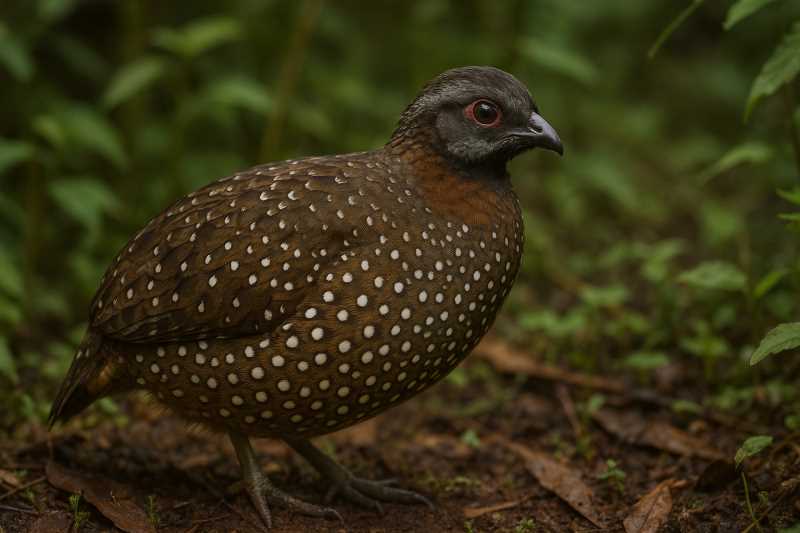
The Spotted Wood Quail is approximately 25–30 cm long and weighs about 300 g. It has a compact, rounded body, short strong legs and rounded wings suited to brief, powerful flights rather than sustained travel.
Adults are predominantly dark brown, olive-brown and rufous above, with contrasting white spots on the breast and lower parts. The throat is dark, often appearing blackish with narrow pale streaks, and the bird has a distinctive orange or rufous crest that can be raised when it is alert or excited. Some individuals show more rufous colouring on the underparts than others.
The sexes are broadly similar. Males are reported to average slightly larger, while females may have a duller crest. Juveniles are less strongly marked, with smaller, more buff-toned spots and a less distinctly dark throat.
Range and Habitat
The Spotted Wood Quail occurs from south-eastern Mexico through Guatemala, Belize, Honduras, El Salvador, Nicaragua and Costa Rica to western Panama. It is non-migratory and remains within forested areas throughout the year.
It is associated mainly with humid tropical and subtropical forest, including lowland and foothill forest, montane forest, cloud forest, forest borders and some secondary growth. Dense understorey, vines, bamboo and thick leaf litter provide cover and foraging habitat. The species is most often found in the forest interior, although it may use suitable edges and regenerating vegetation. Reported elevations vary across its range, from lower foothills to highland forest approaching the timberline.
Its distribution is uneven because suitable forest is increasingly fragmented by agriculture, logging, roads and other land-use changes. It can remain locally common where extensive, well-preserved forest persists.
Behaviour and Diet
Spotted Wood Quails are shy and wary. They usually travel on foot through dense undergrowth and often escape by running rather than flying. If closely approached, they may burst into a short, fast flight before dropping back into cover.
They are generally encountered in pairs or small family groups, although larger groups have also been reported. Their calls include clear whistles, contact notes and coordinated vocalisations. Calling may be the best way to detect them, particularly in thick forest where visual encounters are difficult.
Foraging takes place mainly on the ground. The birds scratch through leaf litter and loose soil for seeds, fallen fruit and small invertebrates. This diet is opportunistic and may vary with local food availability. Although the species may help move seeds while feeding on fruit, its wider ecological role is not well quantified.
Information about breeding remains limited. The species is considered a resident breeder, and reports indicate that nesting may occur during the wetter part of the year in some regions. The nest is a concealed ground site, but detailed descriptions of nest structure, incubation and parental care are scarce. Young wood quails are expected to be mobile soon after hatching, as in other members of the group, but species-specific evidence for the Spotted Wood Quail is limited.
Identification Tips
- Look for a dark, compact quail moving quietly through dense forest undergrowth rather than flying in the open.
- The combination of a raised orange or rufous crest, dark throat and white spotting on the breast is distinctive.
- The back is generally dark brown, olive-brown or rufous-brown, while the underparts may show a variable olive or richer rufous tone.
- Listen for clear whistled calls from the forest floor. Several birds may call close together even when none can be seen.
- Distinguish it from the much smaller Singing Quail, which may occur in some of the same areas. The Spotted Wood Quail is larger, darker, more heavily spotted and more strongly associated with dense humid forest interior.
Conservation Status
The Spotted Wood Quail is currently assessed as Least Concern on the IUCN Red List. This global category does not mean that every population is secure. Deforestation, forest fragmentation, agricultural expansion, logging and the loss of dense understorey can reduce local habitat and make populations more isolated.
Important conservation measures include protecting remaining humid and montane forests, maintaining habitat connections between forest blocks, retaining dense understorey and monitoring populations in areas undergoing rapid land-use change. Protected areas across the species’ range provide important refuges, but continued habitat protection is necessary, particularly in regions where forest clearance is extensive.
Frequently Asked Questions
Where does the Spotted Wood Quail live?
It occurs in humid forests from southern Mexico through Central America to western Panama. It uses lowland, foothill and montane forest, including cloud forest and some suitable secondary growth.
Is the Spotted Wood Quail migratory?
No. It is regarded as a resident species and does not undertake regular long-distance migration.
What does the Spotted Wood Quail eat?
It feeds mainly on seeds, fallen fruit and small invertebrates found on the forest floor. It searches for food by scratching through leaf litter and loose soil.
How can the Spotted Wood Quail be identified?
Key features include a compact dark body, white spotting on the breast, a dark throat and an orange or rufous crest. It is usually detected running through dense vegetation or calling from cover.
Does the Spotted Wood Quail fly?
Yes, but it generally prefers to run. When startled or closely approached, it may make a short, rapid flight into nearby cover.
Is the Spotted Wood Quail threatened?
The species is globally listed as Least Concern, but habitat loss and fragmentation remain important local threats. Conserving large, connected areas of humid forest is the principal conservation priority.
References
- BirdLife International. 2026. Spotted Wood Quail Odontophorus guttatus: Species factsheet. BirdLife DataZone and IUCN Red List for birds. Available at: https://datazone.birdlife.org/species/factsheet/spotted-wood-quail-odontophorus-guttatus. Accessed 8 September 2026.
- International Union for Conservation of Nature. 2026. The IUCN Red List of Threatened Species. Version 2026-1. IUCN, Gland, Switzerland and Cambridge, United Kingdom. Available at: https://www.iucnredlist.org. Accessed 8 September 2026.
- International Ornithologists’ Union. 2025. AviList: A unified global bird checklist, version 2025. International Ornithologists’ Union. Available at: https://www.worldbirdnames.org/new/ioc-lists/master-list-2/. Accessed 8 September 2026.
- Secretaría de Medio Ambiente y Recursos Naturales. 2009. Plan de Manejo Tipo para la Codorniz Bolonchaco (Odontophorus guttatus). Gobierno de México. Available at: https://biblioteca.semarnat.gob.mx/janium/Documentos/Ciga/libros2009/CD001372.pdf. Accessed 8 September 2026.
- U.S. Fish and Wildlife Service. n.d. Spotted Wood Quail, Odontophorus guttatus. U.S. Department of the Interior. Available at: https://www.fws.gov/species/spotted-wood-quail-odontophorus-guttatus. Accessed 8 September 2026.
- Cornell Lab of Ornithology. n.d. Spotted Wood Quail, Odontophorus guttatus. eBird species account. Available at: https://ebird.org/species/spwqua1. Accessed 8 September 2026.
- Stiles, F. G. and Skutch, A. F. 1989. A Guide to the Birds of Costa Rica. Cornell University Press, Ithaca, New York.
Related posts