Introduction
The Speckled Chachalaca, Ortalis guttata, is a resident member of the Cracidae family, which also includes guans and curassows. It occurs mainly in the western Amazon Basin and adjacent Andean foothills, where it is commonly associated with forest edges, riverine vegetation and secondary growth. The species is often detected by its loud, raucous calls before it is seen. (ww.worldbirdnames.org)
Physical Description
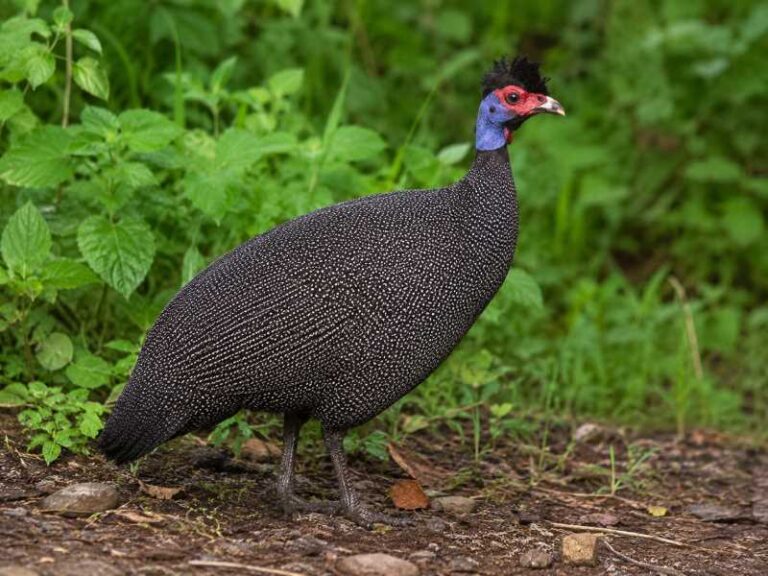
The Speckled Chachalaca is a medium-sized, chicken-like bird measuring approximately 49–60 cm in length and weighing about 500–600 g. Its plumage is mainly brown or reddish-brown, with noticeable pale speckling or scaling on the neck and upper breast. The long tail has contrasting rufous tones on the outer feathers, while the legs are pinkish or reddish and the bill is pale grey to greyish. (leyendas.gob.pe)
The sexes are broadly similar in appearance, and no prominent sexual dimorphism is generally used for field identification. The head and face lack the conspicuous bare facial skin seen in some related cracids, although a reduced reddish throat wattle or dewlap may be visible. Juveniles are less well documented than adults, so age-related plumage differences should be treated cautiously. (ebird.org)
Range and Habitat
The species is distributed in a discontinuous range across eastern Colombia, eastern Ecuador, eastern Peru, northern Bolivia and parts of western and central Brazil. Some taxonomic treatments also include geographically isolated Brazilian forms within O. guttata, while other authorities recognise certain populations as separate species. The Speckled Chachalaca is resident rather than migratory. (bioweb.bio)
It favours forest edges, river margins, clearings with shrubs and scattered trees, palm-dominated vegetation, and secondary forest. It is also recorded in agricultural landscapes adjoining woodland. The species is generally associated with lowlands and foothills, with records reaching approximately 1,700 m in parts of its range, although local elevational limits vary. (leyendas.gob.pe)
Behaviour and Diet
Speckled Chachalacas are social birds that usually occur in pairs or family groups and may form small, noisy flocks. Their loud calls are particularly conspicuous around dawn and dusk, when the calls of several birds may develop into a communal chorus. They forage both in trees and on the ground, moving through different vegetation layers in search of food. (ebird.org)
The diet is principally plant-based and includes fruits, berries, flowers and other soft plant material. As with other cracids, the species is likely to contribute to seed dispersal, although the extent of this ecological role varies with the plants and habitats available locally. Occasional records of animal material should not be taken to mean that insects or other invertebrates form a major part of the diet. (leyendas.gob.pe)
Breeding information remains limited. Documented nests have been placed in vegetation above the ground, including tangled vines and shrubs, and records include clutches of two to four eggs. In the Peruvian Amazon, nests and family groups with young have been recorded mainly during the wetter part of the year, but breeding timing may differ between regions. (scielo.br)
Identification Tips
Look for a medium-sized, long-tailed cracid with:
- Brown or reddish-brown overall plumage.
- Pale speckling or scaling concentrated on the neck and upper breast.
- Pinkish or reddish legs.
- Rufous markings on the outer tail feathers.
- A small or inconspicuous reddish throat wattle rather than a large facial patch.
- Loud, repeated chachalaca calls, often heard before the birds are located.
In suitable Amazonian habitat, the combination of a relatively small, brown chachalaca, a spotted neck and breast, and a preference for forest edges helps separate it from larger guans. Identification can be complicated where related Ortalis species or taxonomically disputed populations occur, so range, vocalisations and local field guides should be considered together. (ebird.org)
Conservation Status
The Speckled Chachalaca is currently assessed as Least Concern on the IUCN Red List. It has a broad distribution and can use secondary growth and forest-edge habitats, but this status does not mean that all populations are secure. Localised threats include deforestation, conversion of woodland to agriculture, habitat fragmentation and hunting for food. Hunting pressure can be greater near settlements and waterways, even where regional populations remain widespread. (datazone.birdlife.org)
Reliable population estimates and a current global population trend are not available in the sources consulted. Conservation priorities include retaining connected forest, protecting riverine and secondary habitats, monitoring isolated populations, and managing hunting where local evidence indicates unsustainable pressure. (datazone.birdlife.org)
Frequently Asked Questions
Where does the Speckled Chachalaca live?
It occurs mainly in eastern Colombia, eastern Ecuador, eastern Peru, northern Bolivia and western or central Brazil, particularly in Amazonian lowlands and nearby foothills. (bioweb.bio)
Is the Speckled Chachalaca migratory?
No. It is considered a resident species, although individuals may make local movements in response to food availability or habitat conditions. (datazone.birdlife.org)
What does the Speckled Chachalaca eat?
Its diet is mainly plant-based, especially fruits, berries, flowers and other soft vegetation. It may occasionally take animal material, but it is not primarily an insect-eating bird. (leyendas.gob.pe)
How can the species be identified in the field?
Look for a brown, long-tailed bird with pale speckling on the neck and upper breast, reddish legs and a loud, raucous call. It is often easier to hear than to see. (ebird.org)
Where does it build its nest?
Available breeding records describe nests placed above the ground in shrubs, vines or other dense vegetation. Reported clutches contain about two to four eggs, although the species’ breeding biology is not fully documented. (scielo.br)
Is the Speckled Chachalaca endangered?
It is not currently considered globally endangered. The IUCN Red List classifies it as Least Concern, but habitat loss, fragmentation and local hunting can still affect particular populations. (datazone.birdlife.org)
References
- BirdLife International. 2019. Ortalis guttata. The IUCN Red List of Threatened Species 2019: e.T155238855A156078461. BirdLife International and IUCN. Available at: https://datazone.birdlife.org/species/factsheet/speckled-chachalaca-ortalis-guttata (accessed 8 September 2026).
- Gill, F., Donsker, D. and Rasmussen, P. (eds). 2026. IOC World Bird List, version 15.2. International Ornithologists’ Union. Available at: https://www.worldbirdnames.org/ (accessed 8 September 2026).
- Begazo, A. J. and Bodmer, R. E. 1998. Use and conservation of Cracidae (Aves: Galliformes) in the Peruvian Amazon. Oryx, 32(4), 301–309. https://doi.org/10.1046/j.1365-3008.1998.d01-60.x
- Universidad EAFIT. n.d. Guacharaca moteada, Ortalis guttata. Universidad Parque. Available at: https://www.eafit.edu.co/universidad-parque/inventario-biotico/garcita-moteada (accessed 8 September 2026).
- Museo de Zoología, Pontificia Universidad Católica del Ecuador. n.d. Ortalis guttata. Aves del Ecuador. Available at: https://bioweb.bio/faunaweb/avesweb/FichaEspecie/Ortalis%20guttata (accessed 8 September 2026).
- eBird. n.d. Speckled Chachalaca, Ortalis guttata. Cornell Lab of Ornithology. Available at: https://ebird.org/species/specha3/PE-PAS (accessed 8 September 2026).
- Parque de las Leyendas. n.d. Chachalaca, Ortalis guttata. Municipalidad Metropolitana de Lima. Available at: https://leyendas.gob.pe/zoologia/chachalaca/ (accessed 8 September 2026).
- Silveira, L. F., et al. 2017. Ortalis remota: a forgotten and critically endangered species of chachalaca (Galliformes: Cracidae) from eastern Brazil. Revista Brasileira de Ornitologia, 25. Available at: https://piacentinilab.com/publication/silveiraal2017/Silveira%26al2017.pdf (accessed 8 September 2026).
Related posts