Introduction
The South Moluccan Pitta, Erythropitta rubrinucha, is a compact, vividly coloured forest bird endemic to Indonesia’s southern Moluccan islands. It occurs principally on Buru and Seram, where it inhabits humid forest and dense undergrowth. Like many pittas, it is more often heard than seen, moving quietly across the forest floor before making a short, powerful flight into cover.
This species was formerly treated as part of the Red-bellied Pitta complex. Modern taxonomic treatments recognise it as a separate species, with two commonly recognised subspecies: E. r. rubrinucha on Buru and E. r. piroensis on Seram. The separation reflects differences in plumage and the distinctive island history of the Moluccan pittas. The South Moluccan Pitta is also known in older literature and birding reports as the Buru Pitta or Seram Pitta, depending on the island form.
Its brilliant blue, green, red and black plumage can look spectacular in good light, but the bird’s forest-floor habits make it a demanding target. Careful listening, patient observation along quiet forest trails and attention to damp, shaded habitat are usually more productive than scanning the canopy.
Physical Description
The South Moluccan Pitta is a small, short-tailed passerine measuring approximately 16–18 centimetres in length. A published Indonesian species guide gives a typical mass of about 55 grams. As with many forest pittas, it has a compact body, strong legs, a relatively short tail and a stout bill suited to taking invertebrate prey from leaf litter and soft soil.
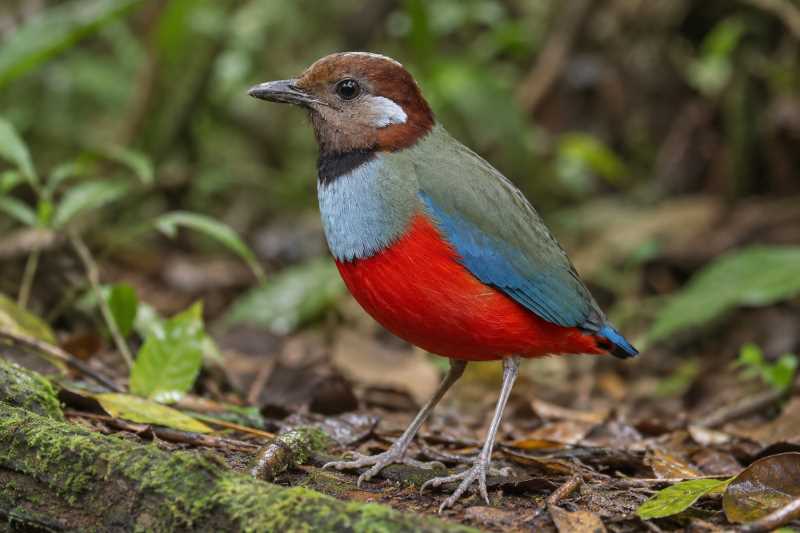
The head is predominantly dark brown to reddish brown. A narrow blue line runs along the central crown, while a conspicuous red patch is present on the nape. Blue or blue-green colouration extends around the rear of the ear-coverts and behind the eye, although the amount and intensity visible can vary with light, posture and the individual bird’s subspecific form.
The upperparts are mainly olive-green. The wings are darker, with deep blue tones in the coverts and darker flight feathers. The rump and tail show blue colouration, giving the bird a particularly striking appearance when it takes flight or flicks its tail in the undergrowth. Small pale or whitish markings may be visible on some wing feathers, but these are not always obvious in the field.
The underparts provide the strongest visual contrast. The throat and upper breast are dark, often appearing blackish or deep brown. Across the breast is a broad, glossy blue band, sometimes bordered below by a narrow dark band. The belly, flanks and lower underparts are vivid scarlet or red. The bill is black, and the legs are generally dark.
Sexual dimorphism appears to be present but is not as pronounced as in some other pittas. Females are generally described as duller, with less intense blue and greener tones in the plumage. Field conditions can make sex determination uncertain, especially when the bird is seen briefly or in shadow.
Juveniles are less colourful than adults. Young birds are mainly dull brown above, with subdued blue on the rump and tail and less sharply defined colour boundaries on the underparts. The brilliant blue breast band and saturated red belly develop with age. A juvenile moving through leaf litter may therefore be mistaken for a different, more uniformly brown forest bird unless its shape, behaviour and flashes of colour are noticed.
The Seram form, E. r. piroensis, has been described as having a larger red nape patch and somewhat darker green upperparts than the Buru form. Such differences should be treated as geographic variation rather than as reliable field marks for every individual. Taxonomic treatments have changed over time, and older accounts may use different combinations of names for the same island populations.
Range and Habitat
The South Moluccan Pitta is endemic to Indonesia. Its confirmed range is centred on Buru and Seram in the southern Moluccas, also known as Maluku. Buru lies west of Seram, and both islands support distinctive bird communities shaped by long geographic isolation.
The nominate subspecies, E. r. rubrinucha, occurs on Buru. The Seram population is generally assigned to E. r. piroensis. Older sources sometimes treated these forms as separate species, particularly as Buru Pitta and Seram Pitta, while other classifications included them within a broader Red-bellied Pitta complex. Current major taxonomic treatments recognise the South Moluccan Pitta as Erythropitta rubrinucha.
The species is primarily associated with humid evergreen forest, including lowland and lower montane forest. It uses areas with dense undergrowth, deep leaf litter, fallen branches and relatively moist ground. Such conditions provide both cover and feeding opportunities. It may also occur in secondary forest and disturbed wooded habitat where vegetation remains sufficiently dense, although heavily cleared land and open agricultural areas are unlikely to provide suitable habitat.
Records from Buru show that the bird can occur along forest roads and tracks, including upland roads through wooded terrain. On Seram, the species has been recorded in forest along the Trans-Seram Highway at approximately 1,350 metres. These observations suggest that the pitta uses a broader elevational range than a strictly lowland species, although the available evidence is not sufficient to define precise upper and lower limits for the whole population.
The bird is considered resident rather than migratory. There is no established evidence that it undertakes long-distance seasonal migration between islands or to other countries. Local movements may occur in response to food availability, breeding activity, rainfall or disturbance, but these movements are poorly documented.
The distribution is naturally fragmented because it is confined to islands and suitable forest habitat within them. Buru and Seram are large islands, but their forests are not uniform. Logging, small-scale agriculture, roads and other land-use changes can divide suitable habitat into smaller blocks. The persistence of the species therefore depends not only on the total area of forest remaining, but also on the quality and continuity of forest-floor habitat.
Where to See This Species
The South Moluccan Pitta is a difficult species to see and travel in the southern Moluccas can be logistically demanding. Local guides, permission from landowners or park authorities, suitable vehicles and flexible plans are important. The venues below are included because the species has been specifically documented there, rather than simply because they lie within the bird’s broad island range.
Manusela National Park and the Trans-Seram Highway, Seram, Maluku, Indonesia
Manusela National Park protects a large tract of Seram’s lowland, hill and montane forest. A documented birding expedition recorded the Seram form of the South Moluccan Pitta in mossy forest along the Trans-Seram Highway at about 1,350 metres. This makes the highway’s forested upper sections one of the clearest publicly accessible places to try for the species on Seram.
The most suitable approach is to search quietly along forested road sections and nearby trails, particularly where damp leaf litter, dense understorey and shaded ground occur. Early morning is generally the most practical period for listening and watching, although the species may remain difficult throughout the day. Rain and mist can reduce visibility but may also maintain the moist forest conditions favoured by ground-foraging pittas.
Nearby accommodation: Sawai and other north-coast gateway settlements offer simple guest houses and locally arranged accommodation, while Masohi provides a wider selection of hotels and guest houses for visitors using the southern approach.
Wamlana Logging Road, Buru, Maluku, Indonesia
The Wamlana Logging Road on Buru is a documented location for the nominate form, E. r. rubrinucha. A birding expedition reported excellent views there, and the road provides access through forested terrain that is otherwise difficult to reach. Although it is not a formal national park or wildlife sanctuary, it is a recognised field venue for observing Buru’s forest birds.
The species should be sought in quiet, shaded stretches with intact undergrowth rather than in broad clearings or heavily degraded roadside vegetation. Forest roads can be useful because they provide access and allow observers to pause and listen, but conditions, permissions and road access may change. Visitors should use local guides and avoid disturbing birds or entering restricted logging areas.
Nearby accommodation: Waspait is the nearest practical accommodation area mentioned in birding accounts, with simple guest houses and locally arranged lodging. Namlea is the principal town and offers a broader range of basic hotels and guest houses, although travel to forest sites can be lengthy.
Behaviour and Diet
The South Moluccan Pitta is primarily terrestrial and diurnal. It spends much of its time on or close to the ground, moving through leaf litter and low vegetation rather than perching conspicuously in the canopy. Its short tail, strong legs and compact body are typical of pittas that forage in dense forest-floor habitat.
It is usually secretive. A bird may remain motionless beneath vegetation, move away through cover or make a short burst of flight when approached. The sudden appearance of a blue rump, red belly or blue breast band may be the only visual contact. Birds often favour shaded places where the colours are difficult to see, so an observer may hear the species repeatedly without obtaining a clear view.
The diet is believed to consist mainly of invertebrates and other small items collected from the ground. Likely prey includes insects, insect larvae and earthworms. Some accounts also mention other small invertebrates and limited plant material. The bird probably probes or turns leaf litter with its bill and picks prey from the soil surface, but detailed studies of its feeding behaviour are limited.
There is little evidence of regular flocking. The species is generally encountered singly or in pairs, especially outside periods of breeding activity. It may occasionally occur near mixed-species forest activity, but it should not be expected to behave like a canopy-feeding flock bird.
Breeding information is scarce. A domed nest recorded on Buru was constructed from twigs, leaves, grasses and ferns. Reported nest sites included positions on or near the ground, in low scrub and in low vegetation, with some nests placed several metres above the ground. A clutch of two eggs has been reported, and a nest with eggs was recorded in November. These observations indicate flexibility in nest placement, but they are too limited to define the species’ full breeding season or nesting range.
The domed structure is consistent with the nest architecture of several pittas, which often build enclosed or partially enclosed nests in dense vegetation. More information is needed on incubation, parental care, fledging success, territorial behaviour and the effects of rainfall on breeding.
Identification Tips
When searching for the South Moluccan Pitta, listen and watch at the same time. The species may reveal itself first through a call from dense forest-floor vegetation, followed by a short movement across a path or a flash of blue and red.
Key field marks include:
- A compact, short-tailed shape and strongly terrestrial behaviour.
- Dark brown to reddish-brown head with a narrow blue crown stripe.
- Red patch on the nape.
- Blue colour around the rear of the ear-coverts and behind the eye.
- Olive-green back and darker wings.
- Blue rump and tail.
- Dark throat and upper breast with a broad blue breast band.
- Bright scarlet lower underparts.
- Black bill and generally dark legs.
The combination of a blue breast band, red belly, olive-green back and red nape is particularly useful. In poor light, however, the bird may appear mostly brown and black. A glimpse of the blue rump or red belly as it crosses a trail can be more diagnostic than a distant stationary view.
The North Moluccan Pitta, Erythropitta rufiventris, is a relevant comparison because it is also a colourful Moluccan pitta with a blue breast band and red underparts. Its range is farther north, and it should not normally be expected on Buru or Seram. Geographic location is therefore an important part of identification. Other Erythropitta pittas from neighbouring islands can also resemble it in general shape and colour pattern, but they do not share the same combination of range, red nape patch and southern Moluccan distribution.
The South Moluccan Pitta should not be confused with a kingfisher merely because of its blue and red plumage. Unlike kingfishers, it is usually seen walking or hopping on the forest floor, has a short pitta-like tail and does not habitually sit in exposed perches beside water.
Conservation Status
The South Moluccan Pitta is currently assessed as Least Concern under the IUCN Red List framework. That classification does not mean the species is unaffected by habitat loss or that its populations are well monitored. Reliable population estimates are not available, and the direction and rate of any population change are poorly documented.
The main conservation concern is the loss and degradation of humid forest on Buru and Seram. Logging, agricultural expansion, road construction and the gradual conversion of forest can reduce the dense ground cover and leaf-litter habitat on which the species depends. Even where forest remains, repeated disturbance may simplify the understorey and make habitat less suitable.
The species occurs in Manusela National Park on Seram, giving at least part of its range formal protection. It is also included in Indonesia’s national protected-fauna listings. Protection on paper is most effective when supported by forest management, enforcement, ecological monitoring and cooperation with communities living around forest boundaries.
Conservation priorities include maintaining large areas of evergreen forest, retaining connected blocks of understorey habitat, limiting uncontrolled logging and improving knowledge of the species’ distribution on both islands. Surveys should record not only visual sightings but also reliable sound records, since the pitta’s secretive habits make conventional observation difficult.
The species’ restricted island range also makes careful taxonomic treatment important. If geographically distinct populations were later shown to represent more than one conservation unit, the status of each island population could require separate evaluation. At present, the safest approach is to recognise the species as a single South Moluccan Pitta while treating the Buru and Seram forms as important geographic populations.
Frequently Asked Questions
Where does the South Moluccan Pitta live?
The species is endemic to Indonesia and occurs mainly on Buru and Seram in the southern Moluccas. It inhabits humid evergreen forest, including lowland, hill and lower montane forest with dense undergrowth and leaf litter.
What does the South Moluccan Pitta look like?
It is a 16–18 centimetre pitta with an olive-green back, blue rump and tail, a reddish-brown head, red nape patch, blue breast band and bright red lower underparts. The bill is black and the throat is dark.
Is the South Moluccan Pitta rare?
Its global conservation assessment is Least Concern, but it is localised because it is restricted to two Indonesian islands. It is secretive and difficult to detect, so a lack of sightings does not necessarily indicate that it is absent from suitable forest.
Is the South Moluccan Pitta migratory?
It is considered resident. There is no established evidence of long-distance migration, although local movements may occur within islands in response to food, breeding conditions or habitat changes.
What does the South Moluccan Pitta eat?
It feeds mainly on ground-dwelling invertebrates such as insects, larvae and earthworms. It may also take small amounts of plant material. Foraging usually takes place in leaf litter and low vegetation.
Where is the best place to see this pitta?
On Seram, the forested Trans-Seram Highway through or near Manusela National Park has documented records of the Seram form. On Buru, the Wamlana Logging Road is a documented site for the nominate form. Both locations require careful planning and local guidance.
References
- BirdLife International
- IOC World Bird List
- Direktorat Jenderal Konservasi Sumber Daya Alam dan Ekosistem, Indonesia
Related posts