Introduction
The Smooth-billed Ani (Crotophaga ani) is a glossy black member of the cuckoo family, Cuculidae. It is recognised for its large, arched bill, long tail and strongly social behaviour. The species is resident across much of the Caribbean, Central America and South America, with a small, localised population in southern Florida.
Physical Description
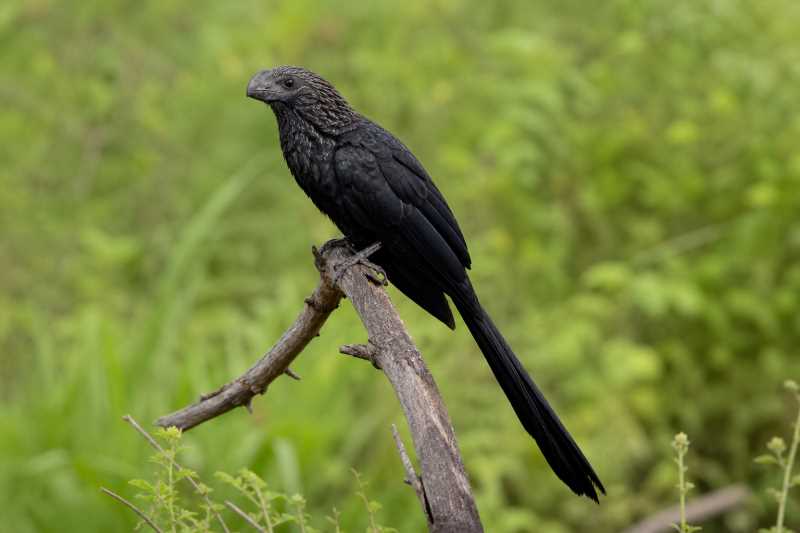
The Smooth-billed Ani is a medium-sized bird measuring approximately 30 to 36 centimetres in length and weighing about 70 to 119 grams. It has an elongated body, short rounded wings and a long, often slightly rounded or wedge-shaped tail.
Adults are black overall, with bronzy, greenish or violet iridescence visible on the upperparts and wings in good light. The bill is large, laterally compressed and strongly arched, with a raised ridge near the base of the upper mandible. Unlike the related Groove-billed Ani, it lacks grooves along the bill.
Males and females are broadly similar in appearance, although males may be slightly larger. Young birds are duller and more brownish-black, with less glossy plumage and a shallower bill.
Range and Habitat
The Smooth-billed Ani is a resident breeding species of southern Florida, the Caribbean, parts of Central America and much of South America. Its South American range extends southwards through countries including Brazil, Bolivia, Paraguay and northern Argentina. It is not considered a long-distance migrant, although individuals may move locally or seasonally in response to rainfall, food availability and habitat conditions.
It favours warm lowland habitats with dense, low vegetation close to open ground. Typical habitats include brushy field margins, pastures, savannas, open wetlands, agricultural land, scrub, roadside vegetation and lightly developed suburban areas. In Florida, it is especially associated with dense thickets beside fields, marshes and pastureland.
The species often benefits from a partly open landscape, but it still requires bushes or small trees for cover, roosting and nesting. It is generally uncommon in extensive, closed-canopy forest.
Where to See This Species
Everglades National Park, Florida, United States
The Smooth-billed Ani is documented in Everglades National Park, where it occurs in brushy thickets, open fields, pasture-like areas and wetland margins. The park’s Eco Pond and other areas around Flamingo have recorded the species. Look for small groups moving through dense vegetation or gliding between thickets, especially where open ground borders cover.
Nearby accommodation: Homestead and Florida City provide the most practical bases, with hotels, guest houses, self-catering accommodation and camping options. Camping is also available in designated areas within the park.
Virgin Islands National Park, Saint John, United States Virgin Islands
The Smooth-billed Ani is a resident bird of the Virgin Islands and has been recorded in Virgin Islands National Park, including around Cinnamon Bay and its forest-edge, campground and trail habitats. It is often detected by its loud calls and may be seen in groups moving between scrub, woodland edges and open areas.
Nearby accommodation: Cruz Bay is the main gateway settlement, with hotels, guest houses, villas and self-catering accommodation. Designated camping is available at Cinnamon Bay by reservation.
Cabo Rojo National Wildlife Refuge, Puerto Rico, United States
The species has been studied and observed year-round at Cabo Rojo National Wildlife Refuge in south-western Puerto Rico. The refuge combines dry forest, pasture, scrub, mangroves and salt-flat habitats, providing the mixture of cover and open ground favoured by Smooth-billed Anis. The wet season, when invertebrate prey is more abundant, is particularly relevant to breeding activity.
Nearby accommodation: Cabo Rojo and the nearby coastal settlement of Boquerón offer hotels, guest houses, self-catering accommodation and other visitor facilities.
Behaviour and Diet
Smooth-billed Anis are highly social and are commonly seen in groups. They may perch close together, preen one another, call frequently and travel between feeding areas in loose flocks. They often hop or climb through low vegetation rather than moving through the high canopy.
The species feeds mainly on insects and other invertebrates, including grasshoppers, crickets, beetles and caterpillars. It also takes small lizards, frogs, snails and other small vertebrates, as well as berries, fruits and seeds. Anis may follow cattle or forage near them, taking insects disturbed by grazing animals. They can also take advantage of prey flushed by army ants.
Breeding is cooperative. Several adults may help construct a bulky communal nest, and more than one female may lay in the same nest. Group members share incubation, nest defence and feeding of the young. Breeding activity varies geographically and is often linked to the wet season, when invertebrate food is most plentiful.
The species has a varied vocal repertoire, including harsh, whining or drawling calls. Vocalisations help maintain contact between group members and may alert the flock to danger. Tail movements, wing displays and close physical contact also contribute to social communication.
Identification Tips
- Look for a completely black, long-tailed bird with a slightly loose or hunched posture.
- The large, smooth, arched bill is the most useful diagnostic feature.
- The plumage may show green, bronze or violet gloss in bright light.
- Smooth-billed Anis often occur in groups and may hop through bushes, follow cattle or glide between thickets.
- The call is a useful clue, especially in dense vegetation. It is commonly described as a harsh, whining or rising sound.
- The similar Groove-billed Ani has distinct grooves on the bill. The Smooth-billed Ani has a smooth bill with a prominent raised ridge instead.
Conservation Status
The Smooth-billed Ani is currently classified as Least Concern on the IUCN Red List. It remains widespread and common across much of its range, and it tolerates many human-modified habitats, including farmland, pasture and lightly developed areas.
Local populations can nevertheless be affected by the removal of dense field-edge vegetation, intensive agricultural practices, urban development and habitat degradation. The species has also experienced local concern and apparent declines in parts of southern Florida. Maintaining brushy margins, pasture mosaics, wetland edges and other semi-open habitats can help support local populations.
Frequently Asked Questions
Where can the Smooth-billed Ani be found?
The species occurs from southern Florida and the Caribbean through parts of Central America and across much of South America. It is most widespread in warm lowland regions.
What does the Smooth-billed Ani look like?
It is an entirely black, medium-sized bird with a long tail, short rounded wings and a large, smooth, arched bill. Glossy green, bronze or violet highlights may be visible on the plumage.
Is the Smooth-billed Ani a cuckoo?
Yes. It belongs to the cuckoo family, Cuculidae, although its behaviour and appearance differ from many familiar cuckoo species.
What does the Smooth-billed Ani eat?
Its diet consists mainly of insects and other invertebrates. It also eats small lizards, frogs, snails, berries, fruits and seeds, and may forage around cattle for disturbed insects.
Do Smooth-billed Anis breed cooperatively?
Yes. Several adults may help build and defend a communal nest, while multiple females may lay eggs in the same nest. Group members can share incubation and care of the young.
How can the Smooth-billed Ani be distinguished from the Groove-billed Ani?
The Smooth-billed Ani has a large, smooth bill with a raised ridge, while the Groove-billed Ani has visible grooves along its bill. Both species are black and long-tailed, so the bill is the most reliable distinguishing feature.
References
- BirdLife International
- IOC World Bird List
- Cornell Lab of Ornithology
Related posts