Introduction
The Scaly Spurfowl (Pternistis squamatus) is a ground-dwelling galliform in the family Phasianidae. It is a resident of forest margins, thickets, clearings and other areas with dense cover across parts of equatorial and eastern Africa. The species is also known as the Scaly Francolin in some field guides and taxonomic databases. Eastern populations have received different taxonomic treatments, so distribution details can vary between authorities. This article follows the species concept and English name used by the IOC World Bird List.
Physical Description
The Scaly Spurfowl is a compact, medium-sized spurfowl measuring approximately 32–33 cm in length. Recorded body mass is about 372–565 g, although measurements vary between regions and sexes.
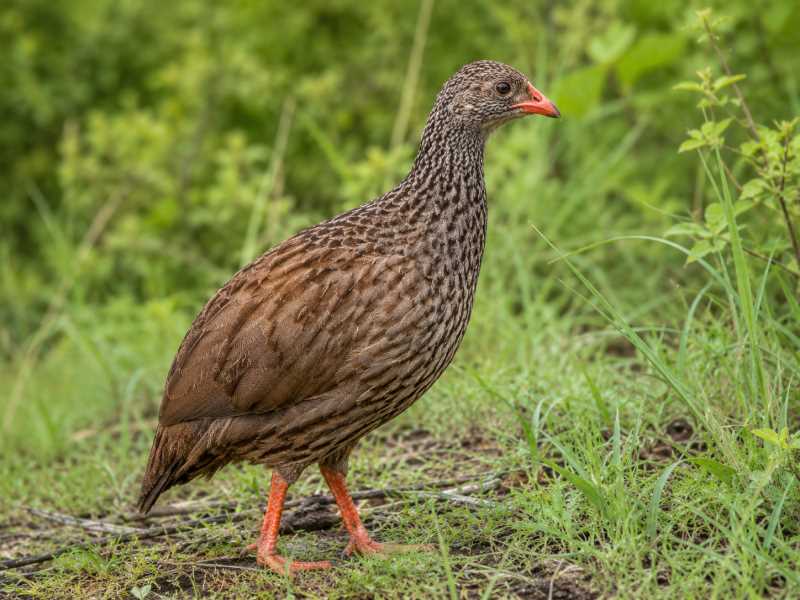
Its plumage is predominantly brown, grey-brown and buff, with fine dark vermiculations and a scaly pattern across the underparts. The head and face are comparatively plain, while the whitish throat contrasts with the darker, patterned breast and belly. The bill is red, and the legs and feet are orange-red.
The sexes are broadly similar in appearance. Males generally possess one or two spurs on the tarsi, whereas females usually lack these prominent spurs. Females may also show more extensive vermiculation than males. Juveniles are less clearly patterned and tend to have duller, more subdued plumage.
Range and Habitat
The Scaly Spurfowl has a broad but discontinuous distribution in sub-Saharan Africa. Its range extends from south-eastern Nigeria eastwards through Cameroon, Gabon, the Republic of the Congo and the Democratic Republic of the Congo, with populations reaching Uganda, Kenya, Tanzania, Ethiopia and northern Malawi under the species concept followed by several major checklists.
It is associated mainly with humid evergreen and montane forests, forest edges, secondary growth, riverine vegetation, plantations with dense understorey, thickets and cultivated areas adjoining natural cover. It generally avoids open, exposed ground and depends on vegetation that provides both food and concealment. The species occurs from lowland habitats to high elevations, reaching about 3,000 m in parts of the Uganda–Kenya highlands.
The Scaly Spurfowl is considered resident rather than migratory. Regional plumage differences and the taxonomic treatment of eastern forms have contributed to variation in published range maps and lists of recognised subspecies.
Behaviour and Diet
Scaly Spurfowls spend most of their time on the ground, where they walk or run through leaf litter and dense vegetation. They are secretive and are more often heard than seen. When disturbed, they usually seek cover on foot, although they can make a short, rapid flight when escape requires it.
The diet includes seeds, grains, berries, fallen fruit, green plant material and small invertebrates such as insects. Foraging takes place mainly on the forest floor and in clearings or cultivated margins with suitable cover. Invertebrates are likely to be particularly important when birds are feeding young, although detailed dietary studies are limited.
The species is often detected by loud, repeated calls, especially during the breeding period and at times of increased activity in the morning or late afternoon. Breeding timing varies geographically rather than following one single season across the entire range.
Nesting information is limited, but the nest is generally a shallow scrape on the ground, concealed beneath grass, vegetation or other cover. Some nests have also been reported on or beside low terrestrial mounds. Clutches usually contain about 3–8 buff or pale brown eggs. The young are precocial and leave the nest soon after hatching, remaining with the adults while they forage.
Identification Tips
- Look for a medium-sized, brown spurfowl moving quietly through dense undergrowth, forest edge or a shaded clearing.
- The finely scaled appearance of the underparts is the most useful plumage clue.
- Note the plain face, whitish throat, red bill and orange-red legs.
- The species is usually identified by a combination of habitat, call and plumage because it often remains hidden in vegetation.
- Do not rely on the old name “Scaly Francolin” alone when consulting modern sources, as major checklists increasingly use “Scaly Spurfowl” for species of Pternistis.
- Identification can be difficult where the range overlaps with other brown, forest-associated spurfowls. Local field guides should be consulted because the treatment of eastern populations and closely related taxa differs between authorities.
Conservation Status
The Scaly Spurfowl is currently assessed as Least Concern on the IUCN Red List. It has a wide geographic range and is not regarded as globally threatened at present, although reliable population estimates and detailed trend data are limited.
Local populations may be affected by deforestation, agricultural expansion, degradation of forest edges and the removal of dense understorey. Hunting pressure may also be relevant in some parts of its range, but its importance is likely to vary between countries and habitats. Maintaining forest, woodland and thicket mosaics, protecting remaining natural vegetation and retaining dense cover in managed landscapes are appropriate conservation measures.
Frequently Asked Questions
Where does the Scaly Spurfowl live?
It occurs in parts of central, eastern and equatorial Africa, from south-eastern Nigeria and the Congo basin to Uganda, Kenya, Tanzania, Ethiopia and northern Malawi under widely used species concepts.
Is the Scaly Spurfowl migratory?
No. It is generally regarded as a resident species that remains within its breeding range, although local movements may occur when birds respond to food availability or habitat conditions.
What does the Scaly Spurfowl eat?
Its diet includes seeds, grains, berries, fallen fruit, green plant matter and small invertebrates such as insects. It usually feeds on the ground beneath forest or dense vegetation.
How can the Scaly Spurfowl be identified?
Look for a secretive, medium-sized brown spurfowl with finely scaled underparts, a plain face, a pale throat, a red bill and orange-red legs. Its loud repeated call can also help locate it.
Where does the Scaly Spurfowl nest?
It nests on the ground, usually in a concealed scrape beneath grass, leaf litter or dense vegetation. Clutches generally contain about 3–8 pale buff or brownish eggs.
Is the Scaly Spurfowl endangered?
It is currently classified as Least Concern. Nevertheless, local populations can be affected by forest clearance, agricultural expansion, habitat degradation and, in some areas, hunting.
References
- BirdLife International. 2016. Pternistis squamatus. The IUCN Red List of Threatened Species. Available at: https://www.iucnredlist.org/species/22678839. Accessed 8 September 2026.
- Gill, F., Donsker, D. and Rasmussen, P. (eds.). 2026. IOC World Bird List, version 15.2. International Ornithologists’ Union. Available at: https://www.worldbirdnames.org/new/ioc-lists/. Accessed 8 September 2026.
- Mandiwana-Neudani, T. G., Little, R. M., Crowe, T. M. and Bowie, R. C. K. 2019. Taxonomy, phylogeny and biogeography of African spurfowls, Galliformes, Phasianidae, Phasianinae, Coturnicini: Pternistis spp. Ostrich: Journal of African Ornithology, 90(2), 145–172. https://doi.org/10.2989/00306525.2019.1584925.
- del Hoyo, J., Elliott, A. and Sargatal, J. (eds.). 1994. Handbook of the Birds of the World, Volume 2: New World Vultures to Guineafowl. Lynx Edicions, Barcelona.
- Integrated Taxonomic Information System. n.d. Pternistis squamatus (Cassin, 1857), Taxonomic Serial No. 553854. Available at: https://www.itis.gov/. Accessed 8 September 2026.
- Avibase. n.d. Pternistis squamatus, Scaly Spurfowl. Denis Lepage, maintained by Bird Studies Canada and BirdLife International. Available at: https://avibase.bsc-eoc.org/species.jsp?avibaseid=1B11690BBCC2B26D. Accessed 8 September 2026.
Related posts