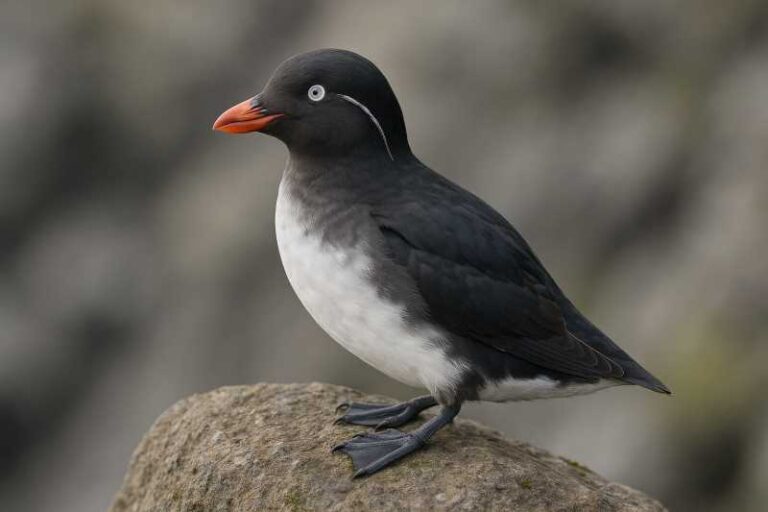
Introduction
The Scaled Quail (Callipepla squamata) is a ground-dwelling New World quail of the arid and semi-arid regions of the south-western United States and Mexico. It is also known as the Blue Quail or Cottontop, names that refer to its bluish-grey plumage and pale crest. The species is associated mainly with desert grasslands, shrublands and open country containing scattered cover.
Physical Description
The Scaled Quail is a compact, short-tailed bird measuring approximately 25–30 cm in length. Adults have bluish-grey and brown plumage, with dark-edged feathers on the breast and belly that create a distinctive scale-like pattern. The pale buff or whitish crest is relatively small and gives the species its name of Cottontop.
Males and females are broadly similar in appearance, although adult males may show slightly stronger colour contrasts and more conspicuous display behaviour during the breeding season. Juveniles are generally duller and more uniformly brown-grey, with less clearly defined scaling and a less developed crest. Regional plumage differences occur among recognised subspecies, including the chestnut-bellied form found in parts of southern Texas and north-eastern Mexico.
Range and Habitat
The Scaled Quail is native to the Chihuahuan Desert and adjacent dry regions. In the United States, its range includes parts of Arizona, New Mexico, Colorado, Kansas, Oklahoma and Texas. In Mexico, it occurs from the northern and central regions southwards into parts of the Mexican plateau.
The species is largely resident rather than migratory, although local and seasonal movements may occur. Some populations shift between breeding areas and nearby foothills, farmland or other sites that provide suitable winter food and cover.
Preferred habitat consists of dry, open valleys, plains, foothills, rocky slopes, draws, gullies and canyons. Suitable sites usually contain a mixture of bare ground, low grasses, forbs and scattered shrubs or cacti. Mesquite, cholla, prickly pear, yucca, sagebrush, saltbush and other low-growing plants can provide important food, shade and escape cover. Dense streamside vegetation and heavily wooded habitats are generally less suitable than open shrub-grassland mosaics.
Behaviour and Diet
Scaled Quail are primarily terrestrial. When disturbed, they usually run rapidly through vegetation and may flush only when closely approached. If they do fly, the flight is generally short, after which the birds regroup. Outside the breeding season, they form coveys, commonly numbering about 15–40 birds, although larger groups have been recorded.
The species is most active while foraging during the cooler parts of the day, especially early morning and late afternoon. Its diet consists mainly of seeds from grasses, forbs, shrubs and trees, supplemented by leaves, fruits and other plant material. Insects, including grasshoppers, beetles, cicadas and true bugs, become particularly important during warmer months and provide additional moisture and protein. Agricultural grains may also be taken where fields occur within the species’ range.
Breeding usually begins in spring, although the timing varies geographically and is influenced by rainfall and food availability. Males advertise from exposed bushes, fence posts or other elevated positions with a repeated, hoarse call often described as a short “whock”. Courtship may include pecking at the ground, erecting the feathers of the neck and flanks, head-bobbing and high-stepping movements.
The nest is a shallow, grass- and leaf-lined scrape on the ground, usually concealed beneath grass, shrubs, yucca, cactus or other low vegetation. A clutch commonly contains 9–16 eggs, and incubation lasts about 21–23 days. The chicks are precocial, leaving the nest soon after hatching and following one or both parents while learning to feed. One or two broods may be produced in a season, depending on local conditions.
Identification Tips
Look for the following combination of features:
- A compact, short-tailed quail with bluish-grey and brown plumage.
- Distinctive dark-edged feathers on the breast and belly, producing a scaled appearance.
- A small pale buff or whitish crest, rather than the larger dark crest of a Gambel’s Quail.
- A preference for open desert grassland and shrubland with scattered cacti or low bushes.
- A tendency to run through cover before taking a short, low flight.
- Coveys that call softly to one another while moving through vegetation.
Gambel’s Quail is the most likely similar species in parts of the south-western United States. Gambel’s Quail has a more prominent dark head plume and lacks the strongly scaled breast pattern of the Scaled Quail. Care is needed in areas where their ranges overlap.
Conservation Status
The Scaled Quail is assessed as Least Concern on the IUCN Red List. This global category reflects the species’ broad distribution and substantial population, but it does not mean that all populations are stable or free from local threats.
Population numbers can fluctuate substantially with drought, winter weather and rainfall because these conditions affect seed production, insect availability and vegetation cover. Regional monitoring has also identified concerns about recent declines in some areas. Heavy livestock grazing can reduce the grasses, forbs and shrubs needed for food and shelter, while agricultural expansion, land conversion, habitat fragmentation and inappropriate brush management can further reduce habitat quality. Hunting is also relevant because the species is a recognised game bird in parts of its range.
Conservation measures include protecting remaining desert grasslands and shrublands, maintaining a varied structure of native grasses, forbs and low woody cover, managing livestock grazing carefully and retaining suitable nesting and loafing cover. Monitoring population trends and adapting land management to local rainfall and vegetation conditions are important because the species can respond rapidly to both drought and favourable breeding seasons.
Frequently Asked Questions
Where does the Scaled Quail live?
The species occurs in arid and semi-arid parts of the south-western United States and Mexico, especially within the Chihuahuan Desert and surrounding desert grasslands, shrublands and open foothills.
Is the Scaled Quail migratory?
No. It is generally considered a resident species, although local or seasonal movements may take place between breeding areas, foothills, farmland and other sites offering better food or cover.
What does the Scaled Quail eat?
Its diet is based mainly on seeds from grasses, forbs, shrubs and trees. It also eats leaves, fruits and insects, particularly during the warmer months.
How many eggs does a Scaled Quail lay?
A typical clutch contains about 9–16 eggs. The female usually incubates the eggs for approximately 21–23 days, and the chicks leave the nest soon after hatching.
How can the Scaled Quail be identified?
The most useful field marks are its bluish-grey body, scale-like breast pattern, small pale crest and preference for open desert grassland with scattered shrubs or cacti. It commonly runs rather than flies when disturbed.
Is the Scaled Quail endangered?
The Scaled Quail is currently listed as Least Concern globally by the IUCN. Nevertheless, local populations may be affected by drought, overgrazing, habitat degradation, land conversion and other pressures, and some regional monitoring indicates concern about declines.
References
- BirdLife International. n.d. Scaled Quail Callipepla squamata Species Factsheet. BirdLife DataZone. Accessed 8 September 2026. https://datazone.birdlife.org/species/factsheet/scaled-quail-callipepla-squamata
- Cornell Lab of Ornithology. n.d. Scaled Quail Life History. All About Birds. Accessed 8 September 2026. https://www.allaboutbirds.org/guide/Scaled_Quail/lifehistory
- Dabbert, C. B., G. Pleasant and S. D. Schemnitz. 2009. “Scaled Quail (Callipepla squamata), version 2.0.” In The Birds of North America, edited by P. G. Rodewald. Cornell Lab of Ornithology, Ithaca, New York. https://birdsoftheworld.org/bow/species/scaqua/cur/introduction
- Sullivan, J. 1994. Callipepla squamata, scaled quail. Fire Effects Information System. U.S. Department of Agriculture, Forest Service, Rocky Mountain Research Station, Fire Sciences Laboratory. https://doi.org/10.2737/feis-species-review-casq
- Texas A&M University. n.d. “Scaled Quail.” The Texas Breeding Bird Atlas. Accessed 8 September 2026. https://txtbba.tamu.edu/species-accounts/scaled-quail/
- Texas Parks and Wildlife Department. n.d. “Scaled Quail Management in the Texas Panhandle.” Accessed 8 September 2026. https://tpwd.texas.gov/landwater/land/habitats/high_plains/upland_game/scaled_quail.phtml
- IOC World Bird List. 2026. IOC World Bird List, version 15.2. International Ornithologists’ Union. Accessed 8 September 2026. https://www.worldbirdnames.org/new/ioc-lists/
Related posts