Introduction
The Scaled Dove (Columbina squammata) is a small South American dove named for the dark-edged feathers that create a distinctive scale-like pattern. It occurs in a range of open and semi-open habitats, including savannas, dry woodland, scrub, farmland, parks and gardens. The species is generally resident, although local movements may occur in response to food and environmental conditions.
Physical Description
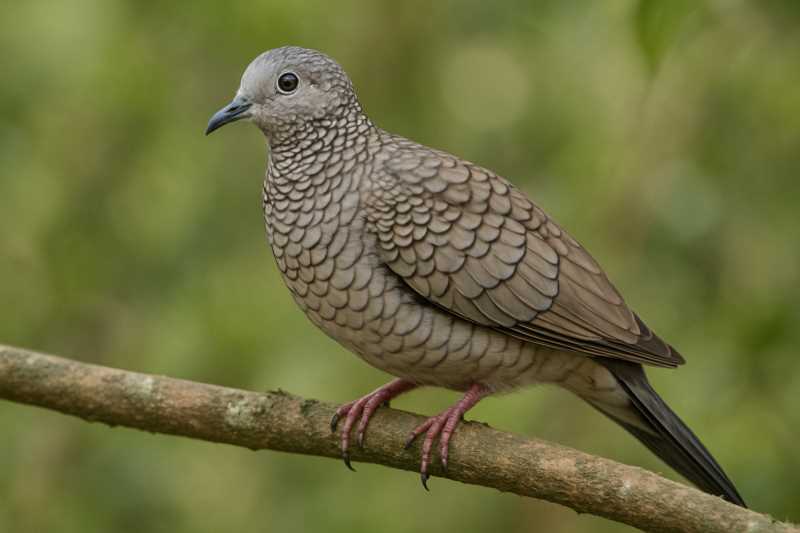
The Scaled Dove measures approximately 18–22 centimetres in length and weighs about 48–60 grams. Adults are compact, with a greyish-brown head, back and breast. The feathers have dark margins that produce the characteristic scaled appearance, particularly across the neck, breast and upperparts.
The wings and back show warm rufous-brown barring, while the wings have darker edges and a noticeable pale patch. When the bird flies, the white sides of the tail become conspicuous. The bill is short and dark, and the feet are pinkish. Males and females are broadly similar, although males may be slightly larger and more brightly coloured. Reliable descriptions of juvenile plumage are limited, so young birds are best identified by their smaller size, less sharply defined feather pattern and association with adults.
Range and Habitat
The Scaled Dove has a disjunct distribution in northern and southern South America. The northern population occurs in Colombia, Venezuela and Trinidad and Tobago. The larger southern population extends through Bolivia, Brazil, Paraguay and Argentina.
It occupies tropical and subtropical dry or moist shrublands, savannas, open grassland with scattered trees, degraded woodland, farmland and other semi-open landscapes. It also uses urban areas, parks, gardens and roadsides where suitable cover and ground-feeding areas remain. In Brazil, it is associated with habitats including cerrado, caatinga, open country, orchards and lightly wooded areas.
The species is generally sedentary rather than migratory. Individuals may nevertheless make short local movements between feeding, roosting and nesting areas.
Where to See This Species
Brasília National Park, Federal District, Brazil
The Scaled Dove is documented in the official bird guide for Brasília National Park, where it is described as common along the park’s paved paths. Look for it in open cerrado, grassland edges and other areas with scattered trees, usually on or near the ground.
Nearby accommodation: Brasília is the practical gateway, with hotels, guest houses, serviced apartments and other urban accommodation.
Brasília Botanical Garden, Federal District, Brazil
The Brasília Botanical Garden’s bird guide records the Scaled Dove among the species found in the garden. Open cerrado, woodland edges, clearings and lightly managed areas provide suitable places to search, particularly during quiet periods when ground-feeding birds are active.
Nearby accommodation: Brasília offers the nearest broad choice of hotels, guest houses, serviced apartments and self-catering accommodation.
Sete Cidades National Park, Piauí, Brazil
The Scaled Dove is included in the official bird guide for Sete Cidades National Park. The park’s cerrado, open woodland, rocky clearings and scrubby habitats are suitable for a species that commonly feeds on the ground in semi-open country.
Nearby accommodation: Piripiri is the main practical gateway, with local hotels, guest houses and simple self-catering accommodation.
Behaviour and Diet
Scaled Doves are diurnal and are usually seen alone, in pairs or in small groups. Feeding groups may contain several birds, particularly where fallen seeds are abundant. The species commonly walks or searches on the ground, but it also perches on trees, shrubs, fences and overhead wires.
Its diet is primarily made up of grass and other plant seeds gathered from the ground. Small insects and snails may be taken occasionally. The bird’s repetitive call may be accompanied by rhythmic rocking of the head and body. Its wingbeats can produce a conspicuous rattling sound when it takes flight.
Scaled Doves are generally monogamous. The nest is a simple platform of twigs and plant material, usually placed in a small tree or shrub. A clutch normally contains one or two eggs, and both parents participate in incubation and care of the young. Breeding timing varies geographically and is influenced by food availability.
Identification Tips
- Look for a small, short-tailed dove with strongly scaled grey-brown plumage.
- Check the dark feather margins on the breast, neck and upperparts, which create the species’ characteristic pattern.
- In flight, watch for the white sides of the tail and the warm brown wings.
- Search on bare ground, grassy paths, field margins and beneath scattered trees rather than only in dense vegetation.
- The Scaled Dove is more heavily patterned than the plain-looking Ruddy Ground-Dove and lacks that species’ strongly reddish male plumage.
- It is also smaller and more ground-oriented than larger woodland doves such as the Picazuro Pigeon.
- The rattling wing sound and repetitive call can help locate a bird that is hidden in low vegetation.
Conservation Status
The Scaled Dove is currently assessed as Least Concern on the IUCN Red List. Its broad distribution and use of modified habitats reduce its immediate global extinction risk. Nevertheless, local populations may be affected by the loss and degradation of cerrado, caatinga, dry woodland, scrub and other semi-open habitats through agricultural expansion, urban development and intensive land use.
Maintaining native vegetation, protecting remaining open woodland and shrubland, and retaining seed-rich field margins and lightly managed urban habitats can help support the species. A reliable current global population trend is not stated here.
Frequently Asked Questions
Where does the Scaled Dove live?
The species occurs in parts of northern and southern South America, including Colombia, Venezuela, Trinidad and Tobago, Bolivia, Brazil, Paraguay and Argentina. It uses savannas, scrub, open woodland, grassland, farmland and urban green spaces.
What does a Scaled Dove look like?
It is a small greyish-brown dove with dark-edged feathers that create a scale-like pattern. Rufous-brown wings, white tail sides and pinkish feet are useful additional field marks.
What does the Scaled Dove eat?
Its main food is seeds collected from the ground. It may also take small insects and snails occasionally.
Is the Scaled Dove migratory?
The Scaled Dove is generally considered sedentary. It may make short local movements between feeding, roosting and nesting sites, but it is not regarded as a long-distance migrant.
Where does the Scaled Dove build its nest?
It builds a simple twig nest in a small tree or shrub. The usual clutch contains one or two eggs, and both parents help incubate the eggs and care for the young.
Is the Scaled Dove endangered?
No. The species is assessed as Least Concern, although habitat loss and degradation can affect local populations.
References
- BirdLife International
- International Union for Conservation of Nature, IUCN Red List of Threatened Species
- Instituto Chico Mendes de Conservação da Biodiversidade, ICMBio
Related posts