Introduction
The Udzungwa Forest Partridge (Xenoperdix udzungwensis) is a small, ground-dwelling member of the pheasant family, Phasianidae. It is endemic to Tanzania and was discovered in the Udzungwa Mountains in 1991 before being formally described in 1994. The species is associated with the ancient Eastern Arc Mountains, a region recognised for its exceptional concentration of endemic plants and animals. (cambridge.org)
Its closest relatives are Asian hill partridges rather than Africa’s more familiar francolins, giving the species considerable evolutionary and conservation importance. (cambridge.org)
Physical Description
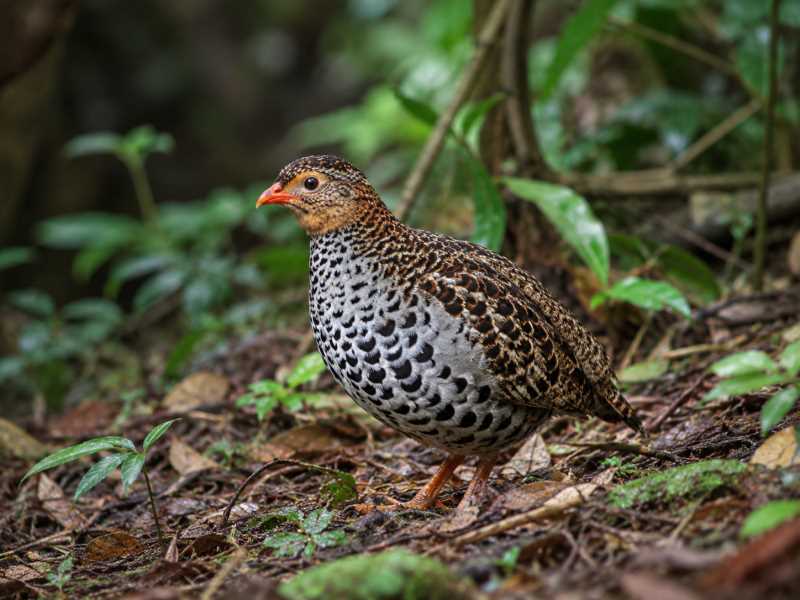
The Udzungwa Forest Partridge is approximately 29 cm long. It has a compact, robust body, a short tail and strong legs suited to moving through leaf litter and dense forest undergrowth. The upperparts are olive-brown with conspicuous dark barring, while the underparts are greyish and marked with darker spots or bars.
Adults have a rufous face and throat, a dark crown and a bright coral-red bill. The iris is brown and the legs are yellow. The sexes are broadly similar in plumage, so sex is not usually obvious in the field. Juveniles are less boldly marked and may have darker bills and a less developed dark forehead, with the bill becoming progressively more reddish as they mature. (api.pageplace.de)
Some populations historically included within X. udzungwensis show consistent morphological differences. The Rubeho population has been treated as Xenoperdix obscuratus by some taxonomic authorities, while the current IOC treatment has returned it to X. udzungwensis. (researchgate.net)
Range and Habitat
The Udzungwa Forest Partridge is a non-migratory bird of eastern Tanzania. In the Udzungwa Mountains, it has been recorded mainly in evergreen montane and submontane forest, particularly in the Ndundulu-Luhombero and Nyumbanitu forest areas. Records are concentrated at roughly 1,350–2,060 metres above sea level, although published habitat descriptions commonly give a narrower core range of about 1,350–1,900 metres. (cambridge.org)
It prefers closed or semi-closed canopy forest with a damp forest floor, leaf litter, sedges and a relatively dense understory. It is generally absent from open habitats and swamps. The species depends on intact forest structure for feeding, concealment and movement, making it especially vulnerable to fragmentation. (cambridge.org)
The Rubeho Mountains, north-west of the Udzungwas, were historically included in the species’ range. Because the taxonomic treatment of the Rubeho population has changed, accounts of the overall distribution may differ. This article follows the current IOC treatment while noting the continuing taxonomic discussion. (worldbirdnames.org)
Behaviour and Diet
The species is secretive and spends most of its time on the forest floor. It commonly moves in small groups, sometimes numbering up to eight birds, although groups are often smaller during the breeding season. Birds may roost on low branches or in trees at night. Its short wings are suitable for brief escape flights, but it normally travels by walking through dense vegetation. (en.wikipedia.org)
Foraging birds move slowly through leaf litter, flicking aside dead leaves to uncover food. The diet includes beetles, ants, flies, insect larvae, woodlice and other small invertebrates, together with seeds. Birds have also been observed taking insects from vegetation. (api.pageplace.de)
Breeding biology remains poorly known. Nests and eggs have not been adequately described, but adults with chicks have been recorded from November to January, and females with brood patches have been observed in January. These observations suggest that breeding is associated with the rainy season. Broods observed in the field have been small, commonly involving one or two chicks. (en.wikipedia.org)
Identification Tips
Look for a small, compact partridge walking quietly through damp montane forest rather than flying through the canopy. The most useful field marks are:
- Olive-brown upperparts with strong dark barring.
- A rufous face and throat.
- Greyish, dark-marked underparts.
- A bright red or coral-red bill.
- Yellow legs.
- A short tail and a strongly terrestrial posture.
The bird’s combination of a rufous face, red bill, yellow legs and heavily barred brown plumage is distinctive within its restricted Tanzanian range. It may be confused with a forest francolin at a distance, but it is smaller and more partridge-like, with a different facial pattern and a particularly distinctive red bill. It is most often detected by movement in leaf litter or by its call rather than by a prolonged view. (dokumen.pub)
Conservation Status
The Udzungwa Forest Partridge is listed as Endangered on the IUCN Red List. A systematic study published after the species’ discovery estimated approximately 2,800 individuals, with an estimated range of 1,680–3,860 birds, confined to less than 150 square kilometres and largely restricted to a single forest area at the time of the study. These figures should be treated as survey-based estimates rather than a current census. (cambridge.org)
The principal threats are the loss and fragmentation of evergreen montane forest, illegal hunting and degradation of habitat outside effectively protected areas. Fragmentation reduces the amount of suitable forest and may isolate local groups, while hunting can remove birds from already small populations. Agricultural expansion, timber extraction and the collection of firewood contribute to wider forest degradation in the Eastern Arc landscape. (cambridge.org)
Important conservation measures include protecting remaining forest, preventing illegal hunting, maintaining habitat connectivity and allowing degraded forest to regenerate naturally. The species occurs within the Udzungwa Mountains conservation landscape, but protected-area designation alone is not sufficient without effective enforcement, monitoring and cooperation with nearby communities. Continued surveys are needed to clarify distribution, population trends, breeding ecology and the status of the Nyumbanitu population. (cambridge.org)
Frequently Asked Questions
Where does the Udzungwa Forest Partridge live?
It lives in evergreen montane and submontane forests of Tanzania’s Udzungwa Mountains, mainly at elevations of about 1,350–2,060 metres. Historical records also connect the name with the Rubeho Mountains, although the taxonomic treatment of that population has changed. (cambridge.org)
What does the Udzungwa Forest Partridge look like?
It is about 29 cm long, with olive-brown barred upperparts, greyish dark-marked underparts, a rufous face and throat, a red bill and yellow legs. Males and females are generally similar in appearance. (api.pageplace.de)
What does the Udzungwa Forest Partridge eat?
It searches through leaf litter for beetles, ants, flies, larvae, woodlice and other invertebrates. Seeds also form part of its diet. (api.pageplace.de)
Is the Udzungwa Forest Partridge migratory?
No. It is regarded as a resident forest bird rather than a migrant. Its movements are mainly local and occur within suitable montane forest habitat. (datazone.birdlife.org)
Why is the Udzungwa Forest Partridge endangered?
Its range is very small, and its remaining forest habitat is threatened by fragmentation, degradation and illegal hunting. These pressures are particularly serious for a species restricted to a few isolated montane forest areas. (cambridge.org)
How can the species be protected?
Protection depends on conserving remaining evergreen forest, reducing hunting, improving management of protected areas, maintaining habitat connections and supporting local communities whose livelihoods are linked to the surrounding landscape. Regular field surveys are also needed to measure population change and identify new threats. (cambridge.org)
References
- BirdLife International. 2026. Udzungwa Forest-partridge Xenoperdix udzungwensis Species Factsheet. BirdLife DataZone. Accessed 8 September 2026. https://datazone.birdlife.org/species/factsheet/udzungwa-forest-partridge-xenoperdix-udzungwensis
- Bowie, R. C. K. & Fjeldså, J. 2005. Genetic and morphological evidence for two species in the Udzungwa Forest Partridge Xenoperdix udzungwensis. Journal of East African Natural History 94(1): 191–201. https://doi.org/10.2982/0012-8317(2005)94[191:GAMEFT]2.0.CO;2
- Dinesen, L., Lehmberg, T., Svendsen, J. O., Hansen, L. A. & Fjeldså, J. 1994. A new genus and species of perdicine bird, Phasianidae, Perdicini, from Tanzania: a relict form with Indo-Malayan affinities. Ibis 136: 2–11. https://researchprofiles.ku.dk/da/publications/a-new-genus-and-species-of-perdicine-bird-phasianidae-perdicini-f/
- Dinesen, L., Jensen, F. P., Sonne, J., Levinsky, I. & Mulungu, E. 2023. Status and habitat description of the globally threatened Udzungwa Forest Partridge Xenoperdix udzungwensis thirty years after discovery. Bird Conservation International 33: e1. https://doi.org/10.1017/S0959270921000319
- Gill, F., Donsker, D. & Rasmussen, P., eds. 2026. IOC World Bird List, version 15.2. International Ornithologists’ Union. Accessed 8 September 2026. https://www.worldbirdnames.org/
- International Union for Conservation of Nature. 2024. The IUCN Red List of Threatened Species, species assessments and conservation categories. IUCN. Accessed 8 September 2026. https://www.iucnredlist.org/
- Jensen, F. P. 2025. Udzungwa Partridge, Xenoperdix udzungwensis. Birds of the World. Cornell Lab of Ornithology. Accessed 8 September 2026. https://birdsoftheworld.org/
Related posts