The Enigmatic White-browed Antbird: A Jewel of the Neotropical Rainforest
The White-browed Antbird (Myrmoborus leucophrys) is a captivating avian species that enchants birdwatchers and ornithologists alike with its striking plumage and intricate behaviors. Found primarily in the dense undergrowth of the Amazon Basin, this bird is a quintessential representative of the rich biodiversity that thrives within tropical rainforests. In this article, we delve into the life of the White-browed Antbird, exploring its habitat, behavior, and the conservation challenges it faces.
Habitat and Distribution
The White-browed Antbird inhabits the humid lowland forests of South America, predominantly within the Amazon Basin. Its range extends across several countries, including Brazil, Colombia, Ecuador, Peru, and Bolivia. The species favors dense, tangled undergrowth, often near streams or wetlands, where it can be observed darting through the shadows in search of food.
This antbird is typically found at elevations ranging from sea level to about 1,200 meters, although it is most commonly seen below 600 meters. Its preference for dense foliage not only provides ample foraging opportunities but also offers protection from predators, making the understory an ideal habitat.
Physical Characteristics
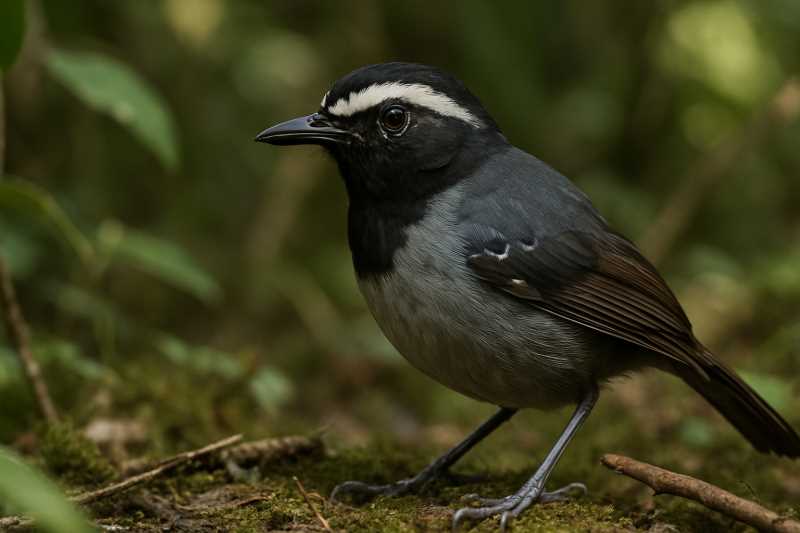
The White-browed Antbird is a small to medium-sized bird, measuring approximately 13 to 14 centimeters in length and weighing around 18 to 20 grams. It exhibits a distinctive plumage pattern that sets it apart from other antbirds. Males are primarily dark gray with a contrasting white eyebrow stripe that gives the species its name. Females, on the other hand, have a more subdued coloration, sporting a brownish plumage with similar white eyebrow markings.
The stark difference between the male and female plumage is a classic example of sexual dimorphism, a common trait among many bird species. This differentiation not only aids in mate selection but also plays a role in their respective roles during nesting and rearing of young.
Behavior and Diet
The White-browed Antbird is an insectivore, primarily feeding on ants, beetles, and other small invertebrates found in the leaf litter and low vegetation. Its foraging behavior is a fascinating spectacle; the bird hops on the forest floor, flicking leaves and debris with its bill to uncover hidden prey. Occasionally, it may follow army ant swarms to capitalize on the insects flushed out by the ants’ movement.
This antbird is known for its territorial nature, with pairs establishing and defending territories throughout the year. They communicate through a series of calls, including a distinctive ‘whit-whit-whit’ song that echoes through the forest. These vocalizations serve multiple purposes, from attracting mates to warding off intruders.
Breeding typically occurs during the wet season when food resources are abundant. The nest is a delicate cup constructed from leaves and fibers, usually located close to the ground in dense foliage. Both the male and female share incubation duties, taking turns to ensure the eggs are adequately protected and kept warm.
Conservation Status
Currently, the White-browed Antbird is classified as a species of Least Concern by the International Union for Conservation of Nature (IUCN). However, like many species inhabiting the Amazon Basin, it faces significant threats from habitat destruction due to deforestation, agricultural expansion, and infrastructure development.
The rapid loss of rainforest habitat not only reduces the available territory for these birds but also fragments populations, making it challenging for them to maintain genetic diversity and resilience. Conservation efforts aimed at preserving large tracts of continuous forest are crucial in ensuring the long-term survival of the White-browed Antbird and countless other species that depend on this environment.
Importance of Conservation
The preservation of the White-browed Antbird is not only vital for maintaining biodiversity but also for sustaining the ecological balance of the rainforest ecosystem. As insectivores, these birds play a critical role in controlling insect populations, thereby contributing to the health of the forest.
Furthermore, the presence of such species is indicative of a healthy environment, making them valuable bioindicators for scientists studying the impacts of climate change and habitat destruction. Protecting this species, therefore, has broader implications for conservation efforts and the preservation of the Amazon rainforest as a whole.
Conclusion
The White-browed Antbird is a remarkable example of the intricate and interconnected life that flourishes within the Neotropical rainforests. Its striking appearance, fascinating behaviors, and the challenges it faces highlight the importance of continued research and conservation efforts. By understanding and protecting this species, we contribute to the broader goal of preserving the rich tapestry of life that makes the Amazon one of the most unique and vital ecosystems on our planet.
Related posts