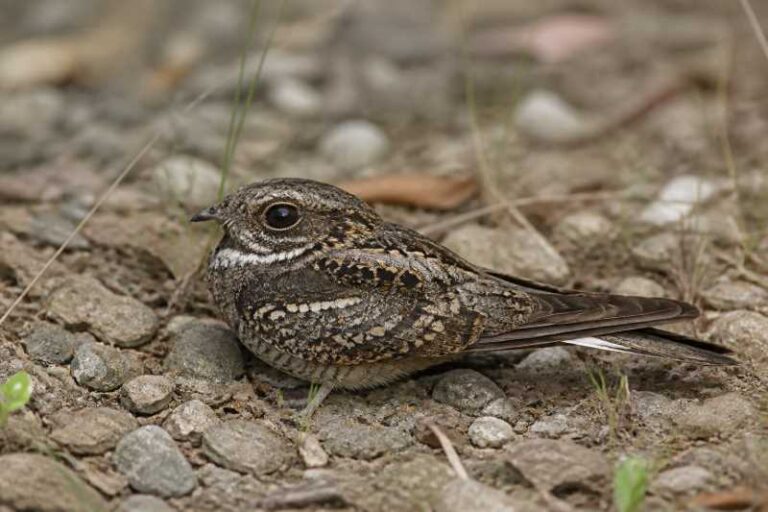
Introduction
The Rusty-margined Guan, Penelope superciliaris, is a medium-sized arboreal bird in the family Cracidae, which also includes chachalacas and curassows. It is native to South America, with a range extending across Brazil, Paraguay, eastern Bolivia and northern Argentina. The species is resident rather than migratory and is associated with a variety of wooded habitats.
Physical Description
The Rusty-margined Guan is a long-tailed guan measuring approximately 65–73 cm in total length. Its plumage is mainly dark brown to blackish, with pale or white streaking on the neck and upper breast. Rust-coloured margins on the wing feathers and other upperparts give the species its common name.
A pale eyebrow or superciliary mark is usually visible above the eye, although it is less distinct than the eyebrow markings of some related guans. The species also has a red throat wattle, pale legs and a strong, slightly curved bill. Males and females are broadly similar in appearance, with any differences being subtle and mainly related to size or colour intensity. Young birds are generally duller and less sharply marked than adults.
Range and Habitat
The Rusty-margined Guan occurs in Brazil, Paraguay, eastern Bolivia and northern Argentina. In Brazil, it is distributed across a broad area that includes parts of the Amazonian region, central Brazil, the Atlantic Forest, the Cerrado and the Pantanal.
It is primarily associated with lowland and foothill forests, including humid forest, dry woodland, secondary growth and small forest fragments. It can also occur in open areas near woodland and, in some parts of its range, mangrove habitats. Local studies indicate that it uses denser forest and areas close to water more frequently, and may avoid heavily disturbed sites.
The species is non-migratory, although individuals may move locally between forest patches and feeding areas. Geographic variation is recognised within the species, and several subspecies have been described in different parts of its range.
Behaviour and Diet
Rusty-margined Guans are mainly active during the day, with additional activity around dawn and late afternoon. They may be seen alone, in pairs or in small family groups. Their loud, harsh calls are often given from trees and may function in contact, alarm or territorial communication.
The species is primarily arboreal but may descend to the ground while feeding. Its diet is dominated by fruit, and it also takes seeds, flowers, leaves and small invertebrates. Studies in south-eastern Brazil have documented a broad range of fruiting plants in its diet. By consuming fruit and moving between feeding sites, the guan contributes to seed dispersal and forest regeneration.
Breeding information remains less well documented than the species’ distribution and diet. Nests are built in trees as platforms of sticks and leaves, and the female lays a small clutch. Detailed information on incubation, chick development and parental care varies between sources and should be treated cautiously.
Identification Tips
- Look for a medium-sized, long-tailed guan with dark plumage, pale streaks on the neck and a reddish throat wattle.
- The rusty or rufous edging on the wings can be noticeable when the bird moves or flies.
- The eyebrow mark is usually present but indistinct, while the back is relatively plain rather than strongly streaked.
- Pale legs and the red throat wattle are useful features at close range.
- Listen for a harsh, bark-like call, often given from the canopy.
- In areas where it overlaps with the Dusky-legged Guan, compare the throat and overall pattern carefully. The Rusty-margined Guan generally shows more obvious pale neck streaking, a plainer back and a more distinct reddish throat wattle, although individual variation and viewing conditions can make identification difficult.
Conservation Status
The Rusty-margined Guan is listed as Least Concern on the IUCN Red List assessment reported in the 2021 Red List statistics. This category reflects its broad distribution and relatively secure global population, but it does not mean that local populations are free from threat.
The principal pressures on the species are deforestation, habitat fragmentation, disturbance and hunting. Cracids are frequently targeted as game birds, and studies in Brazil have found that poaching and habitat alteration reduce occupancy in affected areas. The species may persist in secondary forest and small fragments, but it is generally more frequently recorded in larger, less disturbed forests.
Important conservation measures include protecting remaining forest, maintaining links between forest fragments, reducing illegal hunting and monitoring populations in regions undergoing rapid land-use change. Local conservation assessments may be more severe than the global category, particularly for geographically restricted subspecies or populations.
Frequently Asked Questions
Where does the Rusty-margined Guan live?
It occurs in Brazil, Paraguay, eastern Bolivia and northern Argentina. Its habitats include humid and dry forests, secondary woodland, forest fragments and some nearby open or wetland areas.
Is the Rusty-margined Guan migratory?
No. It is considered a resident species, although individuals may make local movements between forest patches, feeding sites and water sources.
What does the Rusty-margined Guan eat?
Its diet consists mainly of fruit and seeds, supplemented by flowers, leaves and small invertebrates. It is an important potential seed disperser in the forests where it occurs.
How can the Rusty-margined Guan be identified?
Look for a dark, long-tailed guan with pale streaks on the neck, a reddish throat wattle, pale legs and rusty edging on the wings. Its back is relatively plain, and its call is harsh and bark-like.
Does the Rusty-margined Guan live in groups?
It may forage alone, in pairs or in small groups, particularly family groups. Activity is often greatest in the early morning and late afternoon.
Is the Rusty-margined Guan threatened?
Globally, it is currently classified as Least Concern by the IUCN Red List. Habitat loss and hunting remain important local threats, and some regional populations or subspecies may face greater conservation pressure than the species as a whole.
References
- BirdLife International. 2021. IUCN Red List of Threatened Species statistics table, 2021-3, including Penelope superciliaris, listed as Least Concern. IUCN Red List. Available at: https://nc.iucnredlist.org/redlist/content/attachment_files/2021-3_RL_Stats_Table_7.pdf. Accessed 8 September 2026.
- Gill, F., Donsker, D. and Rasmussen, P. (eds.). 2026. IOC World Bird List, version 15.2. International Ornithologists’ Union. Available at: https://www.worldbirdnames.org/. Accessed 8 September 2026.
- Pereira-Ribeiro, J., et al. 2018. The rusty-margined guan (Penelope superciliaris) in the Brazilian Atlantic rain forest: density, population size, activity and habitat use. Wildlife Research 45. https://doi.org/10.1071/WR17161.
- Thel, T. N., Teixeira, P. H., Lyra-Neves, R. M., Telino-Júnior, W. R., Ferreira, J. M. and Azevedo-Júnior, S. M. 2015. Aspects of the ecology of Penelope superciliaris Temminck, 1815 (Aves: Cracidae) in the Araripe National Forest, Ceará, Brazil. Brazilian Journal of Biology 75: 126–135. https://doi.org/10.1590/1519-6984.07314.
- Zaca, W., Silva, W. R. and Pedroni, F. 2006. Diet of the Rusty-margined Guan (Penelope superciliaris) in an altitudinal forest fragment of south-eastern Brazil. Ornitología Neotropical 17(3), Article 5. Available at: https://digitalcommons.usf.edu/ornitologia_neotropical/vol17/iss3/5. Accessed 8 September 2026.
- eBird. n.d. Rusty-margined Guan, Penelope superciliaris. Cornell Lab of Ornithology. Available at: https://ebird.org/species/rumgua1. Accessed 8 September 2026.
Related posts