Introduction
The Gunnison Sage-Grouse, also known as the Gunnison Grouse, is a sagebrush-dependent bird endemic to the south-western United States. Its accepted scientific name is Centrocercus minimus. Closely related to the Greater Sage-Grouse, it was recognised as a distinct species in 2000 because of consistent differences in body size, plumage, courtship behaviour and genetics. The species is restricted mainly to south-western Colorado, with a small population in south-eastern Utah.
Physical Description
The Gunnison Sage-Grouse is a large, heavy-bodied grouse with a small head, feathered legs and a long, pointed tail. Adults measure approximately 46–56 centimetres in length, although body mass varies considerably between individuals and sexes.
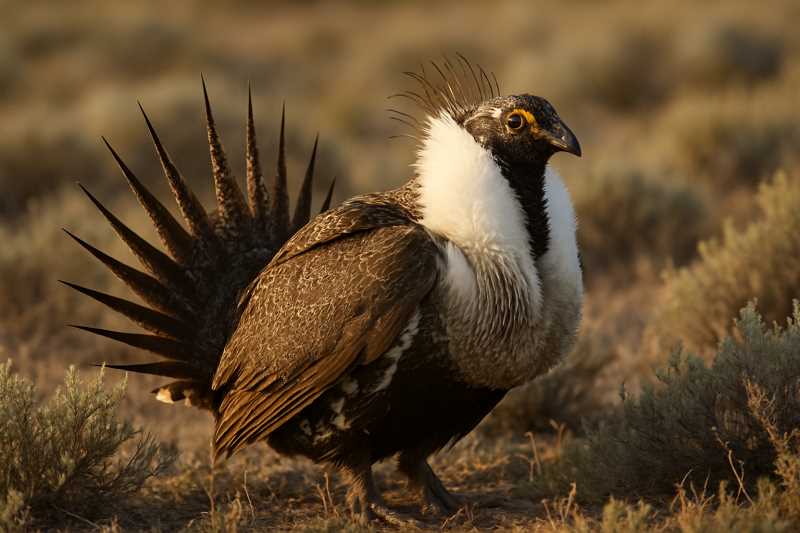
The plumage is mottled grey-brown, buff, black and white, providing effective camouflage in sagebrush. Both sexes have a dark abdomen and a barred, pointed tail. Males are larger and more conspicuous than females. During the breeding season, males show a dark head and throat, a prominent white breast ruff, yellow-green inflatable air sacs and fine, hair-like filoplumes on the back of the head. The tail feathers have relatively conspicuous white markings compared with those of the Greater Sage-Grouse.
Females lack the male’s inflatable air sacs and display feathers. They are more cryptically coloured, with a buffy throat, dark markings and barred lower breast, which helps them remain concealed while nesting. Juveniles and younger birds generally appear duller and less sharply patterned than adults.
Range and Habitat
The Gunnison Sage-Grouse is endemic to the United States. Its current range is centred on isolated sagebrush landscapes in south-western Colorado and south-eastern Utah. Most of the remaining birds occur in Colorado, particularly in and around the Gunnison Basin, with smaller and more fragmented populations elsewhere in the species’ range.
The species is closely tied to sagebrush steppe. Suitable habitat usually contains extensive sagebrush, native grasses and forbs, together with healthy wet meadows or riparian areas that provide important seasonal resources. Sagebrush offers food, nesting cover, shelter from weather and predators, and winter habitat.
Historically, the species occupied a much larger area. Agricultural conversion, roads, urban growth, energy development, invasive plants, vegetation change and other forms of habitat fragmentation have greatly reduced and divided its distribution. Gunnison Sage-Grouse are generally resident rather than long-distance migrants, although individuals make seasonal movements between breeding, nesting, brood-rearing and wintering habitats.
Behaviour and Diet
Gunnison Sage-Grouse spend much of the year on the ground and are often difficult to detect in dense sagebrush. They feed mainly on vegetation. Adult birds consume sagebrush leaves for much of the year, especially during autumn and winter, when other foods are scarce. In spring and summer, they also eat forbs, flowers and buds. Chicks depend heavily on insects and forbs during their early development because young birds are not yet able to digest sagebrush efficiently.
In late winter and spring, males gather at traditional communal display grounds called leks. They compete and display by inflating their air sacs, raising their white breast feathers, fanning their tails and producing a series of popping, swishing and other mechanical sounds. Females visit the leks to assess the males and usually mate with a small number of successful males.
After mating, females select nesting sites in or near sagebrush and raise the young without assistance from the male. Broods are led to areas with more abundant forbs and insects, while mature birds continue to rely heavily on sagebrush as seasonal conditions change.
Identification Tips
- Look for a large, round-bodied grouse with a small head, long pointed tail and mottled grey-brown plumage.
- In ordinary view, the bird is usually subdued and blends closely with sagebrush.
- A displaying male is distinctive: he becomes almost spherical, raises a white breast ruff, inflates yellow-green air sacs, fans his tail and produces popping sounds.
- Females are smaller-looking and more heavily camouflaged, with a buffy, barred throat and breast.
- The closest potential confusion species is the Greater Sage-Grouse. Gunnison Sage-Grouse are smaller, have more conspicuous white tail markings and males show more developed filoplumes behind the head. Geographic range is also an important clue, because the two species occupy separate broad range areas.
Conservation Status
The Gunnison Sage-Grouse is listed as Endangered on the IUCN Red List and as Threatened under the United States Endangered Species Act. Its populations are small, geographically isolated and vulnerable to further habitat loss and degradation.
Major threats include the fragmentation and conversion of sagebrush habitat, human disturbance near leks, infrastructure and energy development, invasive annual grasses, altered fire regimes, drought, climate change and disease. Wildfire can be especially damaging where invasive grasses increase the likelihood of repeated burning and slow the recovery of sagebrush.
Conservation measures include protecting occupied and important unoccupied habitat, maintaining traditional leks, restoring sagebrush and wet-meadow ecosystems, controlling invasive plants, improving grazing and land-use practices, limiting disturbance during the breeding season, and monitoring populations and habitat condition. The United States Fish and Wildlife Service published a federal recovery plan in 2020, and a five-year review completed in 2024 retained the species’ federal threatened classification.
Frequently Asked Questions
Where does the Gunnison Sage-Grouse live?
It occurs in isolated sagebrush landscapes in south-western Colorado and south-eastern Utah, with most of the remaining population in Colorado.
Is the Gunnison Sage-Grouse a separate species?
Yes. It was formally described as Centrocercus minimus in 2000 after research identified consistent differences from the Greater Sage-Grouse in morphology, plumage, behaviour and genetics.
What does the Gunnison Sage-Grouse eat?
Adults depend heavily on sagebrush leaves, particularly in autumn and winter. They also eat forbs, flowers and buds, while chicks consume many insects and forbs during early development.
What is a Gunnison Sage-Grouse lek?
A lek is a traditional communal display site where males gather during the breeding season to compete and court visiting females. Leks are usually open areas within or beside sagebrush habitat.
How can the Gunnison Sage-Grouse be distinguished from the Greater Sage-Grouse?
The Gunnison Sage-Grouse is smaller and has more pronounced white tail markings and longer filoplumes behind the male’s head. Location is also useful because the two species have largely separate ranges.
Why is the Gunnison Sage-Grouse threatened?
The species is affected by habitat loss and fragmentation, disturbance, drought, climate change, invasive grasses, altered wildfire patterns, development and the vulnerability of small isolated populations.
References
- Colorado Parks and Wildlife. 2023. Gunnison Sage-Grouse. Colorado Parks and Wildlife species account. Available at: https://cpw.state.co.us/species/gunnison-sage-grouse (accessed 8 September 2026).
- Gill, F., Donsker, D. and Rasmussen, P., eds. 2026. IOC World Bird List, version 15.2. International Ornithologists’ Union. Available at: https://www.worldbirdnames.org/new/ (accessed 8 September 2026).
- U.S. Fish and Wildlife Service. 2014. Threatened Status for Gunnison Sage-Grouse. Federal Register 79: 69191–69310. Available at: https://www.fws.gov/policy/library/2014/2014-27109.html.
- U.S. Fish and Wildlife Service. 2020. Final Recovery Plan for Gunnison Sage-Grouse (Centrocercus minimus). Upper Colorado Basin Region, Lakewood, Colorado. Available at: https://ecos.fws.gov/docs/recovery_plan/2020-10-23_GUSG_FinalRP_v8.pdf.
- U.S. Fish and Wildlife Service. 2024. 5-Year Status Review for Gunnison Sage-Grouse (Centrocercus minimus). Available at: https://www.fws.gov/node/5232726 (accessed 8 September 2026).
- Young, J. R., Braun, C. E., Oyler-McCance, S. J., Hupp, J. W. and Quinn, T. W. 2000. A new species of sage-grouse (Phasianidae: Centrocercus) from south-western Colorado. Wilson Bulletin, 112(4), 445–453. https://doi.org/10.1676/0043-5643(2000)112[0445:ANSOSG]2.0.CO;2.
- Young, J. R., Braun, C. E., Oyler-McCance, S. J., Aldridge, C. L., Magee, P. A. and Schroeder, M. A. 2020. Gunnison Sage-Grouse (Centrocercus minimus), version 1.0. In: Rodewald, P. G., ed., Birds of the World. Cornell Lab of Ornithology. https://doi.org/10.2173/bow.gusgro.01.
- Cornell Lab of Ornithology. n.d. Gunnison Sage-Grouse: Identification and Life History. All About Birds. Available at: https://www.allaboutbirds.org/guide/Gunnison_Sage-Grouse (accessed 8 September 2026).
Related posts