Introduction
The Bronze-winged Duck, Speculanas specularis, is a medium-sized South American duck and the only species in the genus Speculanas. It is also widely known as the Spectacled Duck, a reference to the paired white facial markings beside the eyes. The species is associated mainly with forested rivers, streams, lakes and lagoons in Chile and Argentina, where it is often encountered in pairs or small family groups.
Physical Description
The Bronze-winged Duck measures approximately 46–54 cm in length and weighs about 900–1,460 g. It has an elongated body, generally brown plumage, a darker back and a warm brown breast. The head and neck are dark chocolate-brown, with a white throat stripe extending along the sides of the neck.
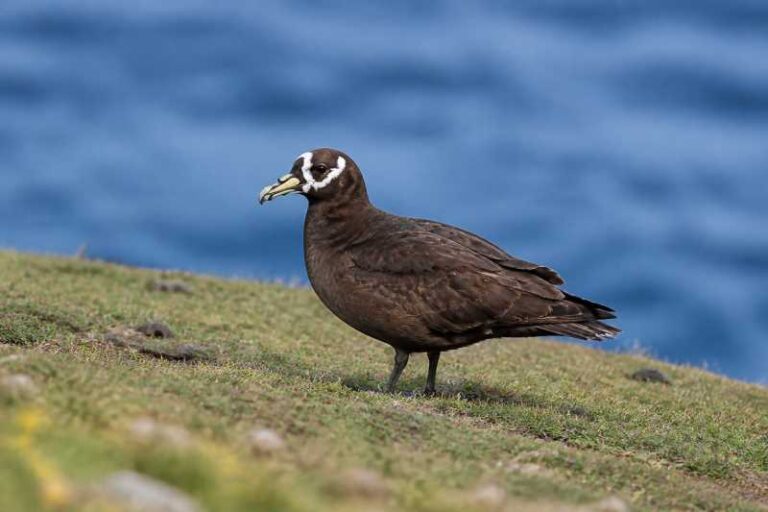
Its most distinctive feature is a pair of oval white patches between the eyes and the bill. These markings give rise to the names Bronze-winged Duck and Spectacled Duck. The bill is grey-blue, the legs and feet are orange, and the wing speculum appears bronze-violet in flight and is bordered by white.
The sexes are similar, although females are generally slightly smaller and paler. Juveniles resemble adults but usually have less white on the face. Ducklings have dark brown upperparts, paler underparts and two parallel brown facial lines.
Range and Habitat
The Bronze-winged Duck is native to the Andean-Patagonian region of Chile and Argentina. In Chile, it occurs from the Maule region southwards to Tierra del Fuego and islands south of the Beagle Channel. It may move north during winter, with occasional records reaching as far as Valparaíso. The species has also been recorded as an accidental visitor to the Falkland Islands, also known as the Malvinas.
It is most strongly associated with well-wooded rivers and relatively fast-flowing streams, particularly along the lower Andean slopes. It also uses slower rivers, forest-edge lakes, lagoons and other freshwater wetlands. In Chile, it has been recorded from sea level to approximately 1,500 m, although local elevation limits vary.
The species is not best described as strictly sedentary or strictly migratory. Sources describe a mixture of resident, dispersive and seasonal movements. Some pairs may remain in the same feeding and breeding area throughout the year, while others move in response to winter conditions, water levels and food availability.
Behaviour and Diet
Bronze-winged Ducks are generally secretive and wary. They are most often seen in pairs, small groups or family parties, although larger temporary gatherings have been recorded. They swim in shallow water, rest on riverbanks and rocks, and often keep close to cover along wooded shorelines.
The species feeds on aquatic and wetland vegetation, including seeds, leaves, stems and roots. Recorded plant foods include water-crowfoot and water milfoil. It also takes aquatic invertebrates such as insects, caddisfly larvae and molluscs. Feeding may involve searching in shallow water and among aquatic plants rather than typical open-water dabbling.
The breeding season generally extends from September to February. Pairs usually nest alone within a territory. The female builds a large, open nest on the ground, concealed among vegetation beside rivers, lakes or lagoons. Small islands within water bodies may be preferred where they are available.
Clutches contain approximately four to seven eggs. Incubation lasts about 30 days and is carried out by the female. Both parents care for the ducklings after hatching. The female has a harsh, barking call, which has contributed to the regional name Pato Perro, or “dog duck”. The male produces a loud, trilled whistle during display.
Identification Tips
Look for the following combination of features:
- A medium-sized, elongated brown duck associated with wooded freshwater habitats.
- Two conspicuous white oval patches between the eyes and the bill.
- A white throat and neck stripe contrasting with the dark chocolate-brown head and neck.
- A grey-blue bill and orange legs and feet.
- A bronze-violet wing speculum visible in flight.
- A preference for rivers, streams and forested wetlands rather than open lowland marshes.
The facial “spectacles” are the most useful field mark. In poor light, the species may appear uniformly brown, so the white throat and orange legs can help confirm an identification. Juveniles may be more difficult to recognise because the facial white is reduced.
Conservation Status
The Bronze-winged Duck is currently assessed as Near Threatened on the IUCN Red List. The species has a relatively restricted distribution, and detailed information on its total population and long-term population trend remains limited.
Important threats include predation of ground nests by introduced American Mink, disturbance from tourism and recreational activity, and degradation of rivers and other freshwater habitats associated with salmonid aquaculture and introduced fish. Hunting has also affected the species historically, although it is not considered the principal current threat in the sources reviewed.
Conservation priorities include protecting forested rivers, lakes and wetlands; maintaining undisturbed nesting areas; reducing disturbance during the breeding season; monitoring populations and breeding success; and managing invasive predators and introduced aquatic species. The species occurs in several protected areas in Chile and Argentina, but protection outside reserves is also important because it uses connected river and wetland systems.
Frequently Asked Questions
What is the scientific name of the Bronze-winged Duck?
The scientific name is Speculanas specularis. It is the only recognised species in the genus Speculanas.
Where does the Bronze-winged Duck live?
It lives mainly in Chile and Argentina, especially in the Andean-Patagonian region. Its preferred habitats include forested rivers, streams, lakes and lagoons.
Why is it called the Spectacled Duck?
The species has two oval white patches between the eyes and the bill. These markings resemble spectacles and are particularly useful for identification.
Is the Bronze-winged Duck migratory?
Its movements are variable. Some birds remain in the same area throughout the year, while others make seasonal or opportunistic movements, including winter movements towards northern parts of Chile.
What does the Bronze-winged Duck eat?
Its diet includes aquatic plants, seeds, leaves, stems and roots, together with aquatic invertebrates such as insects, caddisfly larvae and molluscs.
Is the Bronze-winged Duck threatened?
Yes. The species is assessed as Near Threatened. Major concerns include invasive American Mink, human disturbance and degradation of freshwater habitats.
References
- BirdLife International. 2016. Speculanas specularis. The IUCN Red List of Threatened Species 2016. Available at: https://www.iucnredlist.org/details/22680136/0. Accessed 8 September 2026.
- Chilean Ministry of the Environment. 2019. Ficha de antecedentes de especie: Speculanas specularis (King, 1828). Fourteenth Species Classification Process. Available at: https://clasificacionespecies.mma.gob.cl/wp-content/uploads/2019/10/Speculanas_specularis_14RCE_FINAL.pdf. Accessed 8 September 2026.
- Chilean Ministry of the Environment. 2026. Ficha de especie: Speculanas specularis (King, 1828). Plataforma de Políticas de la Biodiversidad. Available at: https://simbio.mma.gob.cl/Especies/Details/5087. Accessed 8 September 2026.
- Carboneras, C. & Kirwan, G. M. 2017. Spectacled Duck (Speculanas specularis). In del Hoyo, J., Elliott, A., Sargatal, J., Christie, D. A. & de Juana, E. (eds), Handbook of the Birds of the World Alive. Lynx Edicions, Barcelona. Available through the HBW species account cited by the Chilean Ministry of the Environment. Accessed 8 September 2026.
- Gill, F., Donsker, D. & Rasmussen, P. (eds). 2026. IOC World Bird List, version 15.2. International Ornithologists’ Union. Available at: https://www.worldbirdnames.org/. Accessed 8 September 2026.
- Schüttler, E., Klenke, R., McGehee, S., Rozzi, R. & Jax, K. 2009. Vulnerability of ground-nesting waterbirds to predation by invasive American mink in the Cape Horn Biosphere Reserve, Chile. Biological Conservation, 142, 1450–1460.
- Sistema de Información de Biodiversidad, Administración de Parques Nacionales, Argentina. n.d. Speculanas specularis, Pato de Anteojos. Available at: https://sib.gob.ar/especies/speculanas-specularis. Accessed 8 September 2026.
Related posts