The Elusive Rufous-vented Ground Cuckoo: A Forest Enigma
The Rufous-vented Ground Cuckoo (Neomorphus geoffroyi) is a captivating yet enigmatic bird species that has piqued the curiosity of ornithologists and bird enthusiasts alike. Found predominantly in the dense forests of Central and South America, this bird is as elusive as it is fascinating. Despite its intriguing behaviors and striking appearance, the Rufous-vented Ground Cuckoo remains relatively unknown to the general public, primarily due to its secretive nature and preference for secluded habitats.
Habitat and Distribution
The Rufous-vented Ground Cuckoo inhabits the subtropical and tropical rainforests stretching from southern Mexico, through Central America, and into the northern parts of South America, including Colombia, Venezuela, and Ecuador. These birds favor lowland and montane forests, where the dense canopy offers protection and ample food resources.
The species’ distribution is patchy, and it is often found in regions with healthy populations of army ants, which play a crucial role in the cuckoo’s foraging strategy. The bird’s affinity for such habitats is both a blessing and a curse; while the dense forests offer ideal living conditions, they also make the bird challenging to study and observe.
Physical Characteristics
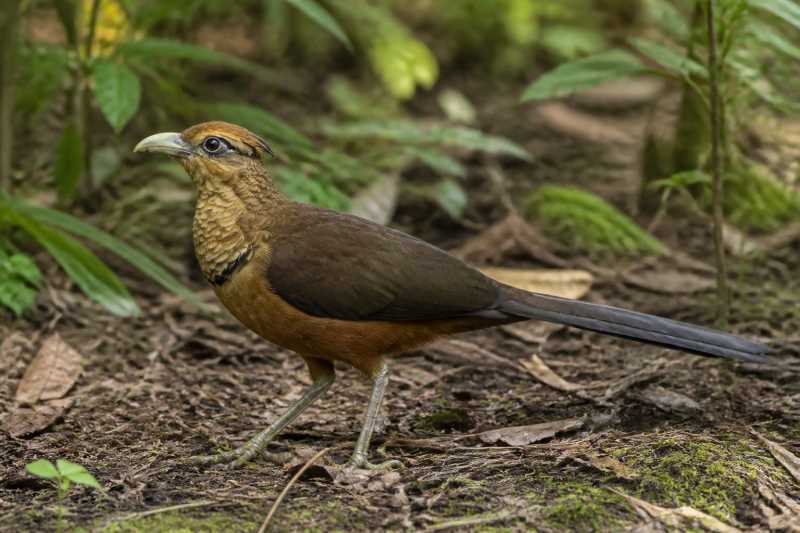
The Rufous-vented Ground Cuckoo is a medium to large-sized bird, measuring approximately 45-51 cm in length. Its plumage is a striking combination of dark browns, blacks, and rufous hues. The bird’s most distinctive feature is its rufous-colored vent and undertail coverts, from which it derives its name.
The cuckoo’s head is adorned with a slightly raised crest, and it possesses a long, curved bill that aids in its foraging activities. Its legs are strong and well-adapted to its ground-dwelling lifestyle, enabling it to move swiftly through the forest underbrush.
Behavior and Diet
Rufous-vented Ground Cuckoos are primarily terrestrial, spending much of their time foraging on the forest floor. They are known to follow swarms of army ants, capitalizing on the insects flushed out by the ants’ relentless advance. This opportunistic feeding strategy allows the cuckoo to feast on a variety of prey, including insects, small reptiles, and amphibians.
These birds often exhibit a curious behavior known as ‘anting,’ where they actively search for army ant swarms. The cuckoos follow these swarms closely, picking off the fleeing prey with remarkable agility. This behavior not only provides a reliable food source but also demonstrates the bird’s remarkable adaptability and intelligence.
Reproduction and Lifecycle
Despite its intriguing behaviors, relatively little is known about the Rufous-vented Ground Cuckoo’s reproductive habits. Like many cuckoos, this species is presumed to be a brood parasite, laying its eggs in the nests of other bird species. However, direct observations of this behavior are rare, and more research is needed to fully understand its breeding strategies.
The cuckoo’s nesting habits remain largely a mystery, contributing to the challenges of studying this elusive bird. The lack of detailed information on its reproductive cycle underscores the importance of continued research and conservation efforts.
Conservation Status
The Rufous-vented Ground Cuckoo is currently classified as Near Threatened by the International Union for Conservation of Nature (IUCN). The primary threats to its survival include habitat loss and fragmentation, driven by deforestation and expanding agricultural activities.
Conservationists emphasize the need for preserving the cuckoo’s natural habitat to ensure its continued existence. Protecting large tracts of rainforest is crucial not only for the Rufous-vented Ground Cuckoo but also for countless other species that depend on these ecosystems for survival.
Conclusion
The Rufous-vented Ground Cuckoo is a remarkable bird that embodies the complexity and beauty of tropical ecosystems. Its elusive nature and unique behaviors make it a subject of fascination for researchers and bird lovers alike. While much remains to be discovered about this enigmatic bird, the knowledge we do have highlights the importance of conserving its habitat.
As our understanding of the Rufous-vented Ground Cuckoo grows, so too does our appreciation for the intricate web of life within the world’s rainforests. Efforts to protect these vital ecosystems are essential not only for the cuckoo but for the countless species that share its home.
Related posts