Introduction
The Rufous-capped Thornbill (Chalcostigma ruficeps) is a small Andean hummingbird in the family Trochilidae. It occurs mainly in humid montane forest, cloud forest, forest edges and dense secondary growth on the eastern slopes of the Andes. The species is locally uncommon and is particularly distinctive for the male’s mahogany-rufous crown, short black bill and brilliant green throat patch.
Physical Description
The Rufous-capped Thornbill is approximately 10.5 centimetres long and weighs about 3.3 to 3.9 grams. Both sexes have a very short, straight, black bill, a feature that helps distinguish this thornbill from many hummingbirds with longer bills.
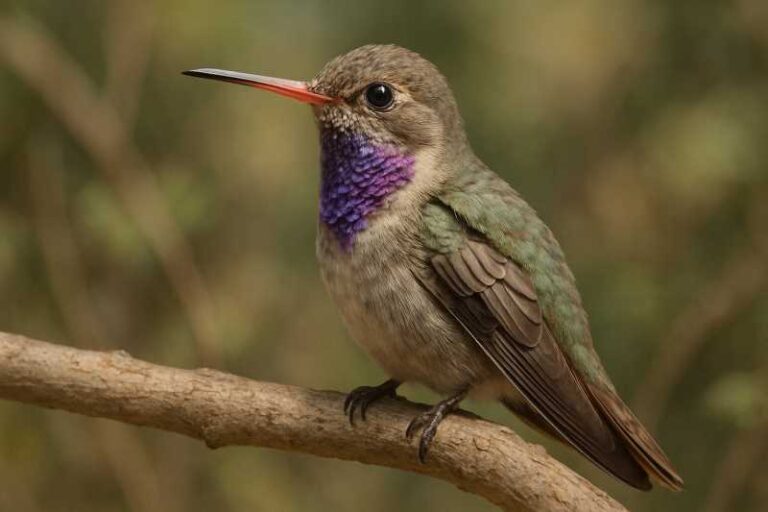
The adult male has bottle-green upperparts, a mahogany-red crown and a narrow emerald-green gorget bordered by yellowish to golden tones. The underparts are mainly rufous or warm brown, with green mottling that is strongest on the flanks. The tail is relatively long and dull olive-green.
The female is less brightly marked. She lacks the male’s mahogany crown and has mainly green upperparts, with an ochre-orange throat and breast marked with olive-green spotting. The outer tail feathers have pale tips. Young birds resemble females and are generally duller than adult males.
Range and Habitat
The species is found primarily along the eastern slopes of the Andes from south-eastern Ecuador through Peru to central-western Bolivia, including the Department of Cochabamba. Reports from Colombia appear to represent vagrancy or an irregular occurrence rather than a confirmed regular population.
It inhabits humid montane forest, cloud forest, mossy forest edges, riparian thickets and wet secondary growth. It is usually recorded between about 1,400 and 3,500 metres above sea level, with most records concentrated around 2,500 metres. It generally forages in the lower and middle levels of dense vegetation and is not considered a long-distance migrant, although seasonal elevational movements may occur.
The species is treated as monotypic, with no currently recognised subspecies in the main global taxonomic lists.
Where to See This Species
Tapichalaca Reserve, Zamora-Chinchipe, Ecuador
Tapichalaca Reserve protects wet montane forest on the eastern Andean slope and lists the Rufous-capped Thornbill among its birds of interest. The species may be encountered around flowering vegetation, forest edges and trails near the reserve lodge, although it is not necessarily common or predictable. The reserve’s position near Podocarpus National Park also makes it part of an important southern Ecuadorian forest corridor.
Nearby accommodation: The reserve lodge provides the most practical option, with additional guesthouses and small hotels available in the nearby settlement of Valladolid.
Podocarpus National Park, Cajanuma Sector, Loja Province, Ecuador
The Cajanuma sector contains high-elevation temperate forest and páramo-edge habitat suitable for the species. Regional bird checklists and birding records document the Rufous-capped Thornbill in this part of the park. Look carefully along forest edges, sheltered trails and flowering shrubs, particularly in misty montane conditions when hummingbirds may remain close to cover.
Nearby accommodation: Loja is the main accommodation base, offering hotels, guesthouses and self-catering accommodation, while park visits are usually made as day trips from the city.
Behaviour and Diet
Rufous-capped Thornbills are generally solitary and may defend productive feeding areas. Males defend nectar sources and may perform short display flights or other aerial movements during courtship and territorial encounters, although detailed observations of the species’ display behaviour remain limited.
The diet consists mainly of nectar from a variety of flowers, with flowers of the Melastomataceae family reported as important sources. The bird commonly clings to flowers while feeding rather than hovering continuously. It may also obtain nectar through holes made at the base of flowers by flowerpiercers. Small insects are taken as supplementary food, but the species’ usual method of capturing them is not well documented.
Breeding information is limited. The female is reported to incubate a clutch of two white eggs without assistance from the male. The breeding season appears to vary geographically, with records from December to March in Bolivia and possible breeding activity from July to October in Peru.
Identification Tips
- Look for a very small hummingbird with an unusually short, straight, black bill.
- Adult males show a mahogany-rufous crown, bottle-green upperparts, a narrow emerald throat patch and rufous-brown underparts.
- Females and young birds are duller, with green upperparts and an ochre-orange throat and breast marked with olive.
- The species is usually found low to mid-level in dense montane vegetation, rather than high above the canopy.
- Do not confuse it with other thornbills solely on the basis of a rufous crown. The combination of the short bill, small size, green gorget and rufous-brown underparts is more useful than crown colour alone.
Conservation Status
The Rufous-capped Thornbill is currently assessed as Least Concern. It has a relatively broad Andean distribution, but it is generally uncommon and its total population size has not been determined. Available assessments indicate that the population may be declining, although the species appears able to tolerate some human-modified habitats.
The main conservation concern is the loss and fragmentation of humid montane forest through agricultural expansion, forest clearance and other land-use changes. Protecting cloud forest, secondary growth and forest-edge habitats across the species’ range is important, particularly where these habitats connect larger protected areas. Continued monitoring is also needed because the species can be difficult to detect and its population trend is not well quantified.
Frequently Asked Questions
Where does the Rufous-capped Thornbill live?
It lives mainly in humid montane forest, cloud forest, forest edges and wet secondary growth on the eastern slopes of the Andes in Ecuador, Peru and Bolivia.
What does the Rufous-capped Thornbill look like?
The male has a mahogany-rufous crown, green upperparts, a bright green throat patch and rufous-brown underparts. The female is greener and more subdued, with an ochre-orange throat and breast.
How high above sea level does it occur?
It is usually recorded between about 1,400 and 3,500 metres, with most observations around 2,500 metres.
What does the Rufous-capped Thornbill eat?
It feeds mainly on nectar, especially from flowers in humid Andean vegetation, and supplements its diet with small insects.
Is the Rufous-capped Thornbill endangered?
No. The species is currently classified as Least Concern, although habitat loss and a possible population decline remain conservation concerns.
Where is a good place to look for this species?
Tapichalaca Reserve and the Cajanuma sector of Podocarpus National Park in southern Ecuador are documented places to look. The bird is local and can be difficult to find, so sightings are not guaranteed.
References
- BirdLife International
- Cornell Lab of Ornithology, Birds of the World
- IOC World Bird List
Related posts