Introduction
The Eastern Crested Guineafowl, Guttera pucherani, is a medium-sized, ground-dwelling member of the guineafowl family, Numididae. It is native to eastern Africa, where it inhabits dense scrub, woodland, forest edges and other areas with substantial ground cover. The species is also known as Pucheran’s Guineafowl and was formerly included within a broader concept of Crested Guineafowl.
Physical Description
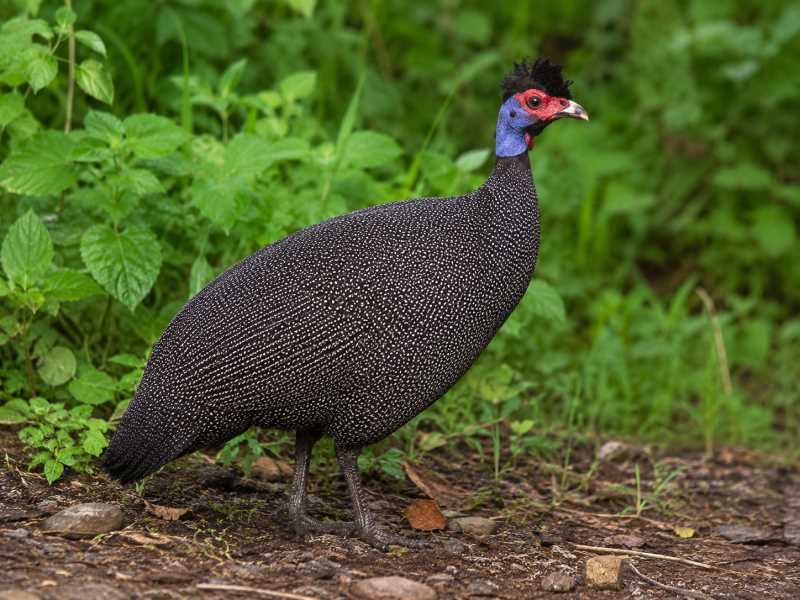
The Eastern Crested Guineafowl is about 45–50 centimetres long and weighs approximately 1.0–1.5 kilograms, although measurements vary between individuals and sources. Its body is dark grey to black and covered with numerous small, pale or whitish spots. The short, curly black crest is its most distinctive feature.
The head and upper neck are largely bare. The exposed skin is mainly blue, with red skin around the eye and on parts of the neck. The eyes are reddish, the bill is dark, and the legs are dark brown to black. The sexes are similar in appearance, although females are generally slightly smaller than males. Young birds have less-developed crests and more subdued plumage than adults.
Range and Habitat
The species occurs in eastern Africa, particularly Somalia, Kenya and north-eastern Tanzania. It also inhabits the islands of Zanzibar and Tumbatu. Records from Mozambique and South Africa generally refer to other members of the former Crested Guineafowl complex, especially the Southern Crested Guineafowl, Guttera edouardi, rather than the Eastern Crested Guineafowl in its current treatment.
Eastern Crested Guineafowls are resident rather than migratory. They favour scrub, dense thickets, forest margins, riverine vegetation, woodland and areas of tall grass where cover is available. They may occur in modified habitats when suitable dense vegetation remains, but they are more secretive and less associated with open savannah than the Helmeted Guineafowl.
Behaviour and Diet
Eastern Crested Guineafowls spend most of their time on the ground. They usually walk or run through leaf litter and undergrowth, scratching at the soil to uncover food. Their diet includes insects and other small invertebrates, seeds, roots and other plant material. Fallen fruit may also be taken where available.
The birds are generally sedentary but can make long daily movements while foraging. They may occur in small family groups or larger groups outside the breeding period. When disturbed, they normally run into dense cover, although they can make short, powerful flights and may roost in trees at night.
Breeding commonly coincides with seasonal rains, although nesting may occur at other times in equatorial areas. Pairs form strong bonds and construct a shallow scrape on the ground, usually concealed among dead leaves, grass or other vegetation. A typical clutch contains four or five eggs, with up to seven reported. Incubation lasts approximately 23–28 days. The chicks are precocial, leaving the nest soon after hatching and following the adults while feeding independently. They develop flight ability at an early age.
Identification Tips
Look for the following combination of features:
- A dark, heavily spotted body.
- A short, curly black crest rather than a tall casque or long plume.
- Bare blue skin on the head and neck, with red around the eye and on parts of the neck.
- A secretive, ground-dwelling manner in dense vegetation.
- A relatively compact shape and short tail.
The Eastern Crested Guineafowl can be confused with other members of the Crested Guineafowl group. Geographic range is important for identification because the Western Crested Guineafowl, Guttera verreauxi, and Southern Crested Guineafowl, Guttera edouardi, were formerly treated as part of a wider Guttera pucherani complex. The Eastern species is distinguished in part by its eastern African distribution, facial and neck skin colour, crest structure and vocal differences recognised by modern taxonomic checklists.
Conservation Status
The Eastern Crested Guineafowl is currently assessed as Least Concern. A global population estimate is not stated here because a reliable, current figure is not available from the sources consulted.
The species is not considered globally threatened, but local populations may be affected by clearance and fragmentation of woodland, scrub and forest-edge habitat. Hunting can also create pressure in parts of its range. Maintaining protected areas, retaining dense vegetation and monitoring local populations are important conservation measures, particularly where habitat is being converted or heavily disturbed.
Frequently Asked Questions
Where does the Eastern Crested Guineafowl live?
It occurs mainly in Somalia, Kenya and north-eastern Tanzania, including the islands of Zanzibar and Tumbatu. It is associated with scrub, thickets, woodland, forest edges and dense grass cover.
Is the Eastern Crested Guineafowl migratory?
No. It is generally resident, although individuals may travel considerable distances during daily movements in search of food and suitable cover.
What does the Eastern Crested Guineafowl eat?
Its diet includes insects and other invertebrates, seeds, roots and other plant material. It also takes fallen fruit when available.
How can the species be identified?
The most useful field marks are its dark body covered with pale spots, short curly black crest, bare blue head and neck, red facial skin and preference for dense ground-level cover.
How many eggs does it lay?
A typical clutch contains four or five eggs, although clutches of up to seven have been reported. Incubation lasts approximately 23–28 days.
Is the Eastern Crested Guineafowl endangered?
It is currently classified as Least Concern. However, local threats such as habitat loss, habitat fragmentation and hunting may affect populations in particular areas.
References
- BirdLife International. n.d. Eastern Crested Guineafowl Guttera pucherani Species Factsheet. BirdLife DataZone. Accessed 8 September 2026.
- BirdLife International. 2024. Handbook of the Birds of the World and BirdLife International Digital Checklist of the Birds of the World: Version 9. BirdLife International and Lynx Edicions. Digital checklist PDF. Accessed 8 September 2026.
- Gill, F., Donsker, D. and Rasmussen, P., eds. 2026. IOC World Bird List, version 15.2. International Ornithologists’ Union. IOC World Bird List. Accessed 8 September 2026.
- Cleveland Metroparks. n.d. Eastern Crested Guineafowl: Guttera pucherani. Zoo Resource Library. Species account. Accessed 8 September 2026.
- Cleveland Metroparks. n.d. Eastern Crested Guineafowl Fact Sheet. Zoo Resource Library. Fact sheet. Accessed 8 September 2026.
- del Hoyo, J., Collar, N. J., Christie, D. A., Elliott, A. and Fishpool, L. D. C. 2014. HBW and BirdLife International Illustrated Checklist of the Birds of the World, Volume 1: Non-passerines. Lynx Edicions and BirdLife International, Barcelona and Cambridge.
- Seavy, N. E., et al. 2015. Ecology and phylogeny of birds foraging at outdoor restaurants in Sweden. Biodiversity Data Journal 3: e6360. https://doi.org/10.3897/BDJ.3.e6360.
Related posts