Introduction
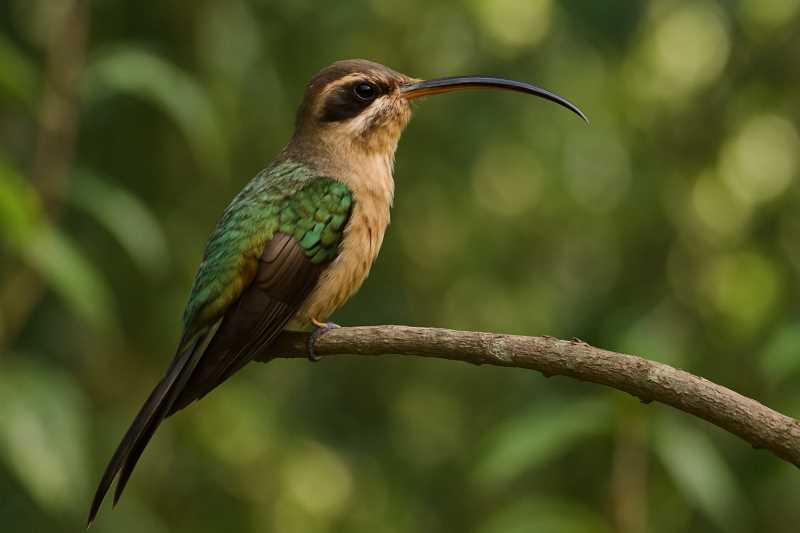
The Planalto Hermit (Phaethornis pretrei) is a medium-sized hummingbird of central and eastern South America. It is recognised by its long, slightly decurved bill, bronze-green upperparts, cinnamon rump and underparts, dark facial mask, and conspicuous white tail tips. Although associated with the Brazilian highlands, it also occurs in woodland, savanna, forest edges and gardens across a broad range.
Physical Description
The Planalto Hermit is approximately 12–15 cm long, including its long tail. It has a bronze-green back, a darker crown, a cinnamon or rufous rump, and warm ochre to cinnamon underparts. A dark mask across the lores and ear-coverts is bordered by pale buff facial stripes.
The bill is long and gently decurved, with a dark upper mandible and a reddish lower mandible. The central tail feathers are elongated and broadly tipped with white. The remaining tail feathers show contrasting dark bands and white tips, which are particularly noticeable when the bird is flying.
Males and females are broadly similar in plumage. Females are generally slightly smaller, while juveniles may show less strongly defined facial and tail markings than adults.
Range and Habitat
The Planalto Hermit occurs across much of eastern and south-central Brazil, extending into eastern Bolivia, Paraguay and northern Argentina. It is not restricted to the Cerrado, although the species is well represented in Cerrado landscapes and other areas of central Brazil.
It uses a variety of semi-open and lightly wooded habitats, including cerrado, dry and semi-humid woodland, gallery forest, forest borders, secondary growth, transition forest and tall shrubby vegetation. It may also visit gardens and other human-modified areas where suitable flowering plants are available. In Bolivia, it has been recorded in woodland, forest understorey, gallery forest and gardens, including areas on the eastern slopes of the southern Andes.
The species is generally associated with resident populations rather than long-distance migration, although local movements may follow flowering and food availability.
Where to See This Species
Calilegua National Park, Jujuy, Argentina
The Argentine National Biodiversity Information System records the Planalto Hermit as a regular species in Calilegua National Park. The park’s forest transitions, woodland edges and shrubby vegetation provide suitable habitat for this hummingbird. Look for it along forest margins and in flowering vegetation, especially in areas where woodland meets more open habitat.
Nearby accommodation: Libertador General San Martín is the practical gateway town, with hotels, guest houses and other basic accommodation.
El Rey National Park, Salta, Argentina
The species is also recorded as regular in El Rey National Park. Its mixture of forest, transition zones, streams and dense vegetation offers suitable feeding habitat. Quiet observation along access roads, woodland edges and flowering patches is likely to be more productive than searching deep inside closed forest.
Nearby accommodation: Salta is the main practical base, offering hotels, guest houses and self-catering accommodation, while park-area stays may be more limited.
Iguazú National Park, Misiones, Argentina
The Planalto Hermit has documented records from Iguazú National Park, where it occurs in forest-edge and secondary habitats as well as areas near flowering plants. It may occur alongside other hermit hummingbirds, so attention to the cinnamon rump, red lower mandible and boldly white-tipped tail is important.
Nearby accommodation: Puerto Iguazú is the principal gateway settlement, with hotels, guest houses, lodges and self-catering accommodation.
Behaviour and Diet
The Planalto Hermit is active during the day and is usually encountered alone while feeding. Males may sing singly, and individuals can defend feeding areas or important flower patches from other hummingbirds.
Nectar forms the main part of its diet. The bird visits tubular flowers and is an important pollinator of several plant species, including members of the Gesneriaceae and other hummingbird-pollinated plant groups. It also takes small insects and spiders, which provide additional protein.
Like other hermits, it may use a trap-lining strategy, visiting a regular circuit of flowering plants at intervals that allow nectar supplies to recover. This behaviour can carry pollen between widely separated plants and gives the species an important role in the pollination of woodland and savanna vegetation.
Breeding information is less well documented than the species’ distribution and feeding ecology. The female builds the small cup-shaped nest, using plant fibres and spider silk, often with lichens or other material on the outside for camouflage. A clutch usually contains two eggs, and the female is responsible for incubation and care of the young.
Identification Tips
- Look for a relatively large, long-tailed hummingbird with a long, slightly curved bill.
- The combination of an olive or bronze-green back and a contrasting cinnamon rump is distinctive.
- Note the dark facial mask bordered by pale buff stripes.
- The lower mandible is reddish, especially near its base.
- The long tail has conspicuous white tips and darker bands.
- Search in woodland edges, cerrado, shrubby vegetation, gallery forest and flowering gardens rather than assuming that the species is confined to dense forest.
- In areas where other hermits occur, compare the tail pattern, cinnamon rump and red lower mandible. The Planalto Hermit’s preference for more open and drier habitats can also help separate it from forest-associated relatives.
Conservation Status
The Planalto Hermit is assessed as Least Concern on the IUCN Red List. It has a broad distribution, occurs in several protected areas and remains locally common in suitable habitat. A precise global population estimate and reliable population trend are not available.
The principal concerns are the loss and fragmentation of native vegetation through agricultural expansion, urban development, road construction and other land-use changes. Protecting Cerrado, woodland, gallery forest and forest-edge habitats, maintaining native flowering plants, and managing protected areas effectively will help conserve the species and the pollination networks on which it depends.
Frequently Asked Questions
Where does the Planalto Hermit live?
It occurs mainly in eastern and south-central Brazil, with additional populations in eastern Bolivia, Paraguay and northern Argentina. It uses cerrado, woodland, gallery forest, forest edges, secondary growth and gardens.
How can the Planalto Hermit be identified?
Look for a long-tailed hummingbird with a bronze-green back, cinnamon rump and underparts, a dark facial mask, a reddish lower mandible and white-tipped tail feathers.
What does the Planalto Hermit eat?
Its diet consists mainly of nectar from tubular flowers. It also takes small insects and spiders, particularly when additional protein is needed.
Is the Planalto Hermit a migratory bird?
It is generally treated as a resident species across its range rather than a long-distance migrant. Local movements may occur as birds respond to flowering patterns and food availability.
Where can I see a Planalto Hermit in a protected area?
Documented protected-area records include Calilegua National Park, El Rey National Park and Iguazú National Park in Argentina. It is most likely to be found around forest edges, woodland transitions, shrubby vegetation and flowering plants.
Is the Planalto Hermit threatened?
The species is currently classified as Least Concern. Nevertheless, habitat destruction and fragmentation remain important local risks, particularly where Cerrado and woodland are converted for agriculture or development.
References
- BirdLife International
- IUCN Red List of Threatened Species
- Sistema de Información de Biodiversidad, Administración de Parques Nacionales, Argentina
Related posts