Introduction
The South African Shelduck, also known as the Cape Shelduck, is a large, goose-like waterfowl of southern Africa. Its accepted scientific name is Tadorna cana. It belongs to the duck, goose and swan family Anatidae and is closely associated with open wetlands in otherwise dry or semi-arid landscapes.
Physical Description
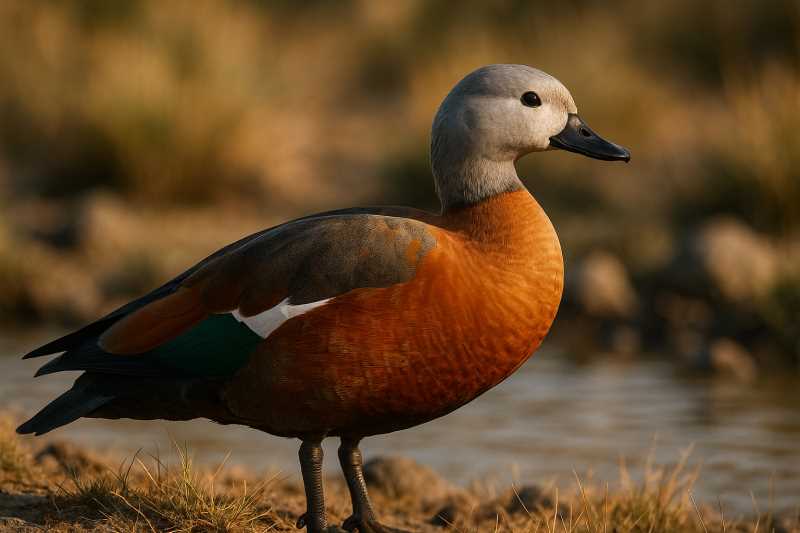
The South African Shelduck measures approximately 61–64 cm in length. Both sexes have a russet or chestnut-brown body, a slate-grey neck, dark grey legs and feet, a black bill and dark brown eyes.
The species is sexually dimorphic. The adult male has an entirely grey head, while the female has a variable amount of white on the face. The male’s secondary feathers may show a green sheen, producing a noticeable green wing patch in good light. In flight, the contrasting white, dark and iridescent wing pattern is conspicuous.
Juveniles are generally duller and browner than adults. Young females may show less white on the face than older females, and the amount of white increases or varies as the bird matures.
Range and Habitat
The South African Shelduck occurs mainly in South Africa, especially the southern Free State and the Western, Northern and Eastern Cape provinces. It also occurs in central and southern Namibia and south-eastern Botswana. Records from Zimbabwe and Eswatini are generally regarded as vagrants. The species is not endemic to South Africa.
It favours open country with suitable water, including shallow permanent freshwater or brackish wetlands, farm dams, estuaries, sewage farms, lakes and other impoundments. Breeding sites often have exposed muddy margins and short surrounding vegetation, which allows the birds to see approaching predators or other shelducks. The species is particularly associated with wetlands in grassland and semi-arid regions.
South African Shelducks are resident overall, but they undertake local and medium-distance movements after breeding. Birds may leave scattered breeding localities and gather at larger water bodies to moult. Ring recoveries have recorded movements of more than 1,000 km, although these movements are better described as dispersal or moult movements than as regular seasonal migration.
Behaviour and Diet
During the breeding season, pairs are generally territorial and may nest alone. Outside the breeding season, South African Shelducks can gather at productive feeding areas and important moulting wetlands, sometimes forming sizeable concentrations.
The species is an omnivorous waterfowl. Natural foods include benthic invertebrates taken from shallow, receding water and submerged aquatic plants. Outside the breeding season, birds may also feed in agricultural areas and use spilled or waste grain, including maize, sorghum and wheat.
Breeding is concentrated in the austral winter and early spring, although nesting records extend from March to December. The main breeding period is usually June to September, with a peak in July and August. Pairs commonly use pre-existing cavities in the ground, especially abandoned aardvark or springhare burrows. Porcupine holes, cavities among rocks and other suitable shelters may also be used.
A typical clutch contains about 7–11 eggs. The female incubates the eggs for approximately 30 days while the male remains nearby and guards the nest area. Both parents tend the young, which remain dependent for several weeks and fledge at about 10 weeks. The species is usually single-brooded, although a pair may attempt to replace a lost brood of small chicks.
Identification Tips
- Look for a large, long-bodied waterfowl with a russet-brown body and a grey neck.
- An adult male has a uniformly grey head.
- An adult female usually has some white on the face, but the extent of white is highly variable.
- The dark bill and dark grey legs help separate it from some other large brown waterfowl.
- In flight, note the contrasting white and dark wing pattern and, particularly in males, the green sheen on the secondaries.
- Juveniles are duller and browner than adults.
- Egyptian Goose can appear similar in flight because of its size and contrasting wing pattern, but the South African Shelduck is distinguished by its russet body, grey neck and sexually dimorphic head pattern.
Conservation Status
The South African Shelduck is assessed globally as Least Concern on the IUCN Red List. The 2025 regional assessment for South Africa, Lesotho and Eswatini also lists it as Least Concern. BirdLife South Africa gives an estimated regional population of approximately 17,000 mature individuals, but population-trend evidence is uncertain and varies between datasets. The regional assessment records a decreasing trend while also noting that some atlas indicators suggest stability or increase.
Important pressures include disturbance at concentrated moulting sites, wetland degradation, changes in water availability, climate-related shifts in rainfall and flooding of breeding burrows. Outbreaks of avian botulism have caused mortality in the past and remain a potential threat. Hunting is regulated in parts of the range, but available assessments do not identify it as a major current threat.
Conservation measures include protecting important wetlands, maintaining suitable water levels and shoreline habitat, monitoring major breeding and moulting sites, and applying appropriate hunting regulations. Several important sites occur within protected areas or Ramsar wetlands, although some key water bodies are on private or working land.
Frequently Asked Questions
Where does the South African Shelduck live?
It occurs mainly in South Africa, with additional populations in central and southern Namibia and south-eastern Botswana. It uses open wetlands such as farm dams, estuaries, shallow lakes and other permanent or semi-permanent water bodies.
Is the South African Shelduck migratory?
It is considered resident overall rather than a regular migrant. However, individuals can travel considerable distances between breeding areas and larger wetlands used for moulting and feeding.
How can male and female South African Shelducks be told apart?
The male has an entirely grey head. The female has a variable white facial area, which may be small in young birds or more extensive in older females. Both sexes have russet-brown bodies and grey necks.
What does the South African Shelduck eat?
Its diet includes benthic invertebrates, submerged aquatic plants and, especially outside the breeding season, grain or agricultural waste in cultivated areas.
Where does the South African Shelduck nest?
It usually nests in a cavity in the ground, often an abandoned aardvark or springhare burrow. It may also use porcupine holes, cavities among rocks or other sheltered sites.
Is the South African Shelduck endangered?
No. It is currently classified as Least Concern globally and regionally. Nevertheless, wetland degradation, disturbance at moulting sites, disease outbreaks and changing rainfall patterns require continued monitoring and habitat protection.
References
- Allan, D. G. 2023. “South African Shelduck (Tadorna cana), version 2.0.” In Birds of the World, edited by G. D. Engelbrecht. Cornell Lab of Ornithology. https://doi.org/10.2173/bow.soashe1.02
- BirdLife International. 2016. “Tadorna cana.” The IUCN Red List of Threatened Species 2016: e.T22680007A92838539. https://doi.org/10.2305/IUCN.UK.2016-3.RLTS.T22680007A92838539.en
- BirdLife International. 2024. “Species factsheet: South African Shelduck Tadorna cana.” BirdLife DataZone. Accessed 8 September 2026. https://datazone.birdlife.org/species/factsheet/south-african-shelduck-tadorna-cana
- Geldenhuys, J. N. 1977. “Feeding habits of South African Shelduck.” South African Journal of Wildlife Research 7: 5–9.
- Geldenhuys, J. N. 1980. “Breeding ecology of the South African Shelduck in the southern Orange Free State.” South African Journal of Wildlife Research 10: 94–111.
- Geldenhuys, J. N. 1981. “Moults and moult localities of the South African Shelduck.” Ostrich 52: 129–134.
- Hockey, P. A. R., W. R. J. Dean and P. G. Ryan, eds. 2005. Roberts: Birds of Southern Africa. 7th ed. Cape Town: Trustees of the John Voelcker Bird Book Fund.
- Shaw, K. and M. Paul. 2025. “South African Shelduck.” In The 2025 Red Data Book of Birds of South Africa, Lesotho and Eswatini, edited by A. T. K. Lee, S. Rose, S. Banda, S. B. Bezeng, M. I. Maphalala, D. H. Maphisa and S. Smit-Robinson. BirdLife South Africa. Accessed 8 September 2026. https://www.birdlife.org.za/red-data-book/red-list/south-african-shelduck/
- International Ornithologists’ Union. 2025. IOC World Bird List, version 15.2. World Bird Names. Accessed 8 September 2026. https://www.worldbirdnames.org/new/ioc-lists/master-list-2/
Related posts