Introduction
The Ocellated Quail (Cyrtonyx ocellatus) is a secretive New World quail in the family Odontophoridae. It is a resident of montane habitats from southern Mexico through Guatemala, El Salvador and Honduras to northern Nicaragua. The species is locally uncommon and difficult to observe, but its distinctive facial pattern and richly marked plumage make it one of the most recognisable quails of the Central American highlands.
Physical Description
The Ocellated Quail is a compact, ground-dwelling bird measuring approximately 20–25 cm in length. It has a short tail, rounded wings, strong legs and a stout body adapted to walking and foraging among leaf litter, grass and low vegetation.
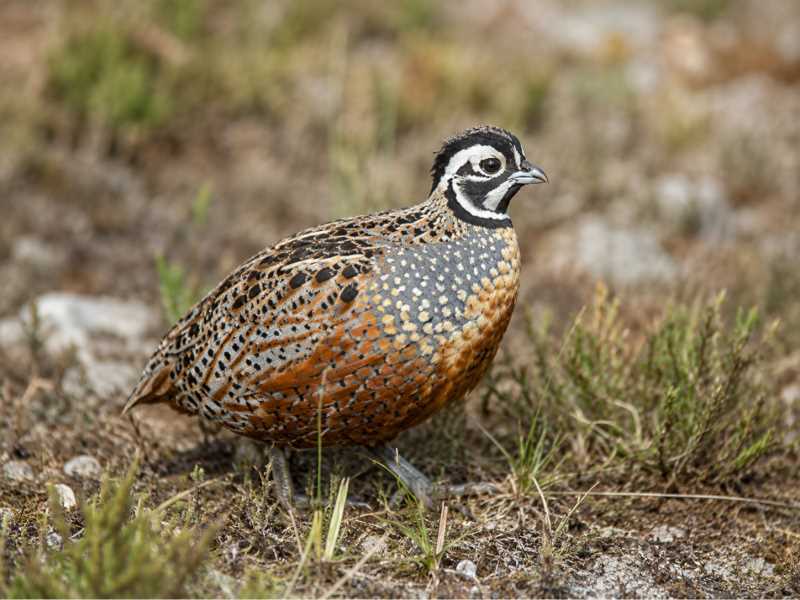
Adult males have a conspicuous black-and-white facial pattern, a long tawny-brown crest that falls backwards over the crown and nape, and strongly patterned upperparts. The breast and flanks are brownish to cinnamon, with dark barring, scalloping or spotting. The female is generally duller, with a more subdued brown and buff face, less contrasting body plumage and similar but less strongly marked crest and upperparts.
The name “ocellated” refers to eye-like markings associated with the species’ patterned plumage. These markings are not always obvious in the field, particularly when the bird is moving through shaded vegetation. Juveniles are less brightly marked than adults and may show more uniformly brown, buff and streaked plumage.
Range and Habitat
The Ocellated Quail occurs in the mountains of southern Mexico and Central America. Its documented range extends from the Sierra Madre de Chiapas and adjacent highlands of southern Mexico through Guatemala, El Salvador and Honduras to northern Nicaragua. Records are unevenly distributed, and the species may be overlooked because of its secretive behaviour and preference for dense ground cover.
It is generally associated with montane pine, pine–oak and other open highland woodland, as well as brushy fields, forest edges and regenerating clearings. Historical accounts and ornithological surveys place it broadly between about 750 and 3,000 metres above sea level, although local habitat use varies. It is considered resident rather than migratory, and no regular long-distance migration is known.
The Ocellated Quail is treated as a monotypic species. Its relationship with the closely related Montezuma Quail (Cyrtonyx montezumae) has received taxonomic discussion, but current major bird lists recognise them as separate species.
Behaviour and Diet
This quail is usually encountered singly, in pairs or in small family groups, although its social organisation is not well documented. It spends most of its time on the ground and tends to remain concealed in grasses, brush, leaf litter and forest undergrowth. When disturbed, it may stay motionless until approached closely before making a short, powerful flush.
The species is believed to feed mainly on plant material gathered from the ground, including seeds and other available vegetation, supplemented by insects and other small invertebrates. It forages by walking and scratching through leaf litter and loose soil, particularly where woodland cover adjoins open or lightly disturbed ground.
Detailed information on courtship, nesting and incubation remains limited. Reproduction has been documented in Guatemala, including records of young birds, but published information is insufficient to support precise general figures for clutch size or incubation period across the species’ range. Breeding activity appears to be associated with seasonal conditions that improve food availability and ground cover.
Identification Tips
Look for the following combination of features:
- A compact, short-tailed quail that usually stays on the ground.
- A distinctive black-and-white facial pattern in the male.
- A long, backward-falling tawny crest.
- Brown, cinnamon and buff plumage with dark barring, scalloping or spotting.
- Occurrence in highland pine, pine–oak and brushy montane habitats.
- Reluctant flushing from dense cover, often followed by a rapid, low flight.
The most relevant comparison is the Montezuma Quail, which belongs to the same genus and also has a bold facial pattern. The two species are largely separated geographically, but where identification is necessary, the Ocellated Quail generally appears less sharply patterned overall, with browner and more subdued body plumage and different flank markings. Geographic location is often an important part of a reliable identification.
Conservation Status
The Ocellated Quail is classified as Vulnerable on the IUCN Red List. The species has a restricted and fragmented range, and available information suggests that it is uncommon in at least parts of that range. A precise global population estimate is not included here because reliable current figures are unavailable.
The principal conservation concerns are the loss, fragmentation and degradation of montane woodland and associated brushy habitat. Agricultural expansion, logging, settlement growth and the gradual conversion of highland vegetation can reduce the cover and feeding areas needed by this ground-dwelling quail. Limited knowledge of its distribution and population trends also makes assessment difficult.
Important conservation measures include protecting remaining pine–oak and montane forest, maintaining connected areas of dense ground vegetation, improving surveys in poorly documented parts of the range and supporting local conservation programmes. Further research on population size, breeding ecology, habitat requirements and the status of historical populations would help guide conservation planning.
Frequently Asked Questions
Where does the Ocellated Quail live?
It lives in montane regions from southern Mexico through Guatemala, El Salvador and Honduras to northern Nicaragua. It is associated mainly with pine, pine–oak and other highland woodland, together with brushy clearings and forest edges.
Is the Ocellated Quail migratory?
The species is considered resident. There is no established evidence of regular long-distance migration, although local movements may occur in response to food, cover and seasonal conditions.
How can the Ocellated Quail be identified?
The strongest field marks are its compact shape, short tail, long tawny crest and, in males, a striking black-and-white facial pattern. Brown and cinnamon body plumage with dark markings is also characteristic.
What does the Ocellated Quail eat?
It is a ground-feeding omnivore that is thought to eat seeds and other plant material, supplemented by insects and other small invertebrates found in leaf litter and low vegetation.
Is the Ocellated Quail endangered?
It is classified as Vulnerable on the IUCN Red List. Habitat loss, fragmentation and degradation in the Central American highlands are the main documented conservation concerns.
Is the Ocellated Quail the same species as the Montezuma Quail?
No. They are closely related members of the genus Cyrtonyx, but current major taxonomic authorities recognise the Ocellated Quail and Montezuma Quail as separate species.
References
- American Ornithologists’ Union. 2008. Check-list of North American Birds, 7th edition, 51st supplement. American Ornithologists’ Union. Species account and distribution summary for Cyrtonyx ocellatus. https://americanornithology.org/wp-content/uploads/2019/07/AOSChecklistGall-Charad.pdf
- BirdLife International. n.d. Ocellated Quail Cyrtonyx ocellatus Species Factsheet. BirdLife DataZone. Accessed 8 September 2026. https://datazone.birdlife.org/species/factsheet/ocellated-quail-cyrtonyx-ocellatus
- Eitniear, J. C. and K. Eisermann. 2009. Status and recent sightings of Ocellated Quail. International Journal of Galliformes Conservation 1: 85–93.
- Eitniear, J. C., C. I. Rodríguez-Flores, C. A. Soberanes-González and M. d. C. Arizmendi. 2020. Ocellated Quail (Cyrtonyx ocellatus), version 1.0. In T. S. Schulenberg, ed., Birds of the World. Cornell Lab of Ornithology. https://doi.org/10.2173/bow.ocequa1.01
- Eisermann, K. and C. Avendaño. 2018. An update on the inventory, distribution and residency status of bird species in Guatemala. Bulletin of the British Ornithologists’ Club 138: 148–229. https://doi.org/10.25226/bboc.v138i3.2018.a10
- Gill, F., D. Donsker and P. Rasmussen, eds. 2026. IOC World Bird List, version 15.2. International Ornithologists’ Union. Accessed 8 September 2026. https://www.worldbirdnames.org/
- Gould, J. 1837. Ortyx ocellatus. Proceedings of the Zoological Society of London 1836, part 4, no. 44, p. 75.
Related posts