
Introduction
Mrs. Hume’s Pheasant, also known as Hume’s Pheasant or the Bar-tailed Pheasant, is a resident forest pheasant of north-eastern India, Myanmar, south-western China and northern Thailand. Its accepted scientific name is Syrmaticus humiae. The species is recognised in the pheasant family, Phasianidae, and is known for the male’s richly coloured plumage and long, barred tail. (ww.worldbirdnames.org)
The name commemorates Mary Anne Hume, wife of the British naturalist Allan Octavian Hume. Unlike many pheasants, Mrs. Hume’s Pheasant is not known to undertake long-distance migration, although it may move locally in response to habitat conditions and seasonal resources.
Physical Description
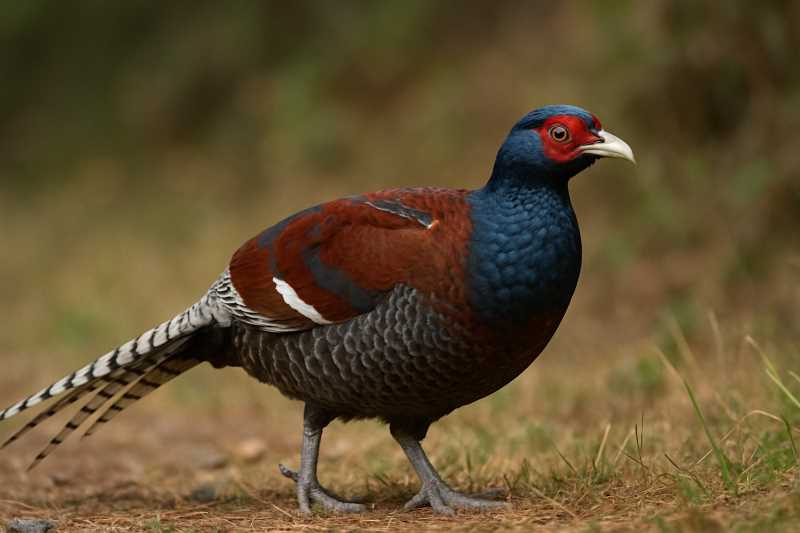
Mrs. Hume’s Pheasant is a medium to large, long-tailed pheasant. Adult males may reach about 90 centimetres in total length, while females are smaller, at approximately 60 centimetres. The male has a dark chestnut to reddish-brown body, a blue-green to purplish head and neck, and a long tail marked with conspicuous pale barring. The face is largely bare, with red facial skin, and the bird lacks the prominent crest seen in some related pheasants. (cza.nic.in)
Females are smaller and more cryptically coloured. Their plumage is mainly brown, buff and grey, with mottling and barring that help them blend into leaf litter, grasses and undergrowth. Both sexes have barred tails, but the male’s tail is substantially longer and more striking. Juveniles resemble females and develop adult male plumage gradually if male.
Two subspecies are commonly recognised in major taxonomic treatments: the nominate Syrmaticus humiae humiae in the western part of the range, and Syrmaticus humiae burmanicus in the eastern part. Their differences are mainly associated with geography and variation in plumage and structure. (worldbirdnames.org)
Range and Habitat
Mrs. Hume’s Pheasant has a fragmented distribution extending from north-eastern India through Myanmar and into south-western China, with the range also reaching northern Thailand. In India, it occurs principally in parts of Manipur, Mizoram and neighbouring hill regions. Chinese populations include areas of Yunnan and Guangxi, with records also reported from south-western Guizhou. It is a local resident rather than a regular long-distance migrant. (digitalrepository.wii.gov.in)
The species uses open or broken woodland rather than uniformly dense forest. Suitable habitats include mixed evergreen and deciduous forest, oak and pine woodland, scrub, forest edges, grassy or rocky slopes, bracken and areas with a well-developed understorey. It is generally associated with upland terrain, although recorded elevations vary between regions. Studies in northern Thailand recorded birds at approximately 1,365 to 1,560 metres, while records from China and India extend from roughly 750 metres to 3,000 metres. (oiseaux.net)
Habitat is often naturally patchy, and further fragmentation by roads, settlements, agriculture and other development can isolate local populations. Research in China indicates that the birds select sites with substantial tree cover, suitable undergrowth and distance from roads and human settlements, particularly for roosting and breeding. (sciencedirect.com)
Behaviour and Diet
Mrs. Hume’s Pheasant is primarily terrestrial and spends much of the day walking through woodland, scrub and grassy slopes while searching for food. It is shy and usually difficult to observe in dense habitat. When disturbed, it can run quickly and may make a short, rapid flight to cover or slightly higher ground. Birds may roost in trees at night, and roost-site studies have recorded a preference for sheltered branches with substantial overhead cover. (sciencedirect.com)
The diet includes seeds, fruits, shoots, leaves and other plant material, supplemented by invertebrates such as insects. The exact composition varies with season and habitat. Foraging takes place mainly on or near the ground, where the birds probe leaf litter and low vegetation.
Breeding takes place during spring, with April and May reported as important breeding months in parts of the range. Males establish areas and display to females, using posture, movement and vocalisations. The female makes a simple ground nest, usually concealed beneath vegetation, a bush or another form of cover. Clutch-size reports vary, but published Indian field material gives approximately six to ten eggs. The chicks are precocial and leave the nest soon after hatching, remaining with the female while they learn to forage and avoid predators. (cza.nic.in)
Identification Tips
- Look for a large, long-tailed pheasant in broken upland woodland, scrub or grassy, rocky slopes.
- The male is distinctive for its dark chestnut body, blue-green neck, red facial skin and long tail with pale bars.
- The female is considerably smaller and predominantly brown, mottled and cryptic, but still has a barred tail.
- The absence of a prominent crest helps separate the species from some other long-tailed pheasants.
- The species is generally more likely to be detected by brief movement, a flush from cover or a call than by prolonged views in the open.
- Do not confuse the brown female with other forest pheasants without checking the combination of habitat, body shape, tail barring and the absence of a crest. In regions where ranges overlap, careful attention is needed because several pheasant species use similar upland woodland habitats.
Conservation Status
Mrs. Hume’s Pheasant is currently assessed as Vulnerable on the IUCN Red List. The change from the former Near Threatened assessment is reflected in the IUCN’s 2023-1 status tables. (nc.iucnredlist.org)
The principal threats are continuing habitat loss and fragmentation, logging, agricultural expansion, infrastructure development, hunting and trapping. Small, isolated populations are especially vulnerable to local poaching and disturbance. BirdLife International has also identified the species as a conservation priority because its remaining populations are scattered and its suitable habitat is declining. (birdlifedata.blob.core.windows.net)
Important conservation measures include protecting remaining forest and woodland, maintaining habitat connections between occupied areas, preventing hunting and trapping, and monitoring populations with repeat surveys. Protected areas in India, Myanmar, China and Thailand provide some protection, but effective enforcement and cooperation with local communities remain essential. The species is also listed in Appendix I of the Convention on International Trade in Endangered Species of Wild Fauna and Flora, which restricts international commercial trade. (cites.org)
Frequently Asked Questions
Where can Mrs. Hume’s Pheasant be found?
It occurs in fragmented upland habitats from north-eastern India through Myanmar and into south-western China, with additional populations in northern Thailand.
What does the male Mrs. Hume’s Pheasant look like?
The male has a chestnut-brown body, a blue-green to purplish neck, red facial skin and a long tail with pale bars. It may reach about 90 centimetres in total length.
How can the female be identified?
The female is smaller and mainly brown, grey and buff, with mottled plumage and a barred tail. Her subdued colouration provides camouflage in leaf litter and dense undergrowth.
What does Mrs. Hume’s Pheasant eat?
Its diet consists mainly of plant material, including seeds, fruits, shoots and leaves, with insects and other invertebrates taken opportunistically.
Is Mrs. Hume’s Pheasant endangered?
It is currently classified as Vulnerable on the IUCN Red List. Habitat loss, fragmentation, hunting and trapping are the main recognised threats.
Does Mrs. Hume’s Pheasant migrate?
It is considered a resident species rather than a long-distance migrant. Local movements may occur, but there is no evidence that it undertakes regular seasonal migration over large distances.
References
- BirdLife International. 2001. Threatened Birds of Asia: The BirdLife International Red Data Book. BirdLife International, Cambridge. Species account for Syrmaticus humiae. https://birdlifedata.blob.core.windows.net/red-data-books/syrmhumi.pdf
- BirdLife International. 2023. Syrmaticus humiae. IUCN Red List assessment and BirdLife species data, species factsheet no. 22679330. BirdLife DataZone. https://datazone.birdlife.org/species/factsheet/22679330. Accessed 8 September 2026.
- Gill, F., Donsker, D. and Rasmussen, P., eds. 2026. IOC World Bird List, version 15.2. IOC World Bird Names. https://www.worldbirdnames.org/. Accessed 8 September 2026.
- Iamsiri, A. and Gale, G. A. 2008. Breeding season habitat use by Hume’s Pheasant Syrmaticus humiae in the Doi Chiang Dao Wildlife Sanctuary, northern Thailand. Zoological Studies, 47(2), 138-145. https://zoolstud.sinica.edu.tw/Journals/47.2/138.pdf
- Jiang, A.-W., Zhou, F., Lu, Z., Han, X.-J., Sun, R.-J. and Li, X.-L. 2006. Roost-site selection of Mrs Hume’s Pheasant (Syrmaticus humiae) in Guangxi, China. Zoological Research, 27(3), 249-254. https://www.zoores.ac.cn/article/id/2561
- International Union for Conservation of Nature. 2023. 2023-1 IUCN Red List status tables. IUCN Red List of Threatened Species. https://nc.iucnredlist.org/redlist/content/attachment_files/2023-1_RL_Table_7.pdf
- Wildlife Institute of India. 2008. Galliformes of India: Mrs Hume’s Pheasant, Syrmaticus humiae. Envis Bulletin. Wildlife Institute of India, Dehradun. https://digitalrepository.wii.gov.in/bitstreams/216ad11b-cb40-4333-ad5c-443fa8f52f71/download
- Convention on International Trade in Endangered Species of Wild Fauna and Flora. n.d. Appendices I, II and III. CITES. https://cites.org/eng/app/appendices.php. Accessed 8 September 2026.
Related posts


