
Introduction
The Mossy-nest Swiftlet (Aerodramus salangana) is a small swift in the family Apodidae. It occurs in parts of Indonesia and Malaysia, where it is associated with lowland forest, limestone landscapes and cave systems. Unlike swiftlets that build nearly pure saliva nests, it constructs a cup-shaped nest containing moss and other plant material, making the nest an important aid to identification.
Physical Description
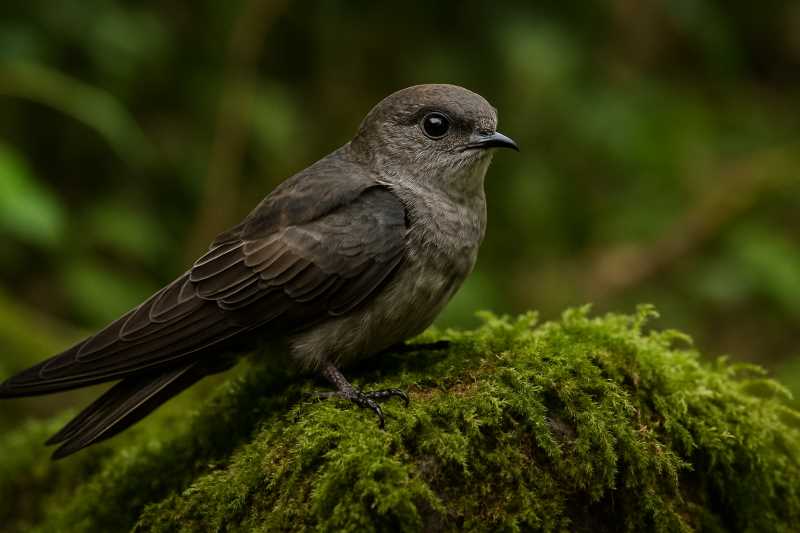
The Mossy-nest Swiftlet is a compact, streamlined bird measuring about 12 cm in length. It has dark brown to blackish-brown upperparts, generally paler brown underparts and a shallowly forked tail. The plumage is relatively uniform, with limited contrast between the back and underside. A subtle greenish gloss may be visible in good light, particularly on the upperparts.
Males and females are not reliably separable by appearance. Juveniles are likely to resemble adults, although detailed age-related differences are not well documented in standard field references. As with other Aerodramus swiftlets, the species has long, narrow wings and is adapted for continuous, agile flight.
Range and Habitat
The Mossy-nest Swiftlet is distributed across parts of the Sunda region. Its range includes Java, western Sumatra, northern Borneo and several nearby islands, including the Natuna and Derawan island groups. It has also been reported from other islands, but identification and taxonomic treatment can vary between sources.
The species uses tropical moist lowland forest, coastal and inland landscapes, limestone areas and caves. It commonly nests inside dark caves or other sheltered cavities, while feeding over forest, clearings, wetlands and nearby settlements. It is generally resident rather than a long-distance migrant, although local movements may occur between nesting caves and feeding areas.
Where to See This Species
Gomantong Caves, Sabah, Malaysia
Gomantong Caves are one of the most reliable places to look for the species because Mossy-nest Swiftlets breed inside the cave system. The species occurs alongside other similar, echo-locating swiftlets, so identification is most dependable when birds are associated with their distinctive moss-covered nests. A local guide and careful observation are recommended, as cave access and nest activity can vary.
Nearby accommodation: The practical bases are the villages and guesthouses around Sukau and the wider Kinabatangan area, with lodges and other visitor accommodation available in the regional wildlife-tourism corridor.
Gunung Halimun-Salak National Park, West Java, Indonesia
The Mossy-nest Swiftlet is recorded from this large protected area, which contains extensive humid forest and rugged volcanic and limestone landscapes. It may be encountered in flight over forest edges and valleys, while suitable caves and rock shelters provide potential nesting habitat. Birding is generally more productive with local park guides who know active roosting and nesting sites.
Nearby accommodation: Visitors commonly use guesthouses, homestays and small lodges in villages around the park, or stay in the Bogor and Sukabumi areas when making day or multi-day visits.
Gunung Gede-Pangrango National Park, West Java, Indonesia
The species is listed for Gunung Gede-Pangrango National Park, where forested mountain slopes, valleys and rocky areas provide suitable habitat. Because swiftlets are difficult to identify in open flight, observers should look for repeated activity around known cave entrances or sheltered rock faces and should compare birds carefully with Cave Swiftlets and other local Aerodramus species.
Nearby accommodation: The main gateway settlements are Cibodas and Cipanas, where visitors can find guesthouses, homestays and small hotels close to park entrances.
Behaviour and Diet
The Mossy-nest Swiftlet spends much of the day on the wing, flying rapidly and manoeuvring over forest, open ground and water while catching flying insects. It may forage alone, in pairs or in mixed groups with other swiftlets. Large gatherings can form near caves, especially around the daily departure and return periods.
The species uses echolocation to navigate in dark nesting caves. Its nest is a small cup made from moss, plant fibres, feathers and other fine material bound together with saliva. Nests are attached to cave walls, ceilings or ledges, often in humid, sheltered locations. Breeding information is incomplete and may vary geographically, but colonies can contain several swiftlet species nesting in the same cave system.
The original article described the species as an important insectivore. This is well supported, but claims that it is a significant pollinator are not well established and are therefore not included here.
Identification Tips
- Look for a small, fast-flying swiftlet with dark brown upperparts, paler brown underparts and a shallowly forked tail.
- The plumage is fairly uniform, without a strong white rump or sharply contrasting throat.
- A greenish sheen may be visible on the upperparts in favourable light.
- In flight, identification is difficult because several local swiftlets are similar in size, shape and colour.
- The most reliable identification often comes from the nest. Mossy-nest Swiftlet nests contain substantial moss and other plant material, rather than being formed mainly from clean, translucent saliva.
- Do not assume that every swiftlet entering a cave is this species. Cave Swiftlet, Black-nest Swiftlet and Edible-nest Swiftlet may occur in the same region or cave system.
Conservation Status
The Mossy-nest Swiftlet is currently assessed as Least Concern. Its broad distribution and apparently substantial population reduce the likelihood that it qualifies for a threatened category at global level, although detailed population data are limited.
Potential local pressures include disturbance of breeding caves, alteration of surrounding forest, pollution and poorly managed harvesting or other human activity in cave systems. The species is less directly targeted than swiftlets whose nests consist largely of edible saliva, because the moss-rich nest is generally unsuitable for the edible-nest trade. Even so, shared cave habitat and nesting colonies can be affected by disturbance.
Useful conservation measures include protecting important caves, retaining surrounding forest, regulating access during breeding periods and distinguishing Mossy-nest Swiftlet colonies from commercially harvested swiftlet species.
Frequently Asked Questions
Where does the Mossy-nest Swiftlet live?
It occurs in parts of Indonesia and Malaysia, including Java, western Sumatra, northern Borneo and nearby islands. It uses humid lowland forest, limestone areas, caves and other sheltered rocky habitats.
Why is it called the Mossy-nest Swiftlet?
The name refers to its nest, which incorporates moss and other plant material bound together with saliva. This gives the nest a rougher, more heavily textured appearance than the mostly saliva-based nests of some related swiftlets.
Is the Mossy-nest Swiftlet the same as the Edible-nest Swiftlet?
No. They are different species. The Mossy-nest Swiftlet has a nest containing considerable foreign material such as moss, while the Edible-nest Swiftlet is known for its predominantly saliva-based nest.
Can the species be identified easily in flight?
Usually not. Several swiftlets have similar brown plumage, size and flight behaviour. Identification is more reliable when the bird is associated with a known nest or when an experienced observer can compare it with local species.
Does the Mossy-nest Swiftlet migrate?
It is generally regarded as a resident species rather than a long-distance migrant. Local movements between caves, forest and feeding areas may occur.
What is the conservation status of the Mossy-nest Swiftlet?
The species is assessed as Least Concern globally. Local populations may still be affected by cave disturbance, habitat loss and poorly managed human activity around nesting sites.
References
- IOC World Bird List
- IUCN Red List of Threatened Species
- Treubia, Birds of Halimun-Salak National Park, West Java, Indonesia
Related posts


