Introduction
The Minute Hermit (Phaethornis idaliae) is a small hummingbird endemic to Brazil. It inhabits humid Atlantic Forest, especially lowland and foothill forest in the states of Bahia, Espírito Santo, Minas Gerais and Rio de Janeiro. Like other hermits, it is more subdued in colour than many hummingbirds and is often detected by its rapid flight, distinctive calls or display behaviour rather than by a prolonged view.
Physical Description
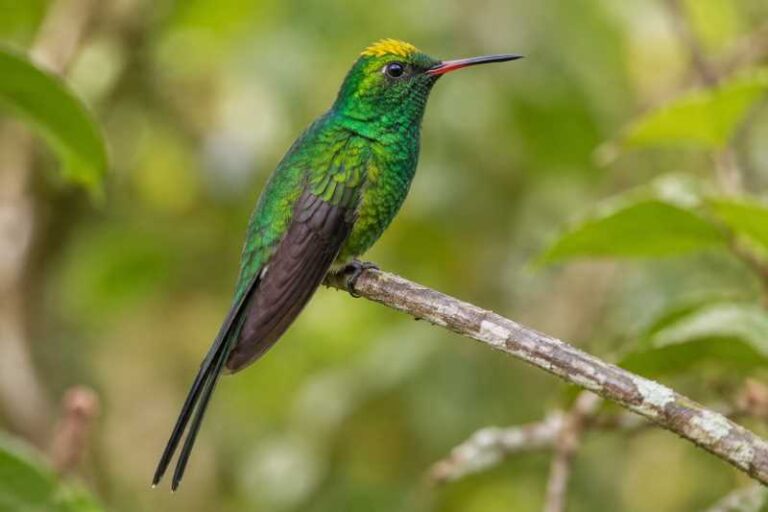
The Minute Hermit is a small, slender hummingbird measuring about 8–10 cm in length and weighing roughly 2.6–3 g. It has bronze-green upperparts, a dark head with pale facial stripes, a long, slightly curved bill and dark wings. The tail is dark, with elongated central feathers ending in conspicuous white tips.
The sexes are broadly similar, although males and females can differ subtly in the tone and strength of the throat and breast plumage. The throat and upper breast may appear warm brown, ochre or reddish-brown, while the underparts are generally paler and greyer. Immature birds are often darker and duller, with a shorter-looking tail and less clearly developed adult patterning.
The white-tipped central tail feathers, small size and long bill are useful features when the bird is seen in the shaded understorey. Its plumage is relatively plain compared with many brilliantly coloured hummingbirds, which helps it blend into dense vegetation.
Range and Habitat
The Minute Hermit is endemic to Brazil and occurs in a relatively narrow band of Atlantic Forest from south-eastern Bahia south through Espírito Santo and eastern Minas Gerais to Rio de Janeiro. It is regarded as a resident species rather than a long-distance migrant.
It is primarily associated with humid lowland and foothill forest, including mature Atlantic Forest, forest edges, dense secondary growth and areas containing tangled understorey vegetation. Records are particularly associated with low elevations, although local observations may extend into foothill habitats. Dense patches of heliconias, palms, vines and other flowering plants can provide important feeding and display sites.
The species has also been recorded in landscapes containing plantations or other modified habitats adjacent to native forest. Such records do not remove the importance of intact forest, because the availability of sheltered understorey, flowering plants and suitable breeding sites remains central to its ecology.
Where to See This Species
Reserva Natural Vale, Linhares, Espírito Santo, Brazil
The Reserva Natural Vale protects a large tract of Atlantic Forest and tabuleiro forest near Linhares. The Minute Hermit is documented from the reserve, where birdwatchers look for it in shaded forest understorey and dense vegetation. Birdwatching visits require advance arrangements and are conducted with authorised guides.
Nearby accommodation: Linhares is the practical gateway, with hotels, guest houses and other town-based accommodation. Accommodation options in the wider Linhares–Sooretama area may also be suitable.
Reserva Biológica de Sooretama, Espírito Santo, Brazil
The Minute Hermit has been recorded in the Sooretama area, one of the most important remaining blocks of lowland Atlantic Forest in Espírito Santo. Visits are controlled and should be arranged in advance, generally for educational, research or conservation purposes. Dense forest margins and understorey habitat are the most appropriate places to search.
Nearby accommodation: Linhares and Sooretama provide the nearest practical bases, with hotels, guest houses and self-catering accommodation available in the surrounding towns.
Reserva Ecológica de Guapiaçu, Cachoeiras de Macacu, Rio de Janeiro, Brazil
The Minute Hermit is included on the documented bird list of the Reserva Ecológica de Guapiaçu, commonly known as REGUA. The reserve contains mature forest, restored habitats and dense understorey within the Atlantic Forest landscape of the Serra dos Órgãos region. It is a realistic site for targeted birdwatching, although the species may require patient searching.
Nearby accommodation: The REGUA area and nearby Guapimirim and Cachoeiras de Macacu provide lodges, guest houses and other nature-tourism accommodation.
Behaviour and Diet
The Minute Hermit is generally solitary outside the breeding context. It forages actively through the understorey, moving rapidly between flowers and often remaining difficult to follow once it enters dense vegetation. It feeds mainly on nectar and also takes small arthropods, including insects and spiders, which provide additional protein.
Males may defend feeding areas or display sites and are known to gather in communal courtship arenas, or leks, in dense understorey. During courtship, males sing and perform controlled hovering and short display flights near low perches. Heliconia thickets and other dense vegetation can be important settings for this behaviour.
The female builds the nest and raises the young. The nest is a small, elongated or cone-shaped structure made from soft plant material and other fibres, often suspended beneath the inner surface of a palm, fern, banana or heliconia leaf. A typical clutch contains two elongated eggs, and nests may be placed close to the ground, sometimes around 1.5 metres above it. Breeding activity has been reported during periods when food and flowering resources are available, but a precise year-round breeding schedule is not well established.
As a nectar-feeding hummingbird, the Minute Hermit contributes to the pollination of flowering plants. Its use of both native forest and some adjacent modified habitats may also help connect plant communities across fragmented landscapes, provided suitable vegetation remains available.
Identification Tips
- Look for a very small, brownish or bronze-green hermit hummingbird in dense Atlantic Forest understorey.
- Check for the long, slightly curved bill and the two elongated central tail feathers with broad white tips.
- The dark head, pale facial stripes and warm brown or ochre throat help separate it from plainer green hummingbirds.
- It is usually seen alone, moving quickly between flowers or hovering briefly near low vegetation.
- Do not rely on body size alone. Several Brazilian hermit hummingbirds are small, and identification is more reliable when bill shape, tail pattern, throat colour and range are considered together.
- Immature birds may appear darker, with a shorter-looking tail and less distinct adult plumage.
Conservation Status
The Minute Hermit is currently assessed as Least Concern. It is endemic to Brazil and has a restricted distribution within the Atlantic Forest, but the available global assessment does not place it in a threatened category.
The main conservation concern is the continued loss and fragmentation of Atlantic Forest, particularly in lowland areas. Logging, agricultural expansion, urban development, roads and the gradual degradation of forest edges can reduce the dense vegetation and flowering resources required by the species. Protection of remaining forest, restoration of degraded corridors and careful management of protected areas are important conservation measures.
The species is resident, so the condition of its breeding and feeding habitat within its Brazilian range is especially important. More field research would improve understanding of its population trend, breeding success and ability to persist in fragmented landscapes.
Frequently Asked Questions
Where does the Minute Hermit live?
The Minute Hermit lives in Brazil’s Atlantic Forest, from south-eastern Bahia through Espírito Santo and eastern Minas Gerais to Rio de Janeiro. It is most strongly associated with humid lowland and foothill forest.
Is the Minute Hermit migratory?
It is considered a resident species. There is no evidence that it undertakes regular long-distance migration, although individuals may make local movements in response to food availability and habitat conditions.
What does the Minute Hermit eat?
It feeds mainly on flower nectar and supplements its diet with small insects, spiders and other arthropods.
How can the Minute Hermit be identified?
Useful features include its very small size, long slightly curved bill, bronze-green upperparts, dark head, warm-toned throat and dark tail with white-tipped central feathers. It is usually found in dense understorey vegetation.
Where is the best place to see a Minute Hermit?
Documented wildlife-viewing locations include Reserva Natural Vale near Linhares, Reserva Biológica de Sooretama in Espírito Santo and Reserva Ecológica de Guapiaçu in Rio de Janeiro. Access conditions vary, so visitors should check arrangements before travelling.
Is the Minute Hermit threatened?
The species is currently classified as Least Concern. Nevertheless, the loss and fragmentation of Atlantic Forest remain important long-term concerns because the bird depends on suitable forest understorey and flowering vegetation.
References
- BirdLife International
- IOC World Bird List
- WikiAves
Related posts