Exploring the Unique World of the Maned Owl (Jubula lettii)
In the dense, shadowy canopies of Africa’s tropical rainforests resides a rare and intriguing bird: the maned owl (Jubula lettii). Distinguished by its unique appearance and elusive nature, the maned owl captivates ornithologists and bird enthusiasts alike. Although not widely known outside specialized circles, this species offers fascinating insights into avian biodiversity and the complexities of rainforest ecosystems.
Habitat and Distribution
The maned owl is endemic to the tropical rainforests of Central and West Africa. Its range extends from Liberia and Sierra Leone in the west, through to the Democratic Republic of Congo and Uganda in the east. Preferring the dense, humid environments of lowland forests and swamps, the maned owl is well-adapted to life beneath the canopy, where it can avoid predators and hunt in relative seclusion.
The owl’s habitat is characterized by high biodiversity and complex ecological interactions, providing ample opportunities for the maned owl to thrive. However, its existence is closely tied to the health of its forest environment, making habitat conservation critical for its survival.
Physical Characteristics
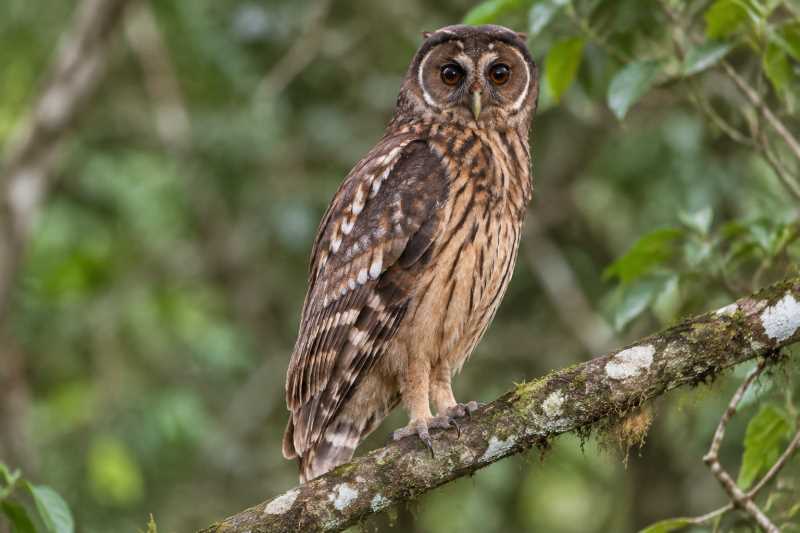
The maned owl is a medium-sized owl, measuring approximately 38 to 44 centimeters in length. Its most striking feature is the mane-like arrangement of elongated feathers on its head and neck, giving the appearance of a lion’s mane. This unique feather configuration not only contributes to its name but also aids in camouflage, breaking up its outline among the forest foliage.
The owl’s plumage is predominantly dark brown with lighter, mottled patterns that help it blend seamlessly into its surroundings. Its large, forward-facing eyes, typical of owls, provide excellent night vision, crucial for its nocturnal lifestyle. The maned owl’s beak and talons are well adapted for seizing and consuming a variety of prey, which includes small mammals, birds, and insects.
Behavior and Ecology
A nocturnal predator, the maned owl is most active during the night, particularly at dawn and dusk. It employs a sit-and-wait hunting strategy, perching silently on branches until it spots or hears potential prey. Its flight is silent, thanks to specialized feathers that minimize noise, allowing it to approach prey undetected.
The maned owl is a solitary species, often seen alone or in pairs. Little is known about its breeding habits, but like most owls, it is believed to nest in tree cavities or abandoned nests of other birds. Its call, a series of low hoots, is rarely heard, adding to the mystery surrounding this elusive bird.
Conservation Status
The International Union for Conservation of Nature (IUCN) currently classifies the maned owl as Least Concern. However, this status does not fully reflect the potential threats it faces. The primary threat to the maned owl is habitat destruction due to logging, agriculture, and human settlement expansion, which leads to fragmentation of its forest habitat.
Conservation efforts aimed at protecting large swathes of rainforest are essential for the survival of the maned owl and countless other species that share its habitat. By safeguarding these ecosystems, we ensure the preservation of biodiversity and the ecological services provided by these critical habitats.
Importance in Biodiversity and Ecosystem Health
The maned owl plays a significant role in its ecosystem as both predator and prey. By controlling populations of small mammals and insects, it helps maintain ecological balance. Moreover, as a part of the food web, it contributes to the health and functioning of its ecosystem.
The presence of the maned owl is also an indicator of forest health, as it requires large, undisturbed tracts of habitat to thrive. Its decline would signal broader environmental issues, prompting conservationists to address potential ecological threats.
Human Interaction and Research
Due to its elusive nature, the maned owl has limited interaction with humans. Most knowledge about the species comes from sporadic sightings and indirect observations. Researchers continue to study this enigmatic bird to better understand its behavior, ecology, and role within the rainforest.
Conservation organizations and researchers emphasize the importance of education and awareness to protect the maned owl and its habitat. By promoting sustainable forestry practices and supporting conservation initiatives, people can contribute to the preservation of this remarkable species.
Conclusion
The maned owl (Jubula lettii) is a testament to the rich biodiversity of Africa’s tropical rainforests. Its unique appearance and secretive lifestyle make it a fascinating subject for study and a symbol of the need to preserve our planet’s natural heritage. Protecting the maned owl requires a collective effort to conserve the rainforests it calls home, ensuring that future generations can continue to marvel at this extraordinary bird.
Related posts