Introduction
Ludwig’s Bustard (Neotis ludwigii) is a large, ground-dwelling bustard of the dry interior and western regions of southern Africa. It is a near-endemic species of arid landscapes, with a patchy distribution influenced by rainfall and food availability. Although it is often difficult to locate, its size, distinctive head pattern and broad black-and-white wings make it an impressive bird to encounter.
Physical Description
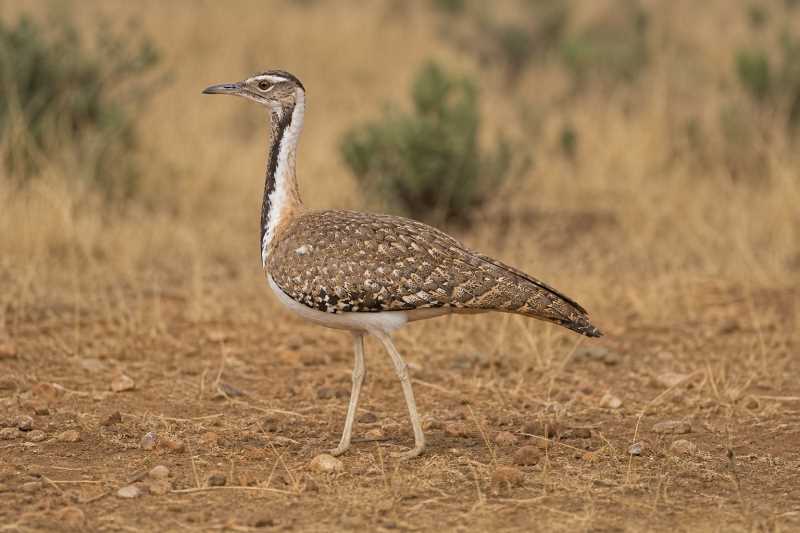
Ludwig’s Bustard is a large bustard with a long neck, long legs and a heavy, broad-winged body. Males are substantially larger and heavier than females. Adult males weigh approximately 3.1–6.0 kg, while females generally weigh about 2.2–3.0 kg. Males also have longer wings and legs.
The plumage is predominantly sandy brown, grey and white, providing effective camouflage in open Karoo and Namib habitats. The face and foreparts of the neck are grey-brown, contrasting with paler areas on the rear of the neck and upperparts. The head has a dark crown, and the neck may show warm buff or orange-brown tones. In flight, the broad wings show a strong black-and-white pattern that is more conspicuous than the bird’s subdued colours when it is standing on the ground.
Females and immature birds are smaller and generally less strongly marked than adult males. Juveniles are more muted overall, with softer contrasts in the head and neck pattern.
Range and Habitat
Ludwig’s Bustard occurs in the arid zone of south-western Africa. Its range extends from extreme south-western Angola through western Namibia and into much of western and central South Africa. It also reaches south-western Botswana, while non-breeding birds may occasionally occur in Lesotho.
The species is associated with open country, including the Namib, Namibian escarpment, Succulent Karoo, Nama Karoo and other semi-arid scrub and grassland habitats. It generally avoids dense woodland and heavily vegetated areas. Suitable habitat consists of open plains, sparse shrubland, gravelly flats and lightly grassed semi-desert where birds can walk and forage while maintaining a clear view of their surroundings.
Ludwig’s Bustard is not a strictly sedentary species. Individuals and groups may move considerable distances in response to local rainfall, temporary increases in plant growth and changes in food availability. These movements can be unpredictable, making local abundance vary substantially between seasons and years.
Where to See This Species
Tankwa Karoo National Park, Western Cape and Northern Cape, South Africa
SANParks lists Ludwig’s Bustard among the park’s birds, and notes that it may occur in some numbers during winter and spring. The open plains and sparse scrub of the Tankwa Karoo are particularly suitable, and birds are often detected in flight or as pairs and small parties on open ground.
Nearby accommodation: The park provides campsites, cottages and other self-catering accommodation. Middelpos and Ceres are practical gateway settlements for additional guest houses, lodges and other accommodation.
Karoo National Park, Western Cape, South Africa
Ludwig’s Bustard is recorded for Karoo National Park and should be looked for along the park’s open plains route. The combination of Nama Karoo vegetation, broad views and lightly vegetated country provides appropriate habitat, although sightings are not guaranteed.
Nearby accommodation: The park has a rest camp with self-catering cottages and camping facilities. Beaufort West is the nearest practical town and offers additional hotels, guest houses and self-catering accommodation.
Namaqua National Park, Northern Cape, South Africa
Ludwig’s Bustard is included on the official bird checklist for Namaqua National Park. The park’s arid western landscapes, open scrub and sparse vegetation are consistent with the species’ habitat preferences. Visitors should search open plains and low scrub while remaining alert for large birds crossing the landscape in flight.
Nearby accommodation: Skilpad Rest Camp and coastal camping areas provide accommodation within the park. Springbok is the nearest recognised town for hotels, guest houses, lodges and self-catering accommodation.
Behaviour and Diet
Ludwig’s Bustard is mainly terrestrial and spends much of its time walking slowly through open country while scanning for food and danger. It may occur alone, in pairs or in small groups, with larger temporary gatherings possible where rainfall has produced favourable feeding conditions.
The species is an opportunistic omnivore. Its diet includes grasshoppers and other insects, seeds, green plant material and, when available, small reptiles or other small vertebrates. Invertebrate prey can be especially important when adults are feeding young.
Breeding takes place on the ground. The female lays a small clutch, usually one or two eggs, in a simple scrape or shallow depression. She undertakes most or all of the incubation and early care of the young. As in other bustards, the chicks are able to walk soon after hatching and are dependent on camouflage and concealment rather than parental defence for protection from predators.
Movements are linked to rainfall and seasonal resources. Birds may undertake daily flights between feeding areas and roosting sites, as well as longer-distance movements across the arid interior.
Identification Tips
- Look for a large, long-legged bird walking across open Karoo, Namib or semi-desert habitat.
- The overall colour is sandy brown, grey and white, with strong camouflage when the bird is standing among low scrub.
- The dark crown and contrasting pale and grey-brown head and neck pattern are useful at closer range.
- In flight, the broad wings show conspicuous black-and-white markings.
- Adult males are noticeably larger and more heavily built than females.
- Do not rely on size alone when separating Ludwig’s Bustard from other large bustards. Habitat, the head pattern and the black-and-white wing pattern are more useful when combined.
- Denham’s Bustard can be a confusing comparison in parts of southern Africa, but Ludwig’s Bustard is generally associated with drier western and Karoo environments and has a different overall head and wing pattern.
Conservation Status
Ludwig’s Bustard is classified as Endangered on the IUCN Red List. The population is considered to be declining, although precise current population figures are not available.
The most significant documented threat is collision with overhead power lines and other wires. The species’ large body, open-country habits and regular flights between feeding and roosting areas make it particularly vulnerable to collisions. Habitat loss and degradation caused by agricultural expansion, infrastructure development and other land-use changes also reduce the amount and quality of suitable habitat. Hunting may pose an additional regional threat.
Important conservation measures include protecting large areas of intact arid habitat, improving knowledge of movements and population trends, monitoring collision mortality and marking or rerouting dangerous power lines. Conservation planning must account for the species’ nomadic movements, because birds may use different areas from year to year.
Frequently Asked Questions
Where does Ludwig’s Bustard live?
It lives in arid and semi-arid regions of south-western Africa, including western Namibia and western and central South Africa. Smaller or occasional parts of its range extend into south-western Angola, Botswana and Lesotho.
Is Ludwig’s Bustard migratory?
It is not a conventional long-distance migrant with a fixed annual route. Instead, it is nomadic or partially nomadic, moving in response to rainfall, plant growth and food availability.
What does Ludwig’s Bustard eat?
Its diet includes insects, seeds, green plant material and some small vertebrates. Grasshoppers and other large insects can be important food items, particularly when birds are breeding.
How can Ludwig’s Bustard be identified?
It is a large, long-legged bustard with sandy brown, grey and white plumage, a dark crown and broad wings with conspicuous black-and-white markings in flight. Adult males are much larger than females.
Where is the best place to see Ludwig’s Bustard?
Tankwa Karoo National Park, Karoo National Park and Namaqua National Park are publicly accessible locations where the species is documented. Tankwa Karoo is particularly noted for sightings during winter and spring, but local conditions and rainfall strongly affect the chances of finding it.
Why is Ludwig’s Bustard endangered?
The principal documented threat is collision with overhead power lines and other wires. Habitat loss and degradation, together with possible hunting pressure in some areas, add to the conservation concern.
References
- BirdLife International
- IUCN Red List of Threatened Species
- South African National Parks
Related posts