Introduction
The Louisiade Pitta, Erythropitta meeki, is a little-known forest-floor bird endemic to Rossel Island, also known as Yela, in Papua New Guinea’s Louisiade Archipelago. It belongs to the pitta family, Pittidae, and is currently treated as a valid species by major taxonomic authorities. The species was formerly included within the Red-bellied Pitta complex, but differences in plumage, structure and geography support its treatment as a separate island endemic. (itis.gov)
For more than a century, the Louisiade Pitta was known almost entirely from museum specimens collected in the late nineteenth and early twentieth centuries. The species was subsequently absent from the scientific record for many decades, contributing to its current classification as Data Deficient rather than allowing a confident assessment of its abundance or population trend. Photographs and sound recordings obtained on Rossel Island in July 2022 provided important modern confirmation that the bird survives. (searchforlostbirds.org)
The Louisiade Pitta is especially significant because its entire known range is restricted to one relatively small tropical island. That narrow distribution makes the condition of Rossel Island’s lowland and foothill forests important, while the scarcity of field observations means that basic aspects of its ecology remain poorly documented.
Physical Description
The Louisiade Pitta is a compact, short-tailed, long-legged passerine, typical of the ground-dwelling pittas. Published identification accounts place it at approximately 16–18 centimetres in length, although detailed modern measurements from living birds are limited. It has the stout body, strong legs, short rounded wings and relatively substantial bill associated with the genus Erythropitta. (birdforum.net)
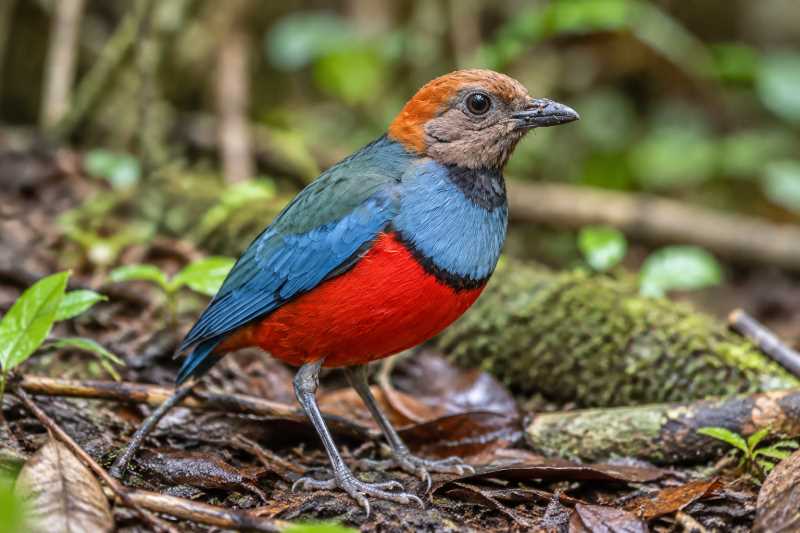
Adults are strongly coloured but can be difficult to see in shaded rainforest. The head is principally pale brown to greyish brown, with warmer reddish or ferruginous tones extending over the crown and hindneck. The throat and sides of the head are comparatively subdued, described as greyish brown or sooty rather than brightly marked. This relatively plain head pattern helps separate the species from several related pittas with more conspicuous blue or black facial markings.
The upperparts are dark green, especially across the mantle and back. The rump and short tail are blue, while the upperwing coverts are deep blue. The flight feathers are dark, with variable small white markings or patches on the inner webs of some primaries. In the field, the combination of a green back, blue rump and blue wing panels can be striking when the bird moves through an opening, although those colours are often concealed when it is walking beneath vegetation.
The underparts provide the most useful identification feature. A broad glossy blue band crosses the breast, followed by a broad black band or dark lower-breast marking that may be finely edged or tipped with red. The lower breast, belly and remaining underparts are vivid scarlet or deep red. This blue, black and red arrangement is characteristic of the species and gives it a distinctive appearance among the birds of Rossel Island.
Available descriptions indicate some sexual differences. Females are generally duller than males, with greener rather than intensely blue breast and wing tones. The difference appears to be one of colour intensity and pattern development rather than a radically different plumage. As with many pittas, sex can be difficult to determine from a brief field observation, particularly in poor light or when only the back of the bird is visible.
Juveniles are much less colourful. Young birds are described as dull brown above, with a subdued blue rump and tail. The underparts are paler than those of adults, the throat is whitish, and the breast is dark brown with pale spotting. This cryptic juvenile plumage is consistent with the camouflage needed by a bird that spends much of its time close to the forest floor. The timing and extent of the transition into adult plumage have not been well documented.
The species was described from Rossel Island by Walter Rothschild in 1898. Its scientific name commemorates the British collector Albert Stewart Meek, who collected birds in the Louisiade region. The older combination Pitta meeki and the former subspecific name Erythropitta erythrogaster meeki may therefore appear in museum catalogues and older literature. (worldbirdnames.com)
Range and Habitat
The Louisiade Pitta is endemic to Rossel Island in Milne Bay Province, Papua New Guinea. Rossel is the easternmost major island of the Louisiade Archipelago and is also known as Yela. No other island or mainland population is reliably documented. The species should therefore be treated as a single-island endemic, not as a bird distributed broadly across the Louisiade island group. (en.wikipedia.org)
Rossel Island is mountainous and heavily forested. Its highest elevations approach 840 metres, while much of the island consists of lowland forest, wooded valleys, ridges and foothills. The Louisiade Pitta is associated with lowland and foothill rainforest, including dense humid forest and, according to available accounts, some secondary woodland. There is no reliable evidence that it undertakes seasonal migration, and it is generally regarded as resident.
The species’ preferred habitat appears to be structurally complex forest with shaded ground, leaf litter and dense understorey vegetation. Pittas typically forage on the ground or just above it, so intact litter, fallen branches, roots and damp soil are likely to be more important than the high canopy alone. The modern photographic record came from a forested ridge near cultivated gardens and a village path above Abeleti Beach, suggesting that the species may tolerate some habitat adjoining small-scale agriculture. This observation should not be interpreted as proof that it is secure in heavily modified landscapes. (macaulaylibrary.org)
The available evidence is too limited to define a precise elevational range. Records and descriptions support occurrence from lowland forest into foothill habitat, but there are not enough confirmed observations to establish whether the species becomes uncommon at higher elevations or uses montane forest more regularly. Similarly, no well-supported geographic variation or subspecies is currently recognised. The species is treated as monotypic in commonly consulted taxonomic accounts.
Rossel Island retains extensive forest, but its conservation context is not free from concern. Regional assessments have identified logging, mining and other forms of land-use change as potential threats to the island’s fragile forest ecosystems. Because the Louisiade Pitta has such a small known range, even localised habitat clearance could be significant. At present, however, the scale of any population reduction has not been quantified. (sprep.org)
Where to See This Species
The Louisiade Pitta is not associated with a well-developed birdwatching reserve or formal public wildlife park. The only verified place to search is Rossel Island itself, where the species is endemic and where modern photographic and acoustic records have been obtained. Access is remote and should be arranged with local communities and experienced Papua New Guinea-based operators. Observers should avoid entering gardens, village land or forest without permission.
Rossel Island, Milne Bay Province, Papua New Guinea
Rossel Island is the only confirmed locality for the Louisiade Pitta. The most useful habitat is likely to be lowland and foothill rainforest, particularly shaded forest edges, tracks, ridge paths and areas of dense undergrowth near intact woodland. A documented 2022 observation occurred on the south-eastern side of a forested ridge near Abeleti, close to cultivated gardens and a village route. The bird was heard at several times of day and photographed, demonstrating that careful searches near occupied settlements can produce records, although this does not make the species easy to find. (macaulaylibrary.org)
Because the Louisiade Pitta is shy, ground-dwelling and seldom seen, a visit should be planned as a targeted field expedition rather than a conventional casual birding stop. Quiet early-morning searches may be sensible, but the available observation indicates that calling or movement may also occur later in the day. No dependable public hide, marked birding trail or regular viewing season has been verified.
Nearby accommodation: Jinjo, the principal settlement on Rossel Island, is the practical local base for arranging community support, guiding and basic overnight accommodation. Visitors should expect to organise village stays, locally arranged lodging or camping in advance rather than rely on a documented commercial birding lodge.
No second or third public venue could be verified from authoritative or dependable biodiversity sources. Other islands in the Louisiade Archipelago should not be presented as Louisiade Pitta sites merely because they lie within the same island group.
Behaviour and Diet
Very little is known about the behaviour of the Louisiade Pitta. It is described as shy and seldom seen, and available modern records indicate a bird that remains close to the ground in rainforest and forest-edge vegetation. Like other pittas, it is likely to move by walking or hopping through leaf litter rather than spending much time perched in the open. Its short wings are suited to brief, direct flights through dense vegetation, while its strong legs are adapted to terrestrial foraging.
The species is probably solitary or encountered singly outside the breeding season, but this has not been adequately studied on Rossel Island. There are no robust published estimates of territory size, home-range use or social organisation. Observers should therefore avoid treating general pitta behaviour as confirmed information for this species.
The diet has not been documented in detail. The bill, legs and ground-foraging habits suggest that the Louisiade Pitta probably takes small invertebrates from leaf litter and damp soil. Likely prey may include insects, insect larvae, spiders, worms and other small forest-floor organisms, as in better-known Erythropitta species. These items should be regarded as informed ecological expectations rather than a verified species-specific diet. There is currently no sound basis for listing particular fruits, amphibians or reptiles as regular food of the Louisiade Pitta.
The bird’s bright adult plumage may be conspicuous when exposed, but its behaviour and habitat make it easy to overlook. It may pause beneath low vegetation, cross a path quickly, or remain motionless when approached. The 2022 observation also included sound recordings, showing that vocal detection can be important even when visual encounters are rare. The vocal repertoire is still poorly known, and comparisons with the Papuan Pitta are tentative rather than definitive. (ebird.org)
Breeding biology is essentially undocumented. There is no reliable published information on nest structure, clutch size, incubation period, parental care, breeding season or fledging success for the Louisiade Pitta. Pittas commonly build domed or enclosed nests on or near the ground, but that general pattern should not be assumed to describe this species without direct evidence. Local knowledge and carefully designed field surveys may be important for filling this gap.
Identification Tips
Look for a small, compact bird walking on the forest floor in shaded lowland or foothill rainforest. The most useful field marks are:
- A brown or grey-brown head with warmer reddish tones over the crown and hindneck.
- A dark green back and mantle.
- A blue rump and short blue tail.
- Deep blue wing coverts, contrasting with dark flight feathers.
- A greyish or sooty throat rather than a strongly patterned face.
- A broad blue breast band followed by a dark blackish band.
- Bright scarlet lower underparts.
- A short tail, sturdy bill and long legs.
A bird seen only from behind may show little more than the green back, blue rump and short tail. A bird that turns sideways should reveal the blue breast band and red belly, which together are more distinctive than any single upperpart colour.
The Louisiade Pitta is not expected to overlap with another pitta species on Rossel Island, so confusion with a genuinely similar local pitta should be limited. The geographically nearest related pittas are found on other islands or in New Guinea, including the Papuan Pitta and members of the former Red-bellied Pitta complex. In comparison with several of those birds, the Louisiade Pitta is notable for its relatively subdued brown head, strong blue breast band, broad dark band below the blue and intensely red lower underparts.
It should not be confused with a brightly coloured kingfisher simply because both may show blue and red. Pittas are stockier, shorter-tailed and strongly terrestrial, whereas kingfishers usually have a larger bill, a more upright posture and more obvious perching behaviour. The Louisiade Pitta’s habit of walking through leaf litter is an important clue.
Conservation Status
The Louisiade Pitta is currently classified as Data Deficient on the IUCN Red List. This category does not mean that the species is safe or common. It means that the available information is insufficient to make a reliable assessment of extinction risk. The species’ extremely restricted distribution, limited number of modern records and lack of population surveys make a more precise category difficult to assign. (datazone.birdlife.org)
Historical collecting records were sparse, and the bird was absent from the scientific record for many decades before its photographic rediscovery in 2022. Modern evidence confirms survival, but it does not establish population size, distribution across Rossel Island or long-term trend. Reports from local residents during earlier fieldwork suggested that the bird may have persisted, but such information has not yet been converted into a quantitative population estimate.
Potential threats include forest clearance, logging, mining activity and degradation of lowland and foothill habitat. The effect of hunting is unclear, and there is no dependable evidence that hunting is a major threat to the species. Introduced predators and disease have also not been adequately assessed. Because the Louisiade Pitta is restricted to one island, threats that may appear local in scale could affect a substantial proportion of the global population.
Important conservation measures would include systematic surveys across Rossel Island, protection of remaining lowland and foothill forest, documentation of local ecological knowledge, and assessment of the effects of logging, mining and agricultural expansion. Acoustic surveys and camera trapping may be particularly useful because the bird is shy, terrestrial and difficult to observe directly. Conservation planning should be developed with Rossel Island communities and relevant Papua New Guinean authorities, with respect for customary land ownership and local access arrangements.
The 2022 photographic and sound records demonstrate that the Louisiade Pitta is not extinct, but they also highlight how little is known about it. Until further surveys are completed, the scientifically responsible position is to regard the species as a surviving but poorly understood island endemic whose conservation needs cannot yet be measured confidently.
Frequently Asked Questions
Where does the Louisiade Pitta live?
The Louisiade Pitta is endemic to Rossel Island, also known as Yela, in the Louisiade Archipelago of Milne Bay Province, Papua New Guinea. Its documented habitat is lowland and foothill rainforest, including dense forest near some small cultivated areas.
Is the Louisiade Pitta extinct?
No. Photographs and sound recordings obtained on Rossel Island in July 2022 confirmed that the species survives. Its population size and trend remain unknown, which is why it is classified as Data Deficient rather than assigned a more specific threat category.
What does the Louisiade Pitta look like?
It is a small, compact pitta with a brownish head, green back, blue rump and wings, a blue breast band, a dark band below the blue and bright red lower underparts. Females and juveniles are generally duller than adult males.
What does the Louisiade Pitta eat?
Its detailed diet has not been studied. It is expected to forage on the forest floor for small invertebrates such as insects, larvae, spiders and worms, but species-specific feeding observations are scarce.
Where can I see a Louisiade Pitta?
Rossel Island is the only verified location. The bird is extremely difficult to see, and there is no established public birdwatching reserve or regular viewing site documented for the species. Visits require careful logistical planning, local permission and appropriate guidance.
Why is the Louisiade Pitta Data Deficient?
There are too few confirmed records to estimate its population, range within Rossel Island or long-term trend. The species’ rediscovery confirms survival but does not provide enough information for a reliable assessment of extinction risk.
References
- BirdLife International
- IUCN Red List of Threatened Species
- IOC World Bird List
Related posts