Introduction
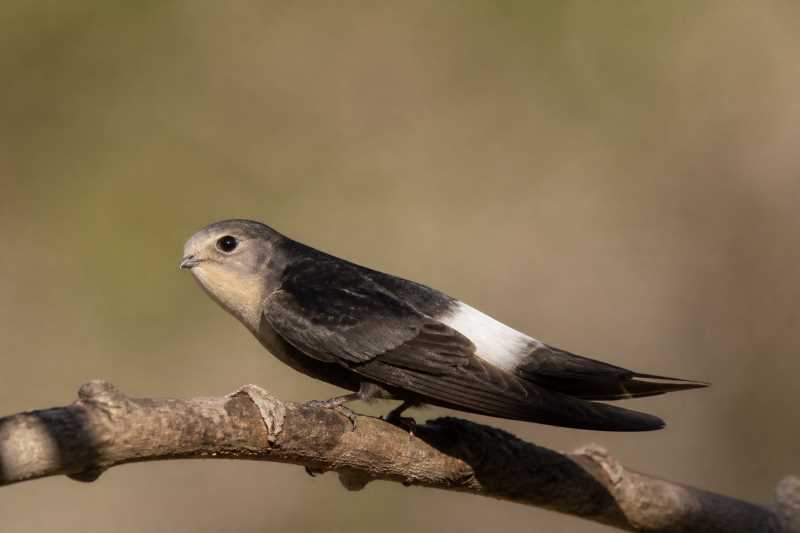
The Horus Swift (Apus horus) is a small African swift in the family Apodidae. It is a fast, aerial insectivore with dark plumage, a pale throat and a broad white rump in the typical form. The species is distributed across sub-Saharan Africa and is especially associated with open country, sandy banks and other areas where suitable nesting cavities are available.
Physical Description
The Horus Swift is approximately 16 centimetres long, with a compact body, long pointed wings and a moderately forked tail. Its plumage is generally dark brown to blackish, although lighting and geographic variation can make it appear browner.
Key features include:
- A broad, usually diffuse white throat patch that blends into the cheeks and upper breast.
- A relatively broad white rump patch that may extend onto the flanks.
- A medium-depth tail fork, less pronounced than that of the White-rumped Swift.
- Long, narrow wings suited to fast, manoeuvrable flight.
There is no well-established sexual dimorphism in the field. Plumage varies between individuals, and some birds have greatly reduced or brownish rump markings. Young birds may appear slightly duller and less sharply marked than adults, but age can be difficult to assess in flight.
Range and Habitat
The Horus Swift occurs widely but unevenly across sub-Saharan Africa. Its range extends from eastern and southern Africa northwards through Kenya, Uganda and Ethiopia, with additional populations in central and western Africa, including recently documented records in Senegal. In southern Africa, it occurs locally in countries including South Africa, Zimbabwe, Botswana, Mozambique, Namibia and Zambia.
Many populations are resident or make only local movements. Some southern African birds undertake seasonal movements, and the species may be more noticeable in different parts of its range according to rainfall and the availability of flying insects.
It usually forages over open habitats such as grassland, savanna, open woodland, wetlands, coastal dunes and semi-arid country. Breeding sites are often associated with sandy or earthy banks containing old tunnels excavated by bee-eaters, kingfishers, woodpeckers or martins. Artificial banks and suitable cavities in buildings may also be used. The species generally avoids dense forest and is not primarily a bird of large urban centres.
Where to See This Species
Kruger National Park, Limpopo and Mpumalanga, South Africa
South African National Parks lists the Horus Swift for Kruger National Park, and specifically notes regular sightings near the bridge over the Levuvhu River in the Pafuri region. Scan open airspace above riverine vegetation, woodland edges and nearby sandy areas, particularly when other swifts are active.
Nearby accommodation: Park camps, campsites and lodges are available in and around northern Kruger. Musina and Phalaborwa are practical outside-park gateway towns with hotels, guest houses and self-catering accommodation.
Lake Nakuru National Park, Rift Valley, Kenya
The Horus Swift is included in recent bird records for Lake Nakuru National Park. Open grassland, lake margins and the park’s surrounding escarpment habitats provide suitable areas for watching swifts feeding overhead. The species may be seen among mixed swift flocks, so careful attention to the white rump, throat pattern and tail fork is useful.
Nearby accommodation: Nakuru is the main practical accommodation centre, with hotels, guest houses, lodges and self-catering options serving visitors to the park.
South Luangwa National Park, Eastern Province, Zambia
Bird checklists and birding records document the Horus Swift in South Luangwa National Park. Open woodland, floodplain edges and sandy river banks are good places to scan the sky, especially where bee-eaters and other aerial insectivores are feeding. Late in the dry season, sandy banks may also provide opportunities to look for breeding-associated activity.
Nearby accommodation: Mfuwe is the principal gateway settlement, with safari lodges, tented camps, campsites and other visitor accommodation in and around the park.
Behaviour and Diet
The Horus Swift spends much of its active time in the air. It feeds on flying insects, including beetles, flies, ants and other small airborne prey, which it captures during fast, twisting flights. It often forages over open ground and may join mixed groups of swifts and swallows where insect abundance is high.
It is generally social while feeding, although it is not regarded as a strongly colonial nester. Several pairs may breed close together when suitable nesting banks contain many old burrows. Vocalisations are high-pitched and buzzing, and calling birds may be heard as they circle above feeding or nesting areas.
Breeding is linked to periods when rainfall increases insect availability. The species commonly takes over old tunnels made by other birds, constructing a small nest pad from plant material, feathers and other debris cemented with saliva. A clutch usually contains two to four eggs. Incubation lasts about 28 days, and young birds remain dependent in the nest for roughly six weeks before fledging. Both parents feed the chicks.
Identification Tips
Look for a compact, dark swift with a pale throat, a broad white rump and a moderately forked tail. The rump may be difficult to see unless the bird banks or passes overhead from behind.
Useful comparisons include:
- Little Swift: usually has a squarer tail and a more extensive white rump. The Horus Swift has a more noticeable tail fork and a broader, often less sharply defined throat patch.
- White-rumped Swift: generally has a narrower white rump and a deeper, more strongly forked tail. The Horus Swift’s rump often extends more broadly onto the flanks.
- African or Common Swift: lack the combination of a broad white rump and the characteristic Horus Swift throat pattern.
Identification should be based on several features together because the amount of white on the throat and rump varies considerably between Horus Swifts.
Conservation Status
The Horus Swift is currently classified as Least Concern on the IUCN Red List. A reliable global population estimate and detailed population trend are not available, so its conservation status should not be interpreted as evidence that all local populations are stable.
Potential pressures include the loss or disturbance of natural nesting banks, changes to open habitats, declining insect availability and pesticide use. Protecting suitable river banks, sandy breeding sites and open foraging habitat can benefit the species. Avoiding disturbance at active colonies and maintaining insect-rich habitats are also important conservation measures.
Frequently Asked Questions
Where is the Horus Swift found?
The Horus Swift is found across sub-Saharan Africa, with an uneven distribution from western and central Africa through Ethiopia, Kenya and Uganda to southern Africa.
What does a Horus Swift look like?
It is a compact, dark swift with long pointed wings, a moderately forked tail, a pale throat and usually a broad white rump that may extend onto the flanks.
What does the Horus Swift eat?
It eats flying insects, including beetles, flies, ants and other small airborne prey captured during flight.
Where does the Horus Swift nest?
It often nests in old tunnels made by bee-eaters, kingfishers, woodpeckers or martins, especially in sandy or earthy banks. Artificial cavities may also be used.
Is the Horus Swift migratory?
Some populations are resident, while others make seasonal or local movements. Southern African birds may move in response to rainfall and food availability.
How can the Horus Swift be distinguished from the White-rumped Swift?
The Horus Swift generally has a broader white rump, a less deeply forked tail and a more diffuse pale throat. The White-rumped Swift usually has a narrower rump band and a deeper tail fork.
References
- IUCN Red List of Threatened Species
- Dutch Birding
- South African National Parks
Related posts