Introduction
The Volcano Hummingbird (Selasphorus flammula) is a tiny high-altitude hummingbird of the Talamanca Mountains in Costa Rica and western Panama. It inhabits cool montane forests, forest edges, clearings and páramo-like vegetation, where it feeds on nectar and small arthropods. Its restricted mountain range and specialised habitat make it an important species of Central America’s highland ecosystems.
Physical Description
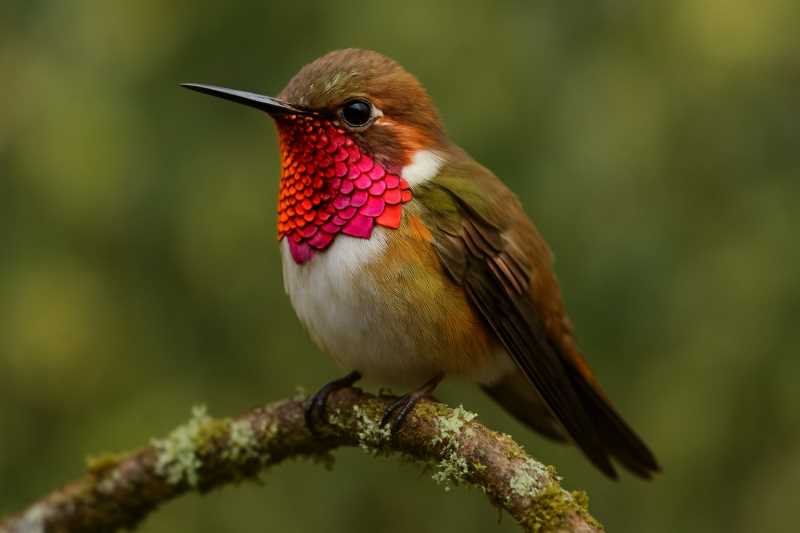
The Volcano Hummingbird measures approximately 7.5–8 cm in length and weighs about 2.2–2.8 g. Both sexes have a short, straight, dark bill, green upperparts and a small pale spot behind the eye.
Adult males are more colourful than females. Their plumage is mainly bronze-green above, with a strongly iridescent gorget that may appear violet, mauve, coppery or reddish depending on the subspecies and light. The outer tail feathers are dark with rufous edging, while the underparts are largely pale, often with buff or cinnamon tones and green spotting on the sides of the breast.
Females are less brightly marked, with greener upperparts, paler underparts and a more subdued, lightly spotted throat. Juveniles resemble females, although young males gradually develop the adult gorget as they mature. As in other hummingbirds, the wings enable sustained hovering and rapid manoeuvring between flowers.
Range and Habitat
The species is restricted to the highlands of Costa Rica and western Panama. It occurs mainly in the Talamanca and associated volcanic mountain ranges, including high-elevation areas around Cerro de la Muerte, the Central Volcanic Cordillera and Volcán Barú.
In Costa Rica, it is documented at approximately 2,300–3,300 metres above sea level, although local movements may take individuals to somewhat different elevations. Suitable habitats include humid montane forest, elfin forest, forest margins, highland scrub, open slopes and flowering clearings. The species is not a long-distance migrant, but individuals may move locally or descend after breeding when food availability changes.
The Volcano Hummingbird’s range is shared with other specialised highland hummingbirds, and local colour variation has contributed to differing treatment of some populations and subspecies in taxonomic literature.
Where to See This Species
Irazú Volcano National Park, Cartago Province, Costa Rica
The park’s high volcanic slopes, open páramo, forest edges and surrounding highland vegetation provide suitable habitat. The species is listed among the common birds recorded in the park, particularly in the higher sectors and nearby forest margins. Look for it around flowering shrubs and open patches, especially during calm daylight periods.
Nearby accommodation: Cartago and the communities around San Gerardo de Oreamuno provide practical access to hotels, guest houses, lodges and self-catering accommodation.
Los Quetzales National Park, San José Province, Costa Rica
Los Quetzales protects high-elevation montane forest and associated clearings in the Talamanca range. The Volcano Hummingbird is documented in the park’s species information and is regularly encountered by birdwatchers in suitable flowering habitat. The surrounding Cerro de la Muerte and Savegre Valley are also well-known highland birding areas.
Nearby accommodation: San Gerardo de Dota and the wider Savegre Valley offer lodges, guest houses, cabins and small hotels.
Volcán Barú National Park, Chiriquí Province, Panama
The park contains cloud forest, high-altitude forest, open volcanic habitats and the Los Quetzales Trail, all within the species’ documented Panamanian range. Birdwatchers may search along flowering forest edges and highland trails, particularly around the Volcán and Boquete approaches.
Nearby accommodation: Boquete and Volcán are the principal gateway settlements, with hotels, lodges, guest houses, cabins and other visitor accommodation.
Behaviour and Diet
The Volcano Hummingbird is active during the day and spends much of its time visiting flowers, hovering briefly while extracting nectar with its extendable tongue. Nectar provides the main source of energy, while small insects and spiders supply protein and other nutrients, especially during breeding.
Individuals may defend productive flowers or small feeding areas from other hummingbirds. Males are particularly conspicuous during courtship, performing steep upward flights followed by rapid dives. Research on the species indicates that these aerial displays are important in mate attraction and may take place in open areas where the movements are easy to see.
Breeding is associated with periods of suitable food availability. The female builds the small cup-shaped nest, using plant fibres, moss, lichen and other soft materials, and is responsible for incubation and care of the young. The usual clutch is two white eggs. Chicks are fed regurgitated food, including nectar and small arthropods, until they are sufficiently developed to leave the nest.
Identification Tips
- Look for a very small hummingbird in high-elevation forest edges, páramo, scrub and flowering clearings.
- The combination of green upperparts, a short dark bill, pale underparts and a small pale spot behind the eye is useful on a perched bird.
- Adult males show a brilliant iridescent throat, which may appear violet, mauve, coppery or reddish depending on the individual, subspecies and lighting.
- Females and immature birds are much plainer, with green upperparts and pale, subtly spotted underparts.
- The species can be confused with other small Selasphorus hummingbirds, especially the Scintillant Hummingbird. Compare overall size, bill proportions, throat colour, tail pattern and the precise elevation and habitat rather than relying on a single feature.
- Behaviour is also helpful: the Volcano Hummingbird often makes fast, aggressive chases around flowers and may perform steep courtship dives from an exposed area.
Conservation Status
The Volcano Hummingbird is assessed as Least Concern on the IUCN Red List. The species has a restricted distribution, but it occurs across a substantial area of protected highland habitat and is not currently considered globally threatened.
Its principal conservation concerns are the loss and fragmentation of montane forest, agricultural expansion, development around highland settlements, changes in flowering patterns and the potential effects of climate change. Warming conditions could alter the distribution of suitable vegetation and the timing of flowering, while habitat degradation may reduce the continuity of feeding and breeding areas.
Protection of high-elevation forest, páramo and forest-edge vegetation is important. Maintaining habitat corridors, limiting further conversion of mountain ecosystems and managing protected areas effectively will help conserve the species and the wider highland community on which it depends.
Frequently Asked Questions
Where is the Volcano Hummingbird found?
It is found in the mountains of Costa Rica and western Panama, especially in the Talamanca range and nearby volcanic highlands.
What habitat does the Volcano Hummingbird use?
It uses humid montane forest, elfin forest, forest edges, highland scrub, open clearings and páramo-like vegetation, generally at high elevations.
What does the Volcano Hummingbird eat?
Its diet consists mainly of flower nectar, supplemented by small insects and spiders. Arthropods are particularly important as a source of protein.
How can a male Volcano Hummingbird be identified?
The male is a tiny green-backed hummingbird with an intensely iridescent throat. The gorget may look violet, mauve, coppery or reddish according to the bird and the light.
Is the Volcano Hummingbird migratory?
It is generally regarded as resident rather than a long-distance migrant. It can, however, make local or seasonal movements along mountain slopes in response to breeding and food availability.
Is the Volcano Hummingbird endangered?
No. It is currently assessed as Least Concern, although habitat loss, fragmentation and climate-related changes to highland ecosystems remain important conservation concerns.
References
- BirdLife International
- Cornell Lab of Ornithology, Birds of the World
- Sistema Nacional de Áreas de Conservación, Costa Rica
Related posts