Introduction
The Hooded Visorbearer (Augastes lumachella) is a small hummingbird endemic to the Brazilian state of Bahia. It is restricted mainly to the high-elevation campo rupestre of the Chapada Diamantina region, where rocky outcrops, cacti, bromeliads and scattered shrubs provide feeding and nesting habitat. The species is sedentary and has a highly localised distribution. (worldbirdnames.org)
Physical Description
The Hooded Visorbearer measures approximately 8.9–10.1 centimetres in length and weighs about 4–4.8 grams. It has a short, straight black bill and compact hummingbird proportions. (researchgate.net)
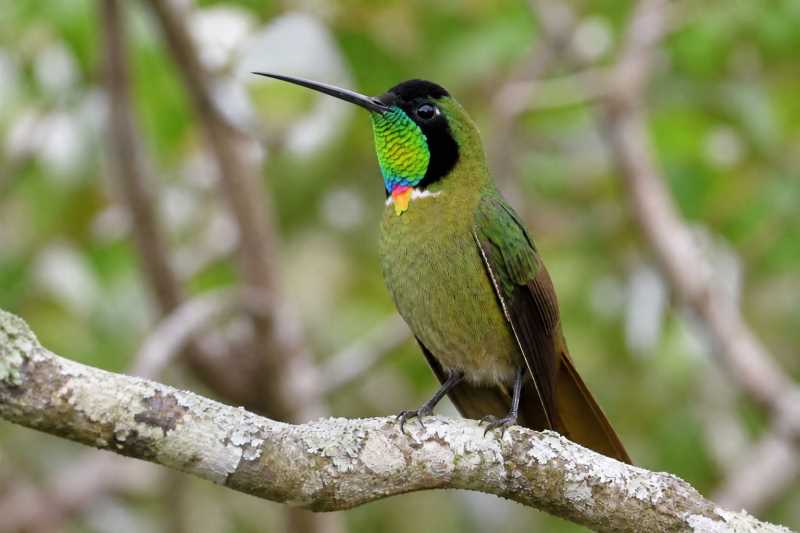
The male is especially distinctive. Its forehead and throat show iridescent golden-green colour, while the crown, cheeks and sides of the throat are velvety black with bluish tones. A narrow white breast band and a small ruby-red central throat patch create the impression of a coloured necktie. The upperparts are bright green to golden-green, and the wings are dark. The tail includes coppery or reddish tones that can be conspicuous in flight or when the bird turns.
Females are duller overall. They usually show greener or bluish-green upperparts, a greyish or brownish throat, and paler underparts, with less strongly contrasting facial and throat markings. The species is therefore sexually dimorphic, and a female may be less immediately recognisable than a male. Juveniles are expected to resemble females more closely than adult males, although detailed age-related information is limited.
Range and Habitat
The Hooded Visorbearer is endemic to Brazil and is known from montane plateaux in central Bahia, particularly within and around the Chapada Diamantina region. Its distribution extends broadly between Morro do Chapéu, Andaraí and Barra da Estiva, although local occurrence is patchy and tied to suitable highland habitat. (researchgate.net)
It inhabits campo rupestre, an open montane vegetation type associated with rocky ground, shallow nutrient-poor soils, cacti, bromeliads and scattered xerophytic shrubs. Records generally come from elevations of approximately 900–2,000 metres. The species is not migratory, and its small, fragmented range makes it particularly dependent on the continued protection of suitable rocky upland vegetation. (oiseaux.net)
Where to See This Species
Chapada Diamantina National Park, Bahia, Brazil
The national park contains documented Hooded Visorbearer records and protects extensive areas of the species’ characteristic high-elevation campo rupestre. Look for it in open rocky vegetation, especially around flowering shrubs, bromeliads and cacti. Trails and viewpoints near the Lençóis and Palmeiras areas can provide access to suitable habitat, although sightings are local and never guaranteed. (avibase.bsc-eoc.org)
Nearby accommodation: Lençóis is the main practical gateway, with guest houses, hotels, lodges, campsites and self-catering accommodation.
Morro do Chapéu State Park, Bahia, Brazil
The state park is a recognised Hooded Visorbearer site within the northern part of the species’ known range. Its protected rocky uplands and campo rupestre provide appropriate habitat, and the park is included in biodiversity records that specifically list the species. (keybiodiversityareas.org)
Nearby accommodation: Morro do Chapéu is the nearest practical town, with hotels, guest houses and self-catering accommodation.
Behaviour and Diet
The Hooded Visorbearer is active during the day and typically forages close to the ground, sometimes less than a metre above it. Like other hummingbirds, it can hover precisely while taking nectar and may defend productive flowers or feeding areas from other hummingbirds.
Its diet consists mainly of nectar from flowering plants, including cacti, bromeliads and other shrubs of the campo rupestre. It also captures small insects and spiders, which provide important protein and other nutrients. Some observations indicate that it may visit bromeliad flowers early in the day, when residual nectar remains available.
The species is generally solitary outside breeding interactions. Courtship behaviour and vocal displays have been reported, but its breeding biology remains incompletely documented. The female builds and attends the nest, while the male does not provide parental care. Available descriptions indicate a small cup nest made from plant material and other fine fibres, with cactus spines reported as part of the nest structure. The former claim that breeding is consistently confined to November–February is not sufficiently established for the species as a whole.
Identification Tips
- Look for a small hummingbird in open, rocky montane vegetation rather than in closed forest.
- Adult males show a striking combination of velvety black on the crown and sides of the throat, iridescent golden-green on the forehead and throat, a white breast band and a small red throat patch.
- The bird’s coppery or reddish tail tones can help confirm an identification when it is perched or turning in flight.
- Females are less brightly marked, with greener upperparts, a greyer throat and paler underparts.
- The short, straight black bill helps separate it from many hummingbirds with noticeably longer or more strongly curved bills.
- The Hyacinth Visorbearer (Augastes scutatus) is a genuinely similar species because it belongs to the same genus, but it occurs mainly in the Serra do Espinhaço of Minas Gerais. Confirming the location is therefore important when distinguishing the two species.
Conservation Status
The Hooded Visorbearer is currently assessed as Near Threatened on the IUCN Red List. The assessment identifies concern arising from its restricted distribution and continuing degradation of suitable habitat. Important threats include uncontrolled fire, mining, conversion of natural campo rupestre to pasture or settlement, infrastructure development and other forms of habitat disturbance. Climate change may further reduce the amount and quality of suitable high-elevation habitat. (cites.org)
The population has not been reliably quantified in the available sources used here, so a precise population estimate should not be stated. Conservation priorities include protecting remaining campo rupestre, managing fire, limiting damaging mining and infrastructure projects, maintaining habitat connectivity, and monitoring populations across protected areas such as Chapada Diamantina National Park and Morro do Chapéu State Park.
Frequently Asked Questions
Where is the Hooded Visorbearer found?
It is endemic to Brazil and occurs mainly in high-elevation campo rupestre in the Chapada Diamantina region of Bahia.
Is the Hooded Visorbearer migratory?
No. It is regarded as a sedentary species, although individuals may move locally in response to flowering and other changes in food availability.
What does the Hooded Visorbearer eat?
It feeds mainly on nectar from flowering plants, particularly cacti, bromeliads and shrubs, and also takes small insects and spiders.
How can the male be identified?
The male has a velvety black crown and throat sides, iridescent golden-green on the forehead and throat, a white breast band and a small ruby-red throat patch.
Where is the best place to look for this species?
Chapada Diamantina National Park and Morro do Chapéu State Park are verified public conservation areas where suitable habitat and documented records make the species a realistic target for birdwatchers.
Is the Hooded Visorbearer threatened?
It is currently classified as Near Threatened. Its principal concerns are its restricted range and the continuing loss or degradation of campo rupestre through fire, mining, land conversion and development.
References
- BirdLife International
- IOC World Bird List
- Key Biodiversity Areas Partnership
Related posts