Introduction
The Hooded Merganser (Lophodytes cucullatus) is a small North American diving duck recognised for its collapsible crest, slender serrated bill and strong sexual dimorphism. It breeds mainly in forested wetlands and nests in tree cavities, while many birds move to larger freshwater bodies, sheltered coastal waters and the southern United States during winter. (allaboutbirds.org)
Physical Description
Hooded Mergansers measure approximately 40–49 cm in length, with a wingspan of about 60–66 cm. They are compact ducks with a relatively long, rounded tail, thin bill and legs set far back on the body, an arrangement that improves diving ability but makes walking on land awkward. (allaboutbirds.org)
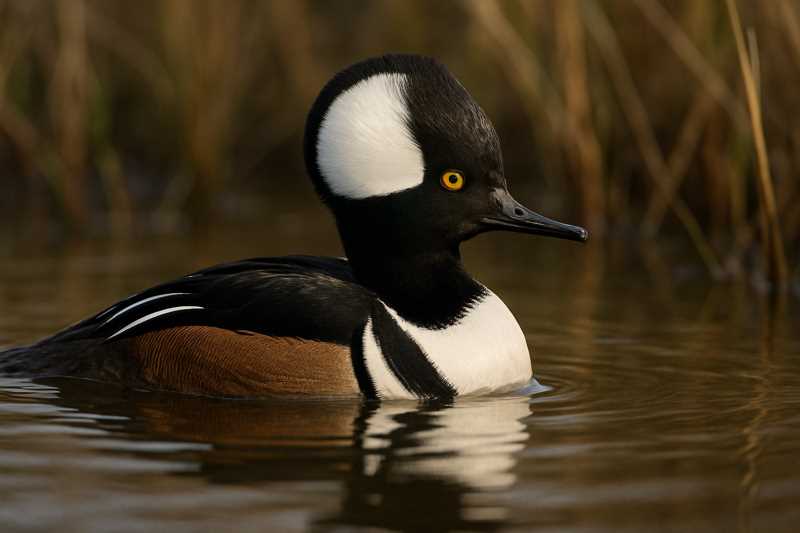
Adult males are particularly distinctive. They have a black head with a large white patch, a broad fan-shaped crest that can be raised or lowered, a mostly black back, white breast and rich chestnut flanks. The crest changes the apparent shape and size of the head and is especially conspicuous during courtship.
Females and immature birds are more subdued, with grey-brown bodies, warm cinnamon-brown crests and slender bills. Adult males generally have bright yellow eyes, while the eyes of females and young birds are darker. The narrow, serrated bill is adapted for grasping slippery prey underwater.
Range and Habitat
The Hooded Merganser is endemic to North America. Its breeding range includes much of eastern Canada and the eastern United States, as well as parts of the Pacific Northwest and adjacent western Canada. Breeding birds favour wooded ponds, forested rivers, beaver wetlands, swamps and other freshwater habitats near suitable nesting cavities. (allaboutbirds.org)
During migration and winter, Hooded Mergansers use larger lakes and rivers, shallow freshwater, marshes, brackish bays, estuaries and tidal creeks. Eastern populations commonly move south or south-west, although some remain in the Great Lakes region or southern Canada where open water persists. Birds breeding west of the Rocky Mountains generally move west or south towards the Pacific coast. Some populations, particularly in milder parts of the range, may remain present throughout the year. (allaboutbirds.org)
Access to mature or dead trees is important during the breeding season because the species normally nests in cavities. It can also use artificial nest boxes, allowing it to breed in some wetlands where natural cavities are scarce.
Behaviour and Diet
Hooded Mergansers are active divers that usually feed in clear, shallow water. They locate prey by sight and propel themselves underwater with their feet. Their diet includes small fish, aquatic insects, crayfish and other crustaceans, amphibians, molluscs and some aquatic vegetation. This relatively varied diet distinguishes them from mergansers that rely more heavily on fish. (allaboutbirds.org)
They are often seen alone, in pairs or in small groups, although larger gatherings may form outside the breeding season. In flight, they have fast wingbeats and commonly take off by running across the water. They usually swim low in the water, with the body partly submerged.
Courtship takes place in groups containing several males and one or more females. Males raise and expand the crest, shake the head, flap the wings and perform a distinctive head-throwing display accompanied by low, rough vocalisations. The female selects the nest site, usually a cavity in a living or dead tree close to water. Cavities are commonly several metres above the ground, although the height varies considerably.
The usual clutch contains 5–13 white eggs. Incubation lasts approximately 26–41 days, depending on the source and circumstances. The female provides most or all of the incubation care. Ducklings are precocial and leave the cavity within about a day of hatching, sometimes making a substantial leap to the ground before following their mother to water. They can dive and begin feeding soon after leaving the nest. Hooded Mergansers may also lay eggs in the nests of other cavity-nesting ducks, and their own nests may be used by other females. (allaboutbirds.org)
Identification Tips
Look for the following combination of features:
- A small diving duck with a thin, straight, serrated bill.
- A large, collapsible crest that can make the head appear oversized.
- In adult males, a black-and-white head pattern, white breast and chestnut flanks.
- In females and immatures, a warm cinnamon crest contrasting with a grey-brown body.
- Rapid, shallow wingbeats and low swimming posture.
- A preference for small freshwater bodies during the breeding season and larger freshwater or sheltered coastal waters during winter.
The male is unlikely to be confused with a female, but females and immature birds can resemble female Buffleheads or other small diving ducks. The Hooded Merganser is usually distinguished by its longer, slimmer bill, cinnamon crest and relatively long tail. It is smaller than a Common Merganser and lacks the shaggy head and rusty breast pattern of a female Red-breasted Merganser. (allaboutbirds.org)
Conservation Status
The Hooded Merganser is currently regarded as a species of low global conservation concern and is listed as Least Concern in global conservation assessments. Available North American monitoring indicates that the species has increased over the long term in areas covered by the Breeding Bird Survey, although local conditions and regional trends may differ. (allaboutbirds.org)
The principal conservation needs are the protection of forested wetlands, clean freshwater and suitable nesting cavities. Loss of mature trees, wetland drainage, water pollution, disturbance and changes to river and lake systems can reduce breeding and feeding opportunities. Leaving suitable dead trees standing where it is safe to do so, protecting riparian woodland and installing appropriately designed nest boxes can support local populations. Nest boxes should be monitored and protected from predators where possible. (allaboutbirds.org)
Frequently Asked Questions
Where does the Hooded Merganser live?
It breeds mainly in forested wetlands across eastern and north-western North America. In winter it also uses larger lakes, rivers, marshes, estuaries, brackish bays and sheltered coastal waters.
What does a Hooded Merganser eat?
Its diet includes small fish, aquatic insects, crayfish and other crustaceans, amphibians, molluscs and some aquatic vegetation. It usually catches prey during shallow underwater dives.
How can you identify a male Hooded Merganser?
The adult male has a black head with a large white patch, a raised or lowered fan-shaped crest, a mostly black back, white breast and chestnut flanks.
How can you identify a female Hooded Merganser?
The female is mainly grey-brown, with a warm cinnamon-coloured crest, a slender bill and a relatively long tail. Immature birds are similar but may appear less sharply marked.
Where does the Hooded Merganser nest?
It normally nests in tree cavities near water, using cavities in living or dead trees. It also readily uses suitable nest boxes where natural cavities are limited.
Do Hooded Merganser ducklings leave the nest soon after hatching?
Yes. Ducklings usually leave the cavity within about 24 hours of hatching. They may jump or flutter to the ground and then follow the female to nearby water, where they begin feeding and diving.
References
- Cornell Lab of Ornithology. 2026. “Hooded Merganser Overview, Lophodytes cucullatus.” All About Birds. Cornell Lab of Ornithology. Available at: https://www.allaboutbirds.org/guide/Hooded_Merganser/overview. Accessed 8 September 2026.
- Cornell Lab of Ornithology. 2026. “Hooded Merganser Life History, Lophodytes cucullatus.” All About Birds. Cornell Lab of Ornithology. Available at: https://www.allaboutbirds.org/guide/Hooded_Merganser/lifehistory. Accessed 8 September 2026.
- Cornell Lab of Ornithology. 2026. “Hooded Merganser Identification, Lophodytes cucullatus.” All About Birds. Cornell Lab of Ornithology. Available at: https://www.allaboutbirds.org/guide/Hooded_Merganser/id. Accessed 8 September 2026.
- Dugger, B. D., K. M. Dugger and L. H. Fredrickson. 2009. “Hooded Merganser (Lophodytes cucullatus), version 2.0.” In The Birds of North America, edited by P. G. Rodewald. Cornell Lab of Ornithology, Ithaca, New York. Available through the Cornell Lab of Ornithology species account.
- Gill, F., D. Donsker and P. Rasmussen, eds. 2026. IOC World Bird List, version 15.2. International Ornithologists’ Union. Available at: https://www.worldbirdnames.org/. Accessed 8 September 2026.
- Hostetler, J. A., J. R. Sauer, J. E. Hines, D. J. Ziolkowski Jr., M. Lutmerding and S. M. Skalos. 2025. The North American Breeding Bird Survey, Analysis Results 1966–2024. U.S. Geological Survey, Eastern Ecological Science Center. Available at: https://eesc.usgs.gov/mbr/bbs2024/metadata.html. Accessed 8 September 2026.
- U.S. Geological Survey. 2019. Visualizing Populations of North American Sea Ducks: Maps to Guide Research and Management Planning. Open-File Report 2019–1142. U.S. Geological Survey. Available at: https://pubs.usgs.gov/of/2019/1142/ofr20191142.pdf. Accessed 8 September 2026.
Related posts