Introduction
The Puerto Rican Mango (Anthracothorax aurulentus) is a medium-sized hummingbird native to Puerto Rico and nearby islands in the Caribbean. It was formerly treated by some authorities as the Puerto Rican form of the Antillean Mango, Anthracothorax dominicus, but is now widely recognised as a separate species. Despite its common name, it is not restricted to the main island of Puerto Rico and is also recorded on Culebra and parts of the Virgin Islands.
Physical Description
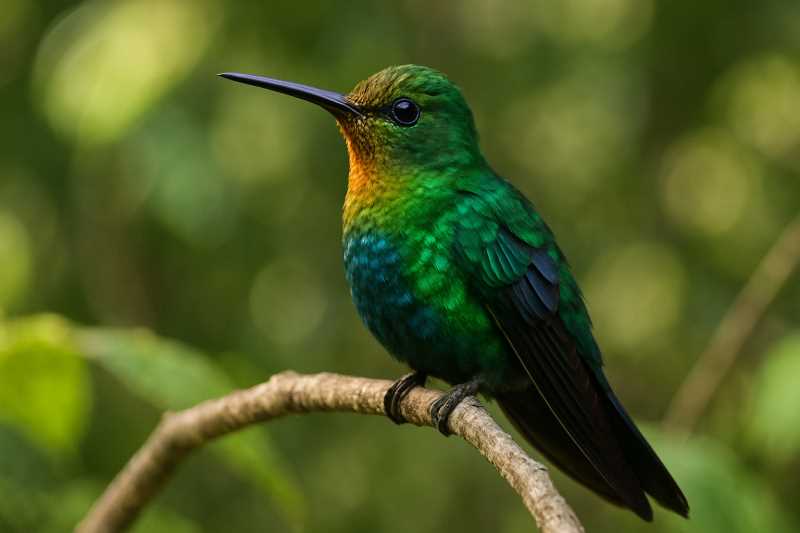
The Puerto Rican Mango is approximately 11–12 cm long. It has a long, slightly down-curved bill and the compact, powerful flight typical of mango hummingbirds.
Adult males have shiny bronze-green upperparts, green flanks and a darker brownish-grey belly. Their plumage can show golden or coppery reflections in strong light, but the species should not be identified by a purple throat patch, which is not a reliable feature of the Puerto Rican Mango.
Females are less brightly coloured. They have bronze-green upperparts, pale greyish underparts that become whitish towards the abdomen, and a brownish-grey tail with broad dark markings near the tips. The outer tail feathers may show pale or whitish tips. Young birds resemble females and gradually acquire adult plumage as they mature.
Range and Habitat
The species is resident rather than migratory. Its range includes Puerto Rico, the offshore island of Culebra, and scattered localities in the British and United States Virgin Islands. It appears to have disappeared from some smaller islands, and its former occurrence on Vieques is uncertain or may represent a local extirpation.
The Puerto Rican Mango is found mainly in lowland habitats, generally below about 250 metres, although it may occur higher in suitable areas. Preferred habitats include dry forest, coastal woodland, forest edges, scrub, shaded agricultural areas, gardens and other places with abundant flowering plants. Its ability to use partly modified habitats helps it persist in areas where natural vegetation has been reduced, but the protection of remaining lowland forest and coastal scrub remains important.
Where to See This Species
Cabo Rojo National Wildlife Refuge, Cabo Rojo, Puerto Rico
The refuge contains subtropical dry forest, mangrove margins, scrub and open coastal habitats, all of which can provide suitable feeding areas for the Puerto Rican Mango. The species has been recorded in the Cabo Rojo area, including in older bird lists under the former name Antillean Mango. Look around flowering vegetation, forest edges and the refuge headquarters area, particularly in the drier southwestern part of the island.
Nearby accommodation: Boquerón and Cabo Rojo provide practical bases with guest houses, small hotels, self-catering accommodation and other visitor facilities.
Culebra National Wildlife Refuge, Culebra, Puerto Rico
Culebra lies within the recognised range of the Puerto Rican Mango and contains dry forest, scrub and mangrove habitats. The refuge is publicly accessible in designated areas and offers walking and wildlife-observation opportunities. Records in older management material may use the former Antillean Mango name, so current field guides and checklists should be consulted when planning a visit.
Nearby accommodation: The town of Dewey is the main accommodation area, with guest houses, small hotels, holiday rentals and self-catering options.
Behaviour and Diet
The Puerto Rican Mango is an active, resident hummingbird that often forages alone. Males may defend nectar-rich feeding territories and can chase competing hummingbirds with rapid aerial manoeuvres. Short local movements may occur as birds track flowering plants, but there is no evidence of regular long-distance migration.
Nectar from a wide range of flowering plants forms the main part of the diet. The bird also takes small arthropods, including insects caught in the air and spiders gleaned from vegetation, bark and leaves. These animal foods provide important protein, particularly during breeding and while young birds are developing.
Breeding information is limited and much of the available evidence is anecdotal. Breeding may occur at different times of year, possibly more than once annually in Puerto Rico, depending on local food availability. The female builds a small cup-shaped nest from soft plant material bound with spider silk and often decorated with lichens or bark fragments. Nests may be placed in shrubs or trees and have also been reported on human-made structures. A typical clutch contains two eggs. The female alone incubates the eggs and cares for the young; reported incubation is about 15 days, with fledging approximately 22–25 days after hatching.
Identification Tips
- Look for a relatively large hummingbird with a long, slightly curved bill and bronze-green upperparts.
- Adult males are darker below than females, with green flanks and a dark brownish-grey belly.
- Females are paler underneath and show a brownish-grey tail with broad dark markings and pale tips on the outer feathers.
- The species often appears coppery or golden-green when sunlight strikes the plumage, but colour varies with angle and light.
- It is larger and longer-billed than the Puerto Rican Emerald, Riccordia maugaeus.
- In areas where it overlaps with the Green-throated Carib, Eulampis holosericeus, compare overall structure, plumage pattern and tail markings rather than relying on a single colour impression.
- Older field guides may label this bird Antillean Mango or Anthracothorax dominicus subspecies aurulentus. Current taxonomies generally treat it as the separate Puerto Rican Mango, Anthracothorax aurulentus.
Conservation Status
The Puerto Rican Mango is currently assessed as Least Concern. Its total population size has not been established, and available assessments indicate that the population may be declining. The species remains widespread in Puerto Rico and can use gardens and other modified habitats, but it is vulnerable to the loss and degradation of lowland dry forest, coastal scrub and flowering woodland.
Habitat conversion, urban expansion and changes in the availability of flowering plants may reduce local feeding and nesting opportunities. Competition with other hummingbirds, including the Green-throated Carib, has also been suggested as a possible factor in declines in parts of the eastern range and on some offshore islands. Maintaining protected dry-forest and coastal habitats, conserving native flowering plants and monitoring populations on smaller islands are important conservation measures.
Frequently Asked Questions
Is the Puerto Rican Mango endemic to Puerto Rico?
No. It is strongly associated with Puerto Rico, but it also occurs on Culebra and in parts of the British and United States Virgin Islands. The species is therefore better described as a Puerto Rican and Virgin Islands regional endemic rather than an island endemic restricted to Puerto Rico itself.
Is the Puerto Rican Mango migratory?
No. It is considered resident throughout its range. Individuals may move locally between gardens, forest edges and flowering areas as food availability changes, but these movements are not regular long-distance migration.
What does the Puerto Rican Mango eat?
It feeds mainly on nectar from flowering plants and supplements this diet with small insects and spiders. Insects are often caught in flight, while spiders may be taken from leaves, bark and other surfaces.
How can the Puerto Rican Mango be identified?
Look for a fairly large hummingbird with bronze-green upperparts, a long slightly curved bill and a dark underside in adult males. Females are paler below and have a brownish-grey tail with broad dark markings and pale outer tips.
Where is the best place to look for a Puerto Rican Mango?
Cabo Rojo National Wildlife Refuge in southwestern Puerto Rico is one of the most reliable publicly accessible areas because it contains suitable dry forest, scrub and flowering-edge habitat. Culebra National Wildlife Refuge also lies within the species’ range and provides additional opportunities in dry woodland and scrub.
What is the conservation status of the Puerto Rican Mango?
The species is currently listed as Least Concern. However, its population size is not well known and may be declining, so continued protection of lowland forest, coastal scrub and other nectar-rich habitats is important.
References
- BirdLife International
- IUCN Red List of Threatened Species
- IOC World Bird List
Related posts