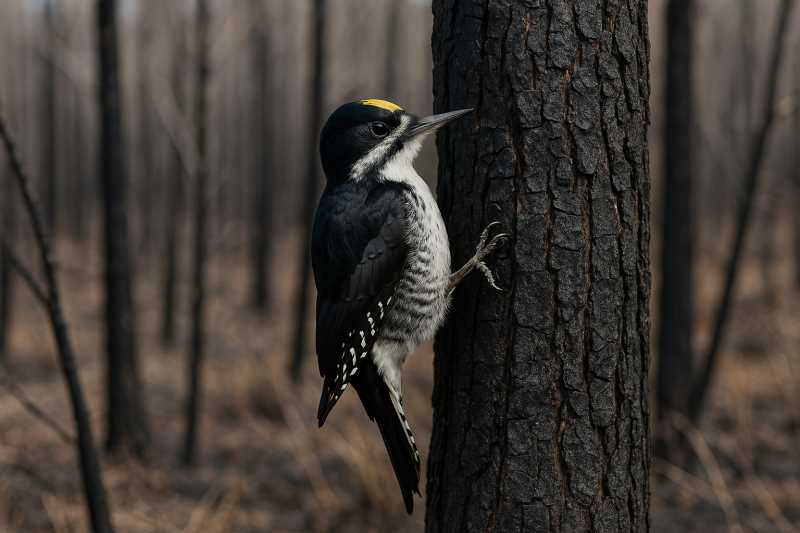
The Black-backed Woodpecker (Picoides arcticus) is a remarkable North American bird species adapted to thrive in a very specific and often transient habitat—burned forests. With its jet-black plumage, bold demeanor, and strong association with post-fire environments, this elusive woodpecker is a symbol of nature’s ability to reclaim and rejuvenate after disturbance. Its presence plays a vital ecological role in forest recovery, making it a species of both conservation interest and fascination for birdwatchers and ecologists alike.
Identification and Physical Description
The Black-backed Woodpecker is a medium-sized woodpecker, measuring about 23 cm (9 inches) in length with a wingspan of approximately 40 cm (16 inches). Its most distinguishing feature is its solid black back, which helps it blend seamlessly into the charred bark of burned trees. The underparts are white, with finely barred flanks, and the wings are black with some white spotting. The male sports a distinctive yellow crown patch, while the female lacks this feature.
Unlike most woodpeckers, this species has only three toes instead of the typical four—a trait it shares with its close relative, the American Three-toed Woodpecker (Picoides dorsalis). This adaptation may aid its specialized foraging technique on the vertical surfaces of burned trees.
Habitat and Range
Black-backed Woodpeckers are primarily found across boreal and montane coniferous forests of Canada, Alaska, and the northern United States, extending into mountainous areas such as the Rockies and the Sierra Nevada. They are uncommon to rare outside these zones and are highly specialized in their habitat preference.
Their preferred habitat is recently burned conifer forests, especially within one to eight years post-fire. These birds rely on the profusion of wood-boring beetle larvae that proliferate in dead or dying trees after a wildfire. Although they can occasionally be found in beetle-killed or wind-damaged forests, they are overwhelmingly dependent on areas recently affected by fire.
Behavior and Diet
The Black-backed Woodpecker is primarily insectivorous, with a diet dominated by wood-boring beetle larvae, especially those of the family Cerambycidae and Buprestidae. It uses its chisel-like bill to peel away bark from fire-killed trees, exposing hidden insects within. This species is a methodical forager, spending long periods working on a single tree.
These woodpeckers are generally solitary or seen in pairs, and they maintain relatively large territories. Unlike some other woodpecker species, they are non-migratory, relying instead on the availability of suitable burned habitat within their range.
During the breeding season, which usually begins in late spring, both sexes excavate a nest cavity in a standing dead tree. The female lays 3 to 6 eggs, and both parents share incubation duties. After hatching, chicks are fed by regurgitation until they fledge roughly three weeks later.
Ecological Importance
Black-backed Woodpeckers are key indicators of forest ecosystem health, particularly in relation to natural fire regimes. By preying on wood-boring beetles, they help moderate insect outbreaks, contributing to forest balance. Furthermore, their nesting cavities provide critical shelter for secondary cavity-nesting species, such as bluebirds, nuthatches, and flying squirrels.
Their presence underscores the ecological importance of allowing natural fires to proceed under controlled management. Suppression of wildfires in some regions has led to declines in suitable habitat for this woodpecker, making fire management policy a critical issue in its conservation.
Conservation Status and Threats
Though not currently listed as globally threatened, the Black-backed Woodpecker faces mounting pressures due to fire suppression policies, salvage logging of burned forests, and habitat fragmentation. In certain parts of its range, such as the Sierra Nevada, small and isolated populations have become a focus for conservationists.
Efforts are underway to recognize the ecological value of post-fire forests and to discourage logging practices that remove standing dead trees essential for the woodpecker’s survival. Conservation strategies include preserving burned habitats, conducting post-fire ecological studies, and improving public awareness of the species’ ecological role.
Birdwatchers eager to spot this elusive species often seek out recently burned forest patches in northern latitudes or mountainous regions. Patience and quiet observation near charred tree stands can yield sightings of this charcoal-colored bird tapping industriously for its insect prey.
Conclusion
The Black-backed Woodpecker exemplifies the resilience and adaptability of wildlife in the face of natural disturbance. Its specialized lifestyle, bound to the cycle of fire and renewal, makes it a vital part of forest ecosystems and a flagship species for the conservation of post-fire habitats. As climate change and land-use decisions continue to reshape forest landscapes, understanding and protecting this unique woodpecker becomes more important than ever.
Related posts