Introduction
The Starred Wood Quail, Odontophorus stellatus, is a secretive member of the New World quail family, Odontophoridae. It inhabits humid forests in the western Amazon Basin and is more often detected by its calls or by the movement of a small group through dense undergrowth than seen in the open. The species is resident rather than migratory and is currently assessed as Least Concern. (datazone.birdlife.org)
Physical Description
The Starred Wood Quail is a compact, ground-dwelling bird measuring approximately 24–27 centimetres in length. Its plumage is predominantly grey, olive-brown and rufous, providing effective camouflage in leaf litter and shaded forest undergrowth.
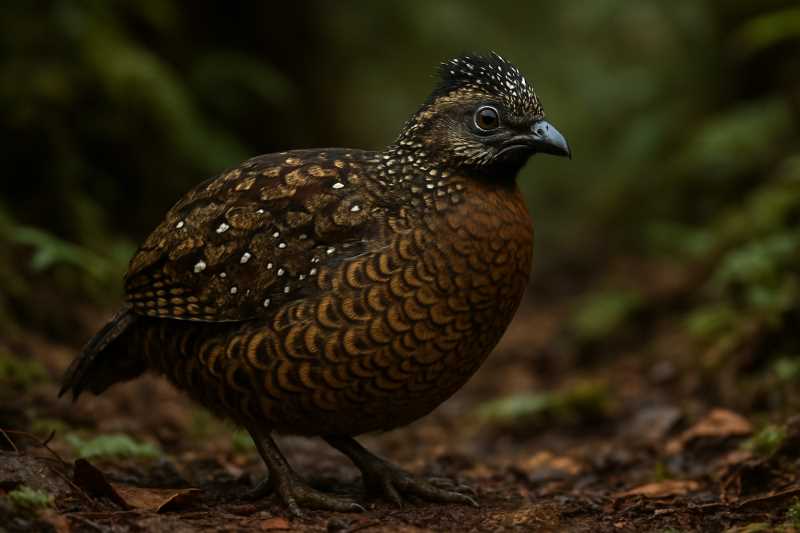
The head, neck, throat and upper breast are generally grey, while the back is olive-brown with darker markings. The rump is paler, the wings are darker and the wing-coverts are marked with pale spots. The reddish-brown underparts carry rows of small white spots across the breast and sides, creating the starred pattern from which the common name is derived. The lower belly and undertail area may show darker barring.
The bill is dark, the iris is brown and the legs are grey. A prominent elongated crest is reddish in males and darker brown to blackish in females. The sexes are otherwise broadly similar, although males are slightly larger. Juveniles resemble adults but may have a more orange or reddish bill and less distinct plumage markings.
Range and Habitat
The Starred Wood Quail occurs in Bolivia, western Brazil, eastern Ecuador and eastern Peru. Its range is centred on the western Amazon Basin, extending locally into humid foothill forest. It is associated mainly with tropical lowland forest, including terra firme and transitional forest, and occurs less frequently in seasonally flooded várzea forest.
Most records are from below approximately 1,050 metres above sea level, although the precise elevational range varies geographically. In Ecuador, it is principally a lowland species, while in parts of Bolivia it may also occur in humid foothill forest. It favours dense ground cover, tangled vegetation and forest interiors, where its cryptic plumage and habit of running through cover make it difficult to observe. (birdsofbolivia.org)
Behaviour and Diet
The Starred Wood Quail is shy, terrestrial and usually encountered in family groups or small coveys. Groups may contain several birds and typically remain close to dense vegetation, moving through the forest floor rather than flying unless disturbed. It is a resident species and there is no evidence that it undertakes regular long-distance migration.
Its presence is often revealed by a repeated, far-carrying call, particularly around dawn or dusk. Vocalisations are described in the field literature as rolling or whistled phrases, with local variation in their exact transcription. The calls probably help birds maintain contact within groups and may also function in territorial or pair communication.
The species forages in leaf litter, scratching and probing for fallen seeds, small fruits, shoots and invertebrates. Reliable information about its breeding biology is limited. Ground nests and parental care have been reported for wood quails generally, but detailed, species-specific information on clutch size, incubation and chick development for the Starred Wood Quail remains scarce and should not be treated as well established.
Identification Tips
Look for a chunky, short-tailed quail moving quietly through dense forest vegetation. The most useful field marks are:
- Yellow bare skin around the eye.
- A grey head, throat and upper breast.
- A conspicuous reddish crest in the male, darker in the female.
- Reddish-brown underparts with small white spots on the breast and flanks.
- A generally olive-brown back, darker wings and pale spotting on the wing-coverts.
- A preference for running through cover rather than remaining in exposed places.
The Marbled Wood Quail, Odontophorus gujanensis, may occur in some of the same Amazonian regions. The Starred Wood Quail is generally greyer on the head and throat, has a more noticeable crest, yellow orbital skin and distinctive white spotting on the reddish breast. The Marbled Wood Quail typically has red rather than yellow orbital skin and is darker overall. (avesdeperu.org)
Conservation Status
The Starred Wood Quail is classified as Least Concern on the IUCN Red List. It has a broad geographic range and is locally common in parts of the Amazon Basin, although it is uncommon or local in other areas. A quantified global population estimate is not available in the sources consulted.
The principal concerns are the loss and degradation of humid forest through agricultural expansion, logging, roads and other infrastructure. Hunting may add local pressure, particularly where new access routes make previously remote forest easier to reach. Maintaining large areas of intact forest, retaining dense understorey and controlling unsustainable hunting are appropriate conservation measures. Protected areas and locally managed forests are important because the species depends strongly on forest habitat. (datazone.birdlife.org)
What conservation research is still needed?
Further field research is needed on population density, breeding biology, vocal behaviour, hunting pressure and the species’ response to forest fragmentation. Better monitoring would help determine whether local declines are occurring within its broad range.
Frequently Asked Questions
Where does the Starred Wood Quail live?
It lives in humid forests of Bolivia, western Brazil, eastern Ecuador and eastern Peru, mainly in the western Amazon Basin. It favours terra firme and transitional forest with dense undergrowth.
Is the Starred Wood Quail migratory?
No. It is regarded as a resident species and is not known to undertake regular long-distance migration.
What does the Starred Wood Quail eat?
It forages on the forest floor for fallen seeds, small fruits, shoots and invertebrates, searching through leaf litter and low vegetation.
Why is the Starred Wood Quail difficult to see?
It is shy, has strongly camouflaged plumage and usually stays in dense forest cover. Birds may run away through vegetation before they are clearly seen, so observers often detect them by their repeated calls.
How can the Starred Wood Quail be identified?
Key features include yellow skin around the eye, a grey head and throat, a reddish crest in the male, reddish-brown underparts with white breast spots and a dark, short-tailed silhouette.
Is the Starred Wood Quail threatened?
The species is currently classified as Least Concern, but forest clearance, habitat degradation and local hunting may affect populations. Continued protection of humid Amazonian forest remains important.
References
- BirdLife International. n.d. Starred Wood-quail Odontophorus stellatus Species Factsheet. BirdLife DataZone. Accessed 8 September 2026. https://datazone.birdlife.org/species/factsheet/starred-wood-quail-odontophorus-stellatus
- Gill, F., Donsker, D. and Rasmussen, P. (eds). 2026. IOC World Bird List, version 15.2. International Ornithologists’ Union. Accessed 8 September 2026. https://www.worldbirdnames.org/
- Schulenberg, T. S., Stotz, D. F., Lane, D. F., O’Neill, J. P. and Parker III, T. A. 2007. Birds of Peru. Princeton University Press.
- Ridgely, R. S. and Greenfield, P. J. 2001. The Birds of Ecuador: Field Guide. Cornell University Press.
- Birds of Bolivia. 2019. Odontophorus stellatus: Starred Wood-Quail. Species account. Accessed 8 September 2026. https://birdsofbolivia.org/species-fact-sheets-2/tinamous-perdices/odontophorus-stellatus/
- Begazo, A. (ed.). n.d. Codorniz Estrellada, Odontophorus stellatus. Aves de Perú, CORBIDI. Accessed 8 September 2026. https://avesdeperu.org/odontophoridae/codorniz-estrellada-odontophorus-stellatus/
- WWF-Peru. n.d. Desde el ojo de la cámara trampa. WWF-Peru publication on Amazonian fauna. Accessed 8 September 2026. https://wwfint.awsassets.panda.org/downloads/libro_fauna_final.pdf
Related posts