Introduction
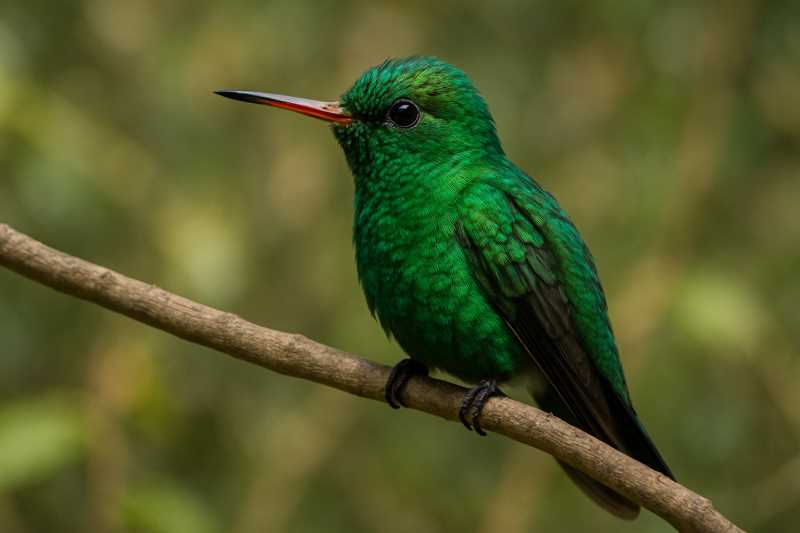
The Garden Emerald (Chlorostilbon assimilis) is a small hummingbird in the family Trochilidae. It is a resident species of south-western Costa Rica and Panama, including some nearby islands, where it occupies forest edges, second-growth vegetation, scrub and gardens. The species was formerly treated as part of the Blue-tailed Emerald complex but is now generally recognised as a separate species.
Physical Description
The Garden Emerald measures about 8 centimetres in length and weighs approximately 3 grams. It has a short, straight black bill and a compact hummingbird shape.
Adult males are almost entirely metallic green, with a brighter green head and underparts. The forked tail is dark blue to blue-black, and small white thigh tufts may be visible at close range. Adult females are less vividly coloured. They are bronzy or metallic green above, with dusky cheeks, a pale post-ocular mark, greyish-white underparts and a dark tail with pale tips on the outer feathers.
The sexes are therefore distinguishable in good views, particularly by the female’s paler underparts and less strongly forked tail. Juveniles are duller than adults and may show less well-developed iridescence.
Range and Habitat
The Garden Emerald occurs on the Pacific slope of south-western Costa Rica and in western and central Panama. Its range also includes Coiba Island and the Pearl Islands. It is considered resident rather than migratory, although individuals may move locally in response to flowering conditions.
It is most often associated with semi-open habitats, including forest margins, woodland, hedgerows, streamside thickets, secondary growth, plantations, pastures with scattered trees and gardens. It is generally a lowland and foothill species, with records extending to roughly 800 metres above sea level in suitable habitat.
The species is locally adaptable and may persist in modified landscapes where flowering plants, shrubs and suitable cover remain available. Its distribution is restricted to Costa Rica and Panama, making it a regional speciality for birdwatchers.
Where to See This Species
Cloudbridge Nature Reserve, San José Province, Costa Rica
The Garden Emerald has been documented at Cloudbridge Nature Reserve in the Talamanca region. The reserve’s forest edges, clearings, trails and regenerating vegetation provide suitable habitat, although the species may be less numerous than at lower elevations. It is worth checking flowering plants and open patches along the trails.
Nearby accommodation: San Gerardo de Rivas and the surrounding valley offer guest houses, lodges and small self-catering accommodation.
Wilson Botanical Garden, Puntarenas Province, Costa Rica
Wilson Botanical Garden, near San Vito, is a well-established birdwatching venue where Garden Emeralds have been recorded. The garden’s combination of native vegetation, flowering plants, woodland margins and adjoining forest makes it a realistic place to search for this locally distributed hummingbird.
Nearby accommodation: San Vito is the nearest practical base, with small hotels, guest houses, lodges and self-catering accommodation.
Soberanía National Park, Panama Province, Panama
Garden Emerald is included on bird checklists for Soberanía National Park. Forest edges, clearings and disturbed vegetation along accessible routes, including the Pipeline Road area, are suitable places to watch for a fast-moving emerald hummingbird. Early morning is generally the most productive time for observing active feeding birds.
Nearby accommodation: Gamboa and the outskirts of Panama City provide hotels, lodges and other accommodation suitable for visits to the park.
Behaviour and Diet
The Garden Emerald is active by day and uses rapid wingbeats to hover while feeding. It usually moves quickly between flowers and perches, and males may defend productive feeding areas from other hummingbirds. It is generally encountered alone or in pairs rather than in large groups.
Nectar forms the main part of its diet. The bird visits a range of flowering plants and may contribute to pollination as pollen is transferred between flowers. It also takes small insects and spiders, particularly when additional protein is needed for growth, maintenance and breeding.
The female is responsible for nest construction, incubation and care of the young. Like other hummingbirds, she builds a small cup-shaped nest using plant fibres and spider silk, often with fine plant material or lichen incorporated into the exterior. A clutch normally contains two small white eggs. Available data indicate an incubation period of about 13 days, but detailed breeding information for this species remains limited.
Identification Tips
- Look for a very small hummingbird with a straight black bill and a dark, forked tail.
- Adult males appear almost entirely metallic green, without the contrasting white belly described in some inaccurate accounts.
- Females are paler below, with greyish-white underparts, dusky facial markings and pale tips to the outer tail feathers.
- The Garden Emerald is usually found in open woodland, forest edges, scrub and gardens rather than deep, closed-canopy forest.
- Distinguish it from the similar Canivet’s Emerald by the Garden Emerald’s black bill. Canivet’s Emerald generally shows red at the base of the bill, while the male Garden Emerald has a less strongly accentuated crown and a dark, forked tail.
Conservation Status
The Garden Emerald is currently assessed as Least Concern. It has a relatively restricted distribution, but it remains adaptable and occurs in a variety of semi-open habitats, including some human-modified areas.
Habitat clearance, the loss of flowering vegetation and further degradation of forest edges may affect local populations. Maintaining native vegetation, protecting remaining woodland and retaining flowering plants in gardens and agricultural landscapes can help provide feeding and nesting habitat. A precise population trend is not established in the available assessments, so population changes should be interpreted cautiously.
Frequently Asked Questions
Where can the Garden Emerald be found?
The Garden Emerald is found in south-western Costa Rica and Panama, including Coiba Island and the Pearl Islands.
Is the Garden Emerald migratory?
No. It is generally considered a resident species, although it may make local movements when the availability of flowers changes.
What does the Garden Emerald eat?
It mainly feeds on flower nectar and supplements its diet with small insects and spiders.
How can a male Garden Emerald be identified?
The adult male is almost entirely metallic green, with a black bill, a dark forked tail and small white thigh tufts that are usually difficult to see in the field.
How is the female Garden Emerald different from the male?
The female is less brightly coloured, with bronzy-green upperparts, dusky facial markings, pale greyish underparts and pale tips on the outer tail feathers.
Is the Garden Emerald endangered?
No. The species is currently assessed as Least Concern, although habitat loss and the removal of flowering vegetation may create local pressures.
References
- BirdLife International and the IUCN Red List of Threatened Species
- IOC World Bird List
- Cornell Lab of Ornithology, Birds of the World
Related posts