Introduction
The Black Spinetail, Telacanthura melanopygia, is a little-known African swift in the family Apodidae. It inhabits the tropical rainforest belt of West and Central Africa, where it is usually encountered in fast, agile flight above forest and other wooded habitats. Although its ecology remains poorly documented, available records indicate that it is primarily an aerial insectivore associated with humid forest landscapes.
Physical Description
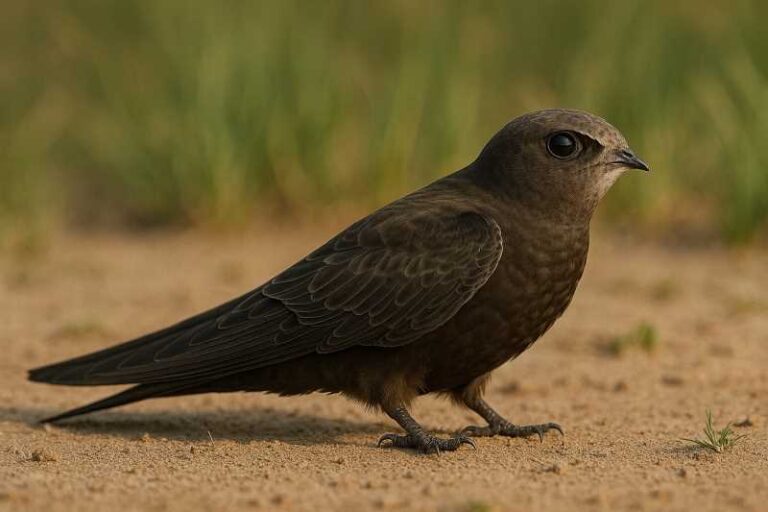
The Black Spinetail is a medium-sized spinetail, measuring about 15–17 centimetres in length. Its plumage is mainly dark blackish-brown, with some paler mottling on the throat and subtle contrast on the underwing. The tail appears broadly square or slightly rounded when spread, and the stiff tail shafts project beyond the webs as short spines, a characteristic feature of the group.
The wings are long and strongly adapted for fast, sustained flight. The sexes are not known to show obvious external differences, and reliable information on juvenile plumage is limited. Its dark overall appearance and relatively large size help separate it from smaller or more strongly patterned spinetails.
Range and Habitat
The Black Spinetail occurs in parts of the Upper Guinea and Congo rainforest regions. Its documented range extends from Sierra Leone and Liberia eastwards through Ghana, Nigeria, Cameroon and Gabon, with additional records from the Republic of the Congo, the Democratic Republic of the Congo, the Central African Republic and north-eastern Angola.
It is associated mainly with humid lowland rainforest, including primary forest, secondary woodland and some plantations. It may also use forest edges, clearings and rocky areas or cliffs where suitable nesting sites are available. The species is generally regarded as resident or largely sedentary, although local movements and occasional wandering have been reported. Its distribution is uneven, and it appears to be uncommon or easily overlooked across much of its range.
Where to See This Species
Kakum National Park, Central Region, Ghana
Kakum protects extensive Upper Guinea rainforest and is a recognised birdwatching destination with forest trails, a canopy walkway and guided walks. Black Spinetails have been recorded at the park, where observers should scan above the forest canopy and open areas, particularly during periods of active insect flight.
Nearby accommodation: Cape Coast and the surrounding Kakum area provide hotels, guest houses, lodges, campsites and other visitor accommodation.
Ankasa Conservation Area, Western Region, Ghana
Ankasa contains some of Ghana’s most intact evergreen rainforest and has recorded Black Spinetail sightings. The species is likely to be most readily detected above forest clearings, tracks and canopy gaps, although sightings may be brief because of its rapid flight and dark plumage.
Nearby accommodation: Axim, Elubo and nearby villages provide practical bases with lodges, guest houses and other small-scale accommodation.
Nouabalé-Ndoki National Park, Republic of the Congo
Black Spinetail is included on the documented bird checklist for Nouabalé-Ndoki National Park. The park’s extensive lowland rainforest and wet forest habitats are suitable for the species, although access is specialised and sightings should be treated as a rewarding possibility rather than a certainty.
Nearby accommodation: Ouesso is the main regional gateway, while park visits may involve organised camps or field accommodation near Bomassa.
Behaviour and Diet
The Black Spinetail is active by day and spends most of its time in the air. It has been observed foraging singly or in small groups, sometimes alongside other swifts and swallows. Its flight is fast and manoeuvrable, allowing it to intercept insects in open airspace above forest, plantations and clearings.
The diet consists mainly of flying insects, with winged ants among the documented prey. Beetles, flies and other small aerial invertebrates may also be taken, but detailed dietary studies are lacking.
Breeding behaviour is poorly known. Courtship or copulation has been reported in flight, and nesting has been suggested in tree hollows or sheltered rock faces and cliffs. Observations of enlarged reproductive organs in Ghana and the Congo indicate breeding activity at different times of year, but the full breeding season and nest structure have not been established with confidence.
Identification Tips
- Look for a dark, medium-sized swift with rapid, twisting flight over forest or clearings.
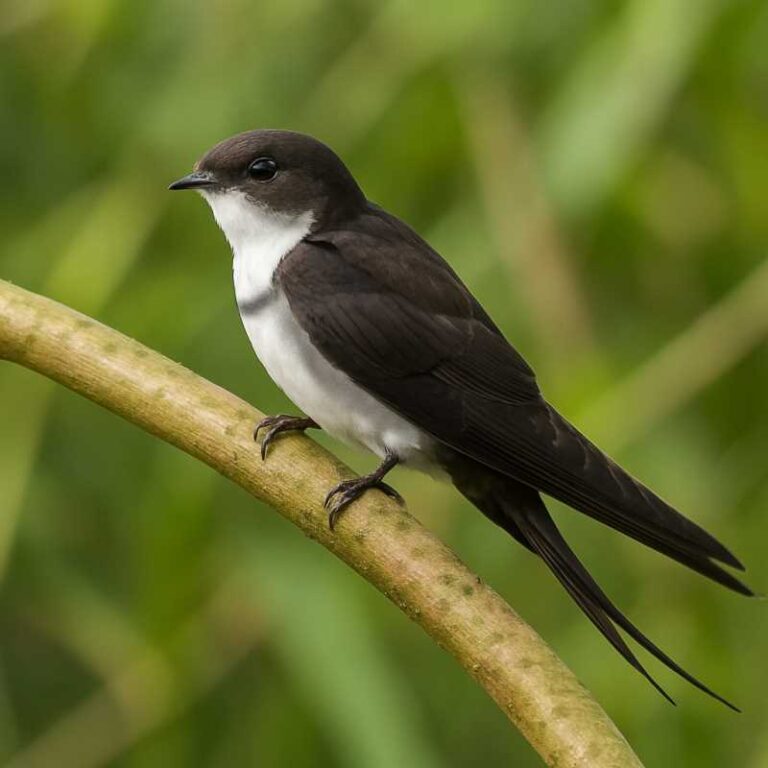
- The plumage is predominantly blackish-brown, without the obvious white underparts shown by some similar spinetails.
- A faintly mottled throat and slight underwing contrast may be visible in good light.
- The tail looks square or gently rounded when spread, with short projecting spines at the tips.
- The species is larger and generally plainer than the Mottled Spinetail, Telacanthura ussheri.
- Identification is often difficult because views are brief and the bird is usually seen at a distance against the forest canopy.
Conservation Status
The Black Spinetail is currently assessed as Least Concern on the IUCN Red List. A reliable global population estimate and a confirmed population trend are not available.
The principal concern is the continuing loss and fragmentation of tropical forest through logging, agricultural expansion, plantations, mining and other land conversion. Protecting remaining rainforest, maintaining forest corridors and managing secondary forest landscapes carefully are important conservation measures. Further field research is also needed to clarify its abundance, movements, nesting requirements and response to habitat change.
Frequently Asked Questions
Where is the Black Spinetail found?
It occurs in tropical West and Central Africa, from Sierra Leone and Liberia eastwards through the rainforest regions of Ghana, Nigeria, Cameroon, Gabon and the Congo Basin, with additional records from several neighbouring countries.
What habitat does the Black Spinetail prefer?
It is mainly associated with humid lowland rainforest, including primary and secondary forest, plantations, forest edges and some rocky or cliff habitats.
What does the Black Spinetail eat?
It feeds on flying insects caught in the air. Winged ants are among the recorded prey, and other small aerial invertebrates are probably taken opportunistically.
Is the Black Spinetail migratory?
Its movements are not fully understood. It is generally considered resident or largely sedentary, although local movements and occasional wandering may occur.
How can the Black Spinetail be identified?
Look for a relatively large, almost entirely dark swift with a square-looking spiny tail, faint throat mottling and fast, agile flight above forest or clearings.
References
- BirdLife International
- International Ornithologists’ Union, IOC World Bird List
- Avibase, Bird Checklists of the World
Related posts