Introduction
The Fawn-breasted Brilliant (Heliodoxa rubinoides) is a medium-sized hummingbird of the northern and central Andes. It belongs to the hummingbird family Trochilidae and is a resident of humid montane forests, forest edges, shaded gardens and other suitable habitats from Colombia through Ecuador and Peru to northern Bolivia.
Physical Description
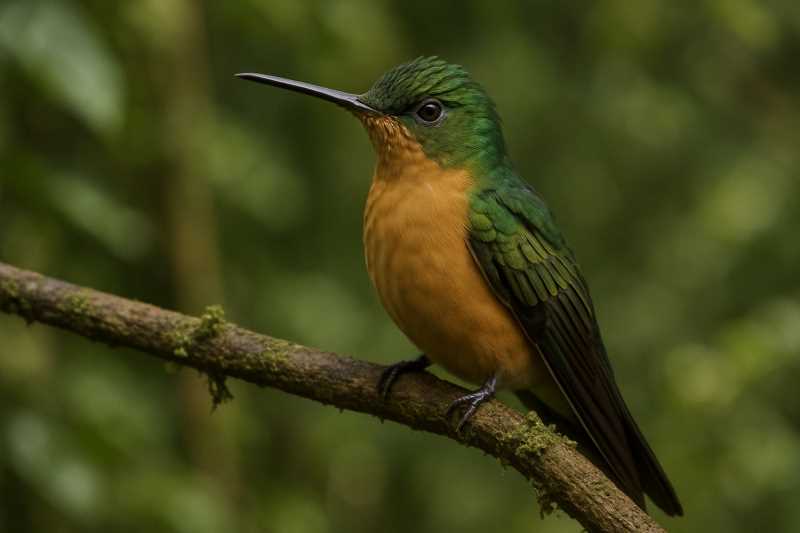
The Fawn-breasted Brilliant measures approximately 11–12 cm in length. It has a stout, fairly long black bill, mainly green upperparts and warm fawn to buff underparts. The male usually shows a more conspicuous iridescent throat patch, which may appear pink, violet or dark depending on the light and viewing angle.
The breast and belly are more extensively brown or fawn than those of several related brilliant hummingbirds. The tail is relatively short and brownish, without prominent white undertail markings. Females are generally duller than males and have less obvious iridescent throat colouring. Juveniles and immature birds may show reduced metallic plumage and less clearly defined adult patterning.
Range and Habitat
The species occurs along both slopes of the Andes, with records from Colombia, Ecuador, Peru and northern Bolivia. BirdLife International gives an elevational range of approximately 1,100–2,600 metres, although local records may fall outside these limits.
It is associated mainly with subtropical and tropical moist montane forest, including cloud forest, but may also visit forest borders, clearings, rural gardens, plantations and other semi-open habitats where flowering plants are available. It is generally resident rather than migratory, although individuals may move locally in response to flowering conditions and food availability.
Several geographic forms are recognised in taxonomic sources. The western Andean form is associated with western Colombia and Ecuador, while other forms occur in the central and eastern Andes. Their precise limits and treatment may vary between taxonomic authorities.
Where to See This Species
Maquipucuna Reserve, Pichincha, Ecuador
The Maquipucuna Reserve protects humid Chocó-Andean cloud forest north-west of Quito and has documented Fawn-breasted Brilliant among its hummingbird fauna. Look along flowering forest edges, trails and garden areas, particularly where native plants attract nectar-feeding birds.
Nearby accommodation: Nanegalito and the surrounding Mindo–Chocó area provide practical access to lodges, guest houses and small hotels.
Tandayapa and the Mindo Cloud Forest, Pichincha, Ecuador
The Tandayapa valley and nearby cloud-forest reserves are established birdwatching destinations where the species has been documented. It may be encountered in forest understory, flowering gardens and feeding areas at suitable elevations. Early morning visits offer the best general birding conditions, although hummingbirds can be active throughout the day.
Nearby accommodation: Mindo is the principal gateway, with lodges, guest houses, hotels and self-catering accommodation.
Buenaventura Reserve, El Oro, Ecuador
Buenaventura protects humid montane forest and restored cloud-forest habitat on the western Andean slope. Its elevational range includes conditions suitable for Fawn-breasted Brilliant, and the reserve is open to organised wildlife visits and birdwatching. Concentrate on flowering plants and forest margins in the cooler, wetter upper parts of the reserve.
Nearby accommodation: Piñas is the nearest practical town for hotels and guest houses, while the reserve area also includes wildlife-oriented lodge accommodation.
Behaviour and Diet
The Fawn-breasted Brilliant feeds mainly on nectar from a variety of flowering plants. It supplements this diet with small insects and spiders, which provide protein and other nutrients, especially when feeding young. Prey may be taken from the air, foliage or spider webs.
It is usually solitary away from breeding activity and may defend productive flowers or feeding areas from other hummingbirds and insects. Its rapid wingbeats allow it to hover at flowers and make quick manoeuvres through dense vegetation. It often perches on an exposed branch or twig between feeding visits.
The female is responsible for nest construction, incubation and care of the young. Published accounts describe a small cup-shaped nest made from plant fibres and spider web, often camouflaged with moss or other materials. A typical clutch consists of two white eggs, with incubation lasting roughly 18–20 days. The young leave the nest at about three weeks of age, although breeding details may vary by region.
Identification Tips
- Look for a medium-sized, fairly robust hummingbird with green upperparts and distinctly fawn or buff underparts.
- The male may show a small, brilliant pinkish-violet throat patch, but this can look dark or nearly black when the bird is not facing the light.
- The relatively short brownish tail and lack of conspicuous white undertail markings are useful field characters.
- Compared with the Green-crowned Brilliant, the Fawn-breasted Brilliant has more extensively brown or fawn underparts and a shorter, browner-looking tail.
- The species can resemble other Heliodoxa hummingbirds in poor light, so bill shape, tail colour, breast pattern and elevation should be considered together.
Conservation Status
The Fawn-breasted Brilliant is currently assessed as Least Concern on the IUCN Red List. Its global population has not been quantified, but the population trend is considered decreasing. BirdLife International describes the species as uncommon and patchily distributed in parts of its range.
The principal concerns are loss and fragmentation of humid montane forest through agricultural expansion, logging, mining and other land-use changes. Climate change may also alter the distribution of cloud-forest habitats and flowering plants. Protection of remaining forest, restoration of degraded slopes and maintenance of habitat corridors are important conservation measures.
Frequently Asked Questions
Where does the Fawn-breasted Brilliant live?
It lives in the Andes of Colombia, Ecuador, Peru and northern Bolivia. It is most closely associated with humid montane and cloud forests, but may also occur in forest edges, rural gardens and other flowering habitats.
What does the Fawn-breasted Brilliant eat?
It feeds mainly on nectar from flowering plants. It also catches or gleans small insects and spiders, particularly when additional protein is needed during breeding.
How can the Fawn-breasted Brilliant be identified?
Look for green upperparts, fawn or buff underparts, a relatively short brownish tail and, in males, a small iridescent pinkish-violet throat patch. The throat may appear dark in subdued light.
Is the Fawn-breasted Brilliant migratory?
No. It is generally considered a resident species, although individuals may make local movements when flowering conditions and food supplies change.
What is the conservation status of the Fawn-breasted Brilliant?
The species is listed as Least Concern. Its population is suspected to be decreasing because of continuing loss and fragmentation of montane forest, although a reliable global population estimate is not available.
References
- BirdLife International
- IUCN Red List of Threatened Species
- Cornell Lab of Ornithology, Birds of the World
Related posts